Virginia SOL 12.C.3.B
The Standard
Examine multimodal sources’ claims, arguments, ideas, and any point of personal bias by evaluating them for reliability and relevance to serve as credible supporting evidence.
Virginia Standards of Learning for English · Integrating Multimodal Literacies
Teacher's field guide
What This Standard Means
What Students Need to Do
- Students identify the claims, reasoning, evidence, and ideas presented through words, images, audio, video, or data. They notice personal bias and decide whether each source is reliable and relevant enough to support an argument.
What Mastery Looks Like
- Students can identify a source’s claim, supporting reasons, and signs of personal bias. They can judge evidence using authorship, date, citations, context, corroboration, and its direct connection to the claim.
Common Misconceptions
- Students may assume polished graphics, confident speakers, or high view counts make a source trustworthy. They may treat any bias as automatic proof that a source is unusable. They may also confuse evidence that agrees with them with evidence that directly supports the claim.
How to Assess It
- Give students a news infographic and a related claim. Ask them to identify one bias cue, rate the source’s reliability and relevance, and cite two details supporting their rating.
Lesson moves
Ways to Teach It
Set up source stations with an infographic, video clip, and podcast excerpt; students label each claim, evidence, bias cue, and missing information.
Compare two reports on the same event, then write which source offers stronger evidence and cite three features that support your judgment.
Play Credibility Court: teams defend or challenge source cards using author, date, citations, purpose, and direct relevance to a given claim.
Fact-check a viral post students might share, trace its image and statistic to original sources, then decide whether to repost it.
Free download
Printable 12.C.3.B Worksheet
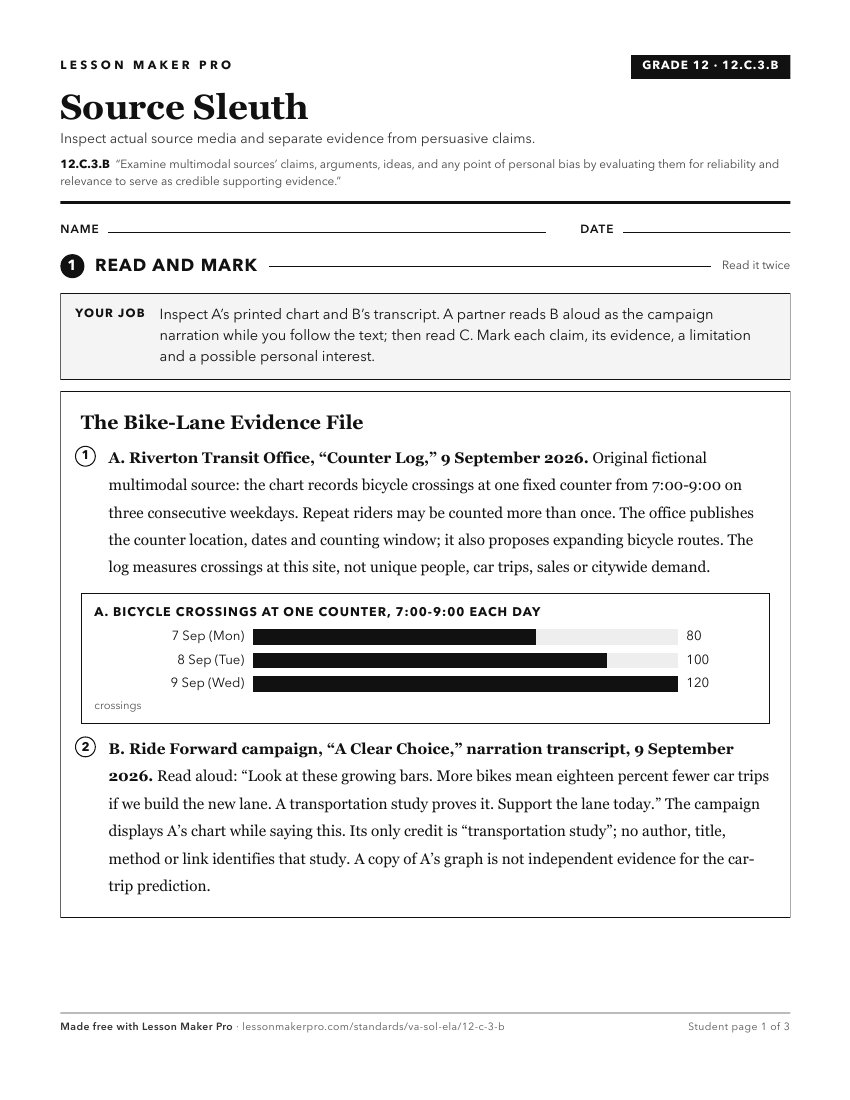
A ready-to-print activity worksheet aligned to 12.C.3.B, with an answer key for the teacher on its own page. No account needed.
PDF, US Letter, prints cleanly in black and white.
Download the worksheetKeep exploring
Related Standards
- 8.R.1.C
Evaluate and analyze the relevance, validity, and credibility of sources (primary, secondary, digital, and print) identifying main and supporting ideas, conflic...
- 11.R.1.C
Objectively evaluate primary and secondary sources for their credibility, reliability, accuracy, usefulness, and limitations. That includes identifying their ma...
- 12.R.1.C
Objectively evaluate primary and secondary sources for their credibility, reliability, accuracy, usefulness, and limitations; that includes identifying the main...
- 10.R.1.C
Objectively evaluate primary and secondary sources for their credibility, reliability, accuracy, usefulness, and limitations, that includes identifying their ma...
Turn this exact standard into a lesson
Grade, subject, topic, and the complete standard are prefilled. Create one free, no account needed.
Also for this standard:Make a WorksheetMake a QuizMake a Sub Lesson