Virginia SOL 10.R.1.C
The Standard
Objectively evaluate primary and secondary sources for their credibility, reliability, accuracy, usefulness, and limitations, that includes identifying their main and supporting ideas, points of view, conflicting information, and any misconceptions or biases.
Virginia Standards of Learning for English
Teacher's field guide
What This Standard Means
What Students Need to Do
- Students compare primary and secondary sources and judge how trustworthy, accurate, and useful each one is. They identify central ideas, supporting details, viewpoints, conflicts, bias, misconceptions, and missing information.
What Mastery Looks Like
- Students can judge a source using the author, evidence, publication context, accuracy, and missing information. They can compare sources, explain conflicts, and support their evaluation with specific details.
Common Misconceptions
- Students may assume a primary source is always more accurate than a secondary source. They may label disagreement as bias without examining evidence or context. They may also confuse usefulness with trustworthiness, though a limited source can still answer a specific question.
How to Assess It
- Give students two short sources on the same event, one firsthand account and one later report. Prompt: Decide which source is more useful, then cite one credibility clue, one conflict, and one limitation.
Lesson moves
Ways to Teach It
Give pairs source cards and have them sort each detail under credibility, accuracy, usefulness, bias, or limitation.
Ask students to write which of two conflicting sources they would use in a report and defend the choice with three details.
Play Source Showdown, where teams score sample sources for author expertise, evidence, accuracy, relevance, and missing context.
Compare a local news report with a related social media post, then identify what each adds, omits, or misrepresents.
Free download
Printable 10.R.1.C Worksheet
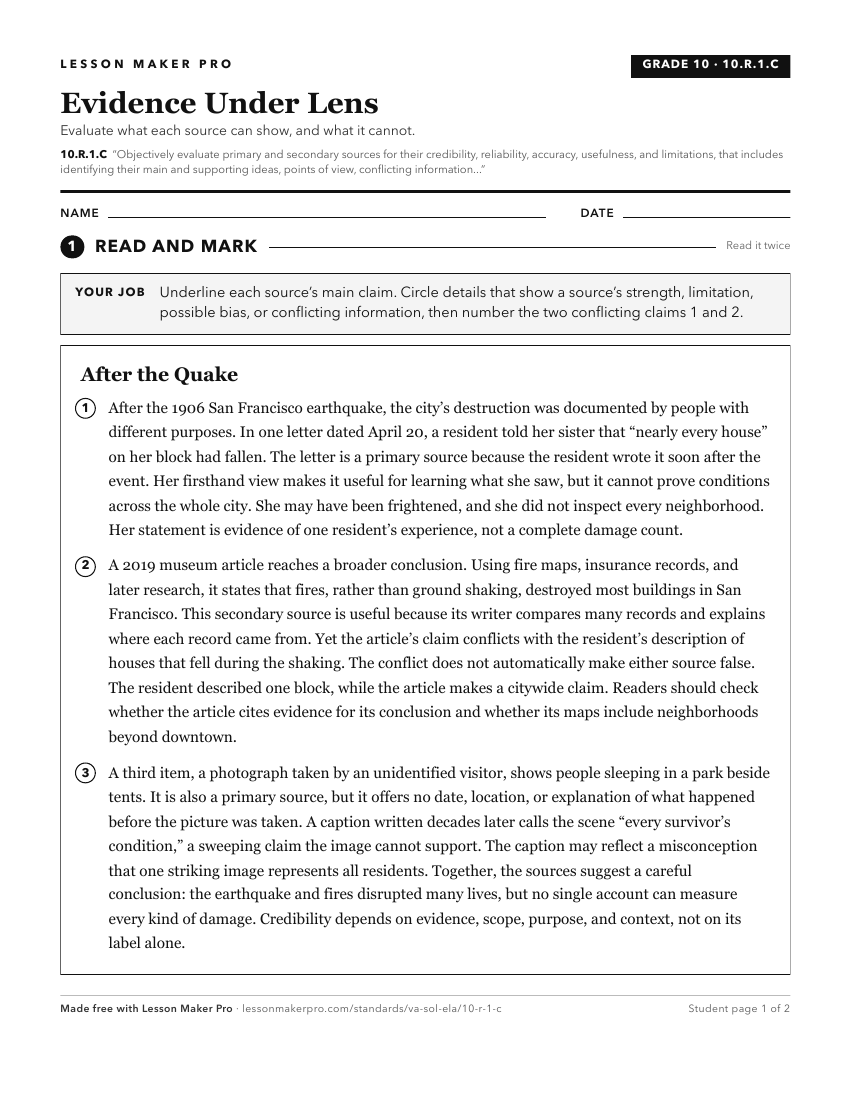
A ready-to-print activity worksheet aligned to 10.R.1.C, with an answer key for the teacher on its own page. No account needed.
PDF, US Letter, prints cleanly in black and white.
Download the worksheetKeep exploring
Related Standards
- 8.R.1.C
Evaluate and analyze the relevance, validity, and credibility of sources (primary, secondary, digital, and print) identifying main and supporting ideas, conflic...
- 11.R.1.C
Objectively evaluate primary and secondary sources for their credibility, reliability, accuracy, usefulness, and limitations. That includes identifying their ma...
- 9.R.1.C
Analyze and evaluate the primary and secondary sources gathered for their credibility, reliability, accuracy, and usefulness that includes identifying their mai...
- 12.R.1.C
Objectively evaluate primary and secondary sources for their credibility, reliability, accuracy, usefulness, and limitations; that includes identifying the main...
Turn this exact standard into a lesson
Grade, subject, topic, and the complete standard are prefilled. Create one free, no account needed.
Also for this standard:Make a WorksheetMake a QuizMake a Sub Lesson