Virginia SOL 12.C.4.A
The Standard
Defend hypotheses about an author’s underlying values, viewpoints, and purposes and reflect on how they shape the content.
Virginia Standards of Learning for English · Examining Media Messages
Teacher's field guide
What This Standard Means
What Students Need to Do
- Students infer a media creator’s values, viewpoint, and goal from wording, images, sound, sources, framing, and omissions. They support their interpretation with evidence and explain how those beliefs shape what is included, excluded, or emphasized.
What Mastery Looks Like
- Students make a plausible interpretation and support it with precise details from the message. They separate evidence from inference, consider another interpretation, and explain how perspective affects selection and emphasis.
Common Misconceptions
- Students may confuse the topic with the creator’s purpose or assume any bias makes a message false. They may state motives as facts, ignore visual or audio choices, or overlook missing voices and information.
How to Assess It
- Show a short advertisement or editorial. Ask students to name one implied value, cite two specific choices that support it, and explain how it shapes the message.
Lesson moves
Ways to Teach It
Give pairs a printed advertisement; they highlight words, images, and omissions in three colors, then write the value each choice suggests.
Discuss: Which unstated belief drives this editorial, and how would the piece change if a different audience were targeted?
Run an Evidence or Guess card sort using claims about a video clip, requiring students to match every defensible claim with details.
Compare two local news reports on one event, noting whose voices appear, which facts lead, and what each outlet seems to value.
Free download
Printable 12.C.4.A Worksheet
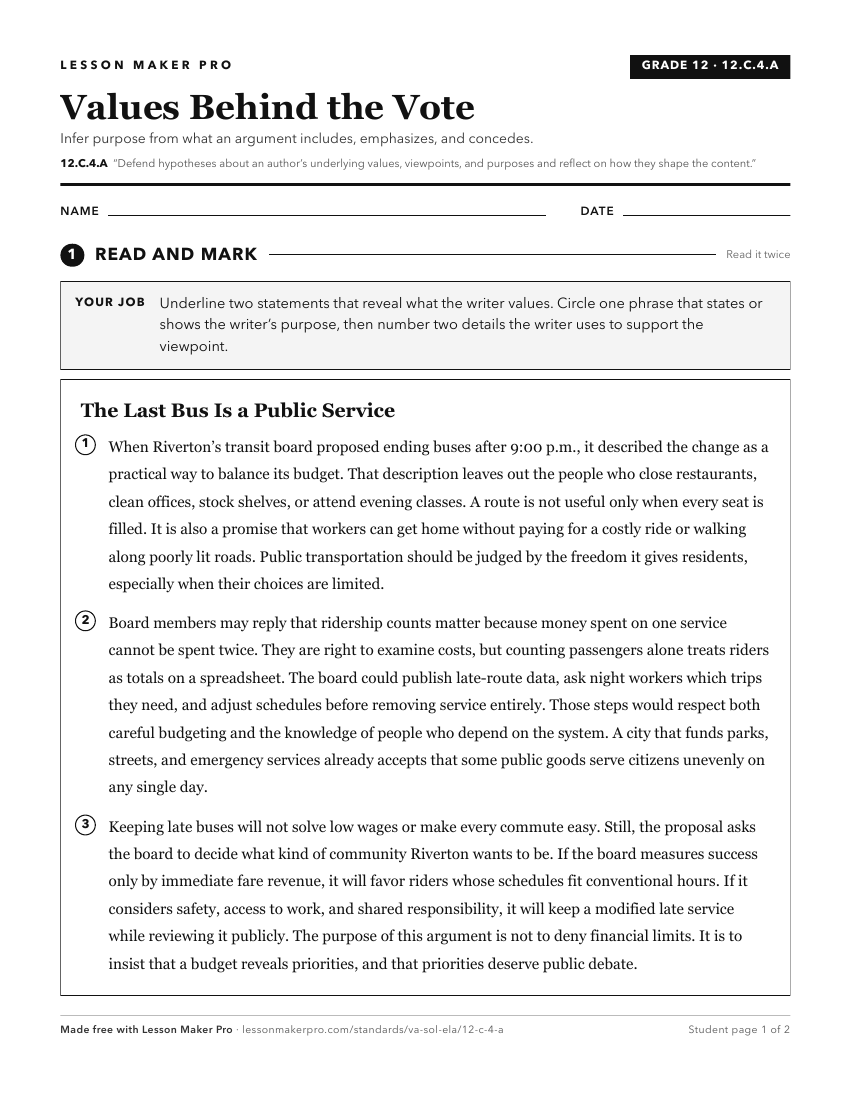
A ready-to-print activity worksheet aligned to 12.C.4.A, with an answer key for the teacher on its own page. No account needed.
PDF, US Letter, prints cleanly in black and white.
Download the worksheetKeep exploring
Related Standards
- 12.RL.3.C
Analyze how authors’ attitudes, viewpoints, and beliefs reflect larger historical, social, or cultural contexts.
- 5.RI.2.C
Determine the author’s purpose(s) and describe how the author’s perspective (e.g., beliefs, assumptions, biases) influences the meaning of the text.
- 7.RI.2.C
Analyze how an author’s purpose(s) reflects the author’s perspective (e.g., beliefs, assumptions, biases) and influences the meaning of an informational text.
- 11.RL.3.C
Analyze how authors’ attitudes, viewpoints, and beliefs reflect larger historical, social, or cultural contexts.
Turn this exact standard into a lesson
Grade, subject, topic, and the complete standard are prefilled. Create one free, no account needed.
Also for this standard:Make a WorksheetMake a QuizMake a Sub Lesson