Virginia SOL 11.RL.3.C
The Standard
Analyze how authors’ attitudes, viewpoints, and beliefs reflect larger historical, social, or cultural contexts.
Virginia Standards of Learning for English · Integration of Concepts
Teacher's field guide
What This Standard Means
What Students Need to Do
- Students infer an author’s perspective from word choice, characterization, conflict, and narration. They connect those choices to specific events, social norms, or cultural beliefs from the author’s time.
What Mastery Looks Like
- Students make a clear claim about the author’s perspective and support it with precise details from the text. They explain how period events, social norms, or cultural beliefs shaped that perspective. They distinguish the author from narrators and characters.
Common Misconceptions
- Students often treat the narrator or a character as the author. They may name a historical event without explaining its effect on the text. Some judge the work only by present-day values or make claims about the author without evidence.
How to Assess It
- Exit ticket: Choose one sentence from today’s reading that reveals the author’s perspective. Explain how it connects to one belief, conflict, or social norm from the period.
Lesson moves
Ways to Teach It
Give pairs quote cards and context cards to match, then have them write one sentence explaining each connection.
Ask, “Which belief from the author’s time appears most clearly in the text, and what details reveal it?”
Play Context Detective, where teams earn points by linking passages to period facts and defending each link with textual evidence.
Compare a literary passage with a newspaper article from the same period, then identify a shared social concern or cultural belief.
Free download
Printable 11.RL.3.C Worksheet
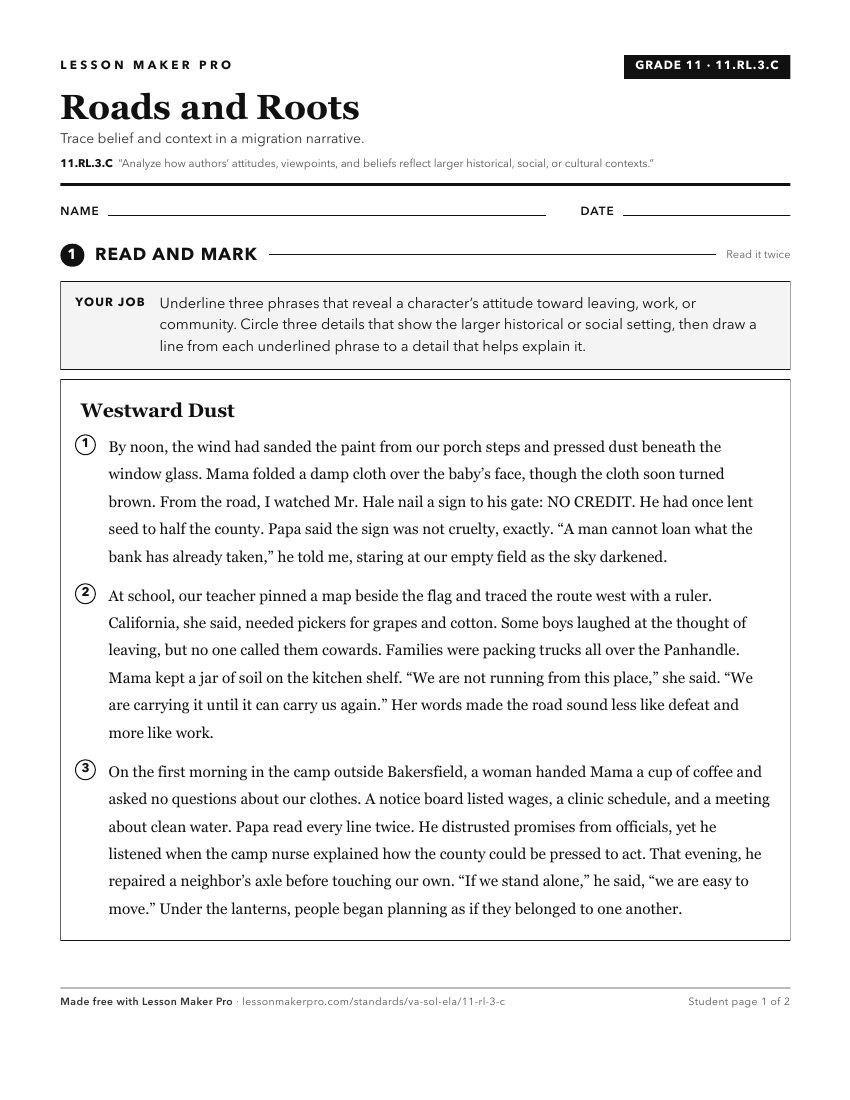
A ready-to-print activity worksheet aligned to 11.RL.3.C, with an answer key for the teacher on its own page. No account needed.
PDF, US Letter, prints cleanly in black and white.
Download the worksheetKeep exploring
Related Standards
- 12.RL.3.C
The 12th Grade version of this standard.
- 5.RI.2.C
Determine the author’s purpose(s) and describe how the author’s perspective (e.g., beliefs, assumptions, biases) influences the meaning of the text.
- 12.C.4.A
Defend hypotheses about an author’s underlying values, viewpoints, and purposes and reflect on how they shape the content.
- 7.RI.2.C
Analyze how an author’s purpose(s) reflects the author’s perspective (e.g., beliefs, assumptions, biases) and influences the meaning of an informational text.
Turn this exact standard into a lesson
Grade, subject, topic, and the complete standard are prefilled. Create one free, no account needed.
Also for this standard:Make a WorksheetMake a QuizMake a Sub Lesson