TEKS ELAR 2.11
Knowledge and Skills Statement (Standard Cluster)
The student uses the writing process recursively to compose multiple texts that are legible and uses appropriate conventions.
Texas Essential Knowledge and Skills for English Language Arts and Reading
Cluster contents
Student Expectations in This Statement
2.11 is a knowledge and skills statement. These are the student expectations under it.
- 2.11.A
plan a first draft by generating ideas for writing such as drawing and brainstorming
- 2.11.B.i
organizing with structure
- 2.11.B.ii
developing an idea with specific and relevant details
- 2.11.D.i
complete sentences with subject-verb agreement
- 2.11.D.ii
past, present, and future verb tense
- 2.11.D.iii
singular, plural, common, and proper nouns
- 2.11.D.iv
adjectives, including articles
- 2.11.D.ix
capitalization of months, days of the week, and the salutation and conclusion of a letter
- 2.11.D.v
adverbs that convey time and adverbs that convey place
- 2.11.D.vi
prepositions and prepositional phrases
- 2.11.D.vii
pronouns, including subjective, objective, and possessive cases
- 2.11.D.viii
coordinating conjunctions to form compound subjects and predicates
- 2.11.D.x
end punctuation, apostrophes in contractions, and commas with items in a series and in dates
- 2.11.D.xi
correct spelling of words with grade-appropriate orthographic patterns and rules and high-frequency words
- 2.11.E
publish and share writing.
Teacher's field guide
What This Cluster Means
What Students Need to Do
- Students generate ideas through drawing, lists, or talk, then shape one idea into an organized draft with relevant details. They return to the draft to add, remove, or move language. They edit for readable handwriting, complete sentences, grammar, capitalization, punctuation, and spelling before publishing and sharing.
What Mastery Looks Like
- A student produces a clear, readable piece with a beginning, connected details, and an ending. The student makes meaningful revisions, then edits sentences, verb tense, word forms, capitalization, punctuation, and spelling before sharing the final copy.
Common Misconceptions
- Students may treat the first draft as finished and change only spelling during revision. They may write fragments, switch verb tense, or use capitals and punctuation inconsistently. They also confuse plural nouns with possessives and overlook agreement between subjects and verbs.
How to Assess It
- Give students a short draft with one weak detail, one misplaced sentence, and three convention errors. Ask them to revise one idea, rearrange the sentence, correct the errors, and explain one change.
Lesson moves
Ways to Teach It
Give pairs sentence strips from a mixed-up paragraph, then have them arrange, add details, remove repetition, and copy the improved version.
Ask students to write about a memorable recess, then explain which two details help the reader picture what happened.
Play Editor Relay with task cards that ask teams to correct verb tense, pronouns, conjunctions, capitals, commas, contractions, and spelling.
Have students write and publish a thank-you letter with a salutation, clear details, a conclusion, and correct capitalization and punctuation.
Free download
Printable 2.11 Worksheet
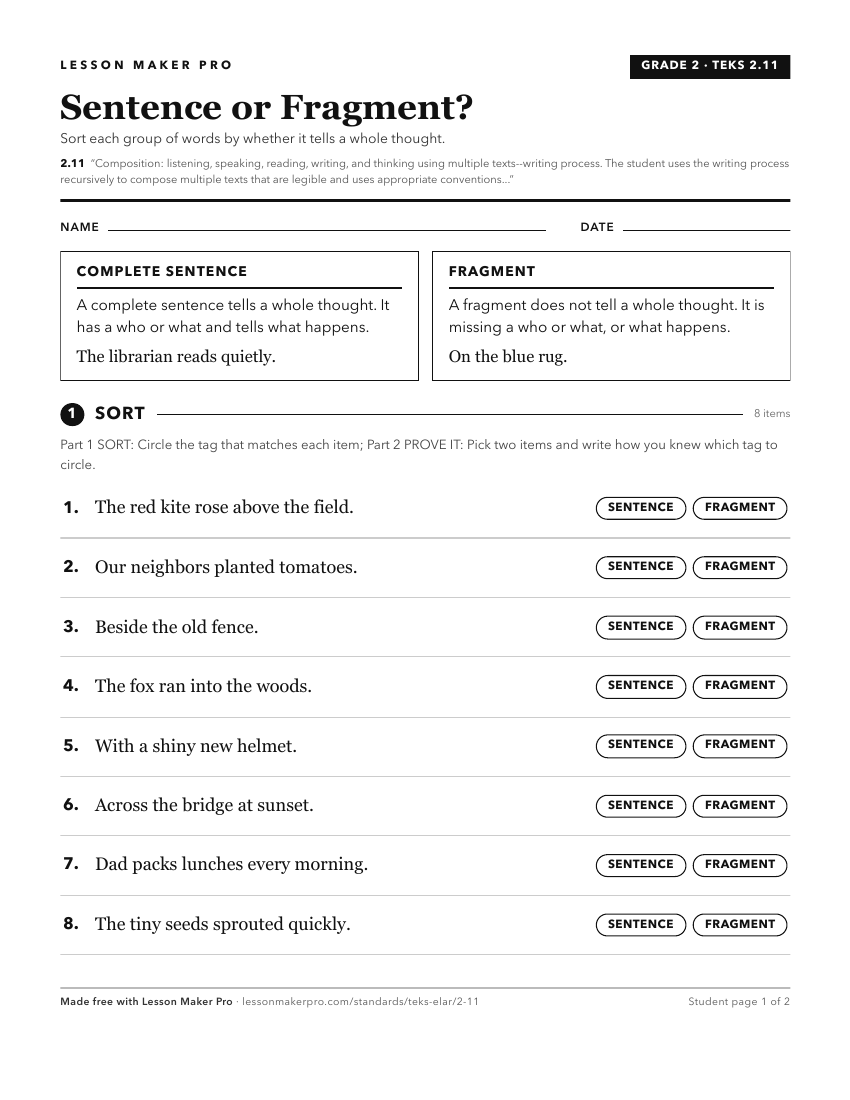
A ready-to-print activity worksheet aligned to 2.11, with an answer key for the teacher on its own page. No account needed.
PDF, US Letter, prints cleanly in black and white.
Download the worksheetKeep exploring
Related Standards
Turn this cluster into a lesson
Grade, subject, topic, and the complete cluster are prefilled. Create one free, no account needed.
Also for this cluster:Make a WorksheetMake a QuizMake a Sub Lesson