TEKS ELAR 2.11.D.vii
The Standard
pronouns, including subjective, objective, and possessive cases
Texas Essential Knowledge and Skills for English Language Arts and Reading · The student uses the writing process recursively to compose multiple texts that are legible and uses appropriate conventions.
Teacher's field guide
What This Standard Means
What Students Need to Do
- Students edit sentences so pronouns match their jobs. They use forms such as I, me, and my for the person acting, receiving, or owning.
What Mastery Looks Like
- Students choose the correct pronoun based on who acts, who receives the action, or who owns something. They find and fix errors such as “me went,” “to he,” and “her book” when the owner is male.
Common Misconceptions
- Students may write “Me and Ava ran” or “Give it to she” because they choose the wrong form for the pronoun’s job. They may also write “him backpack” or add an apostrophe to “hers.”
How to Assess It
- Exit ticket: Edit “Me found the glove. I gave it to he because it was him glove.” Ask students to explain each change.
Lesson moves
Ways to Teach It
Give pairs sentence strips and pronoun cards, then have them replace each incorrect pronoun and explain its job.
Ask students to write three sentences about one backpack, showing who carries it, who receives it, and who owns it.
Play Pronoun Relay, where teams choose I or me, she or her, and they or them to complete projected sentences.
Have students edit a pretend class note, correcting pronouns in directions such as “Give the folders to she” and “Put him name here.”
Free download
Printable 2.11.D.vii Worksheet
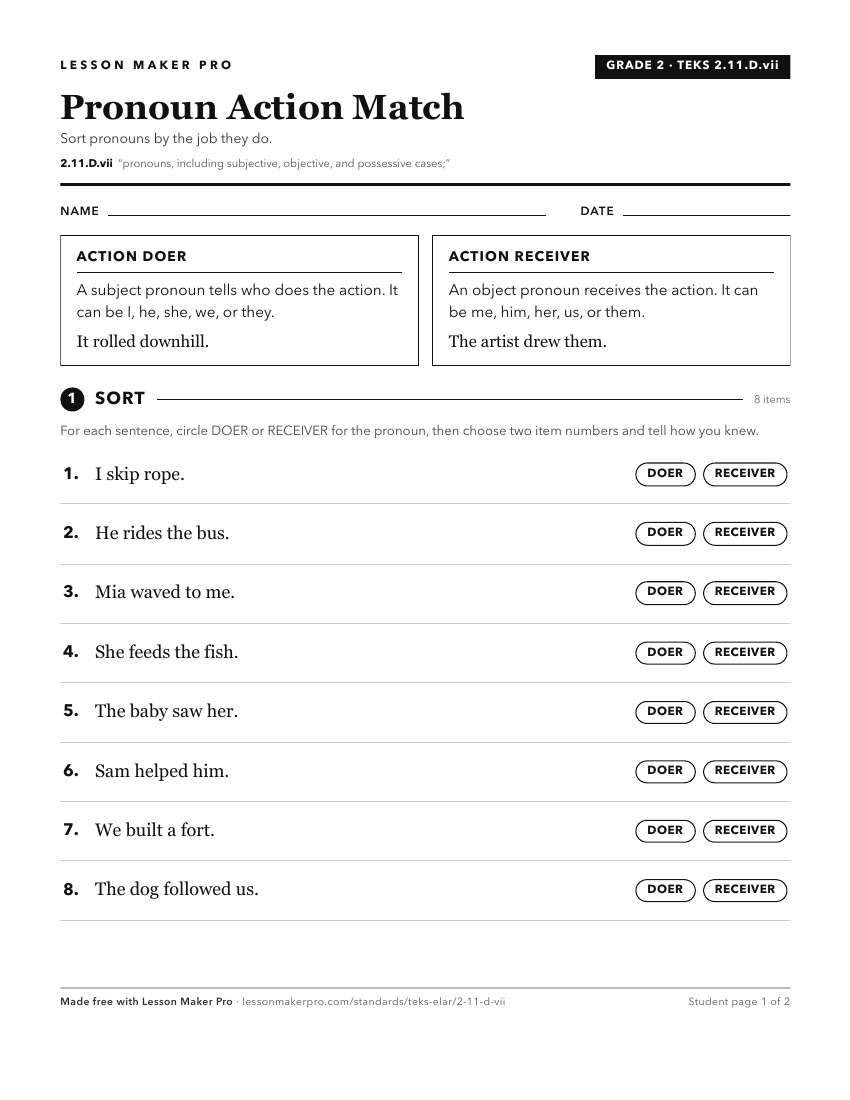
A ready-to-print activity worksheet aligned to 2.11.D.vii, with an answer key for the teacher on its own page. No account needed.
PDF, US Letter, prints cleanly in black and white.
Download the worksheetKeep exploring
Related Standards
Turn this exact standard into a lesson
Grade, subject, topic, and the complete standard are prefilled. Create one free, no account needed.
Also for this standard:Make a WorksheetMake a QuizMake a Sub Lesson