TEKS ELAR 3.11.D.vii
The Standard
pronouns, including subjective, objective, and possessive cases
Texas Essential Knowledge and Skills for English Language Arts and Reading · The student uses the writing process recursively to compose multiple texts that are legible and uses appropriate conventions.
Teacher's field guide
What This Standard Means
What Students Need to Do
- Students choose pronouns that fit their job in a sentence: naming the doer, receiving the action, or showing ownership. They edit drafts to replace incorrect forms and clarify whom or what each pronoun names.
What Mastery Looks Like
- A student writes “She called him about their project” rather than “Her called he about they project.” During revision, the student finds and fixes pronoun errors without changing the intended meaning.
Common Misconceptions
- Students often use me or him as the subject, as in “Me and him ran.” They may write “That pencil is their” or choose I after a preposition because it sounds formal.
How to Assess It
- Give this exit ticket: Edit “Him carried the box,” “Mia gave it to she,” and “That red hat is their.” Label each correction doer, receiver, or owner.
Lesson moves
Ways to Teach It
Give pairs pronoun cards and sentence strips; students place each card in a doer, receiver, or owner slot, then read the sentence aloud.
Ask students to explain why “Her gave I the folder” sounds wrong, then rewrite it and name each pronoun’s job.
Play Pronoun Repair Relay: teams correct one pronoun error on a draft sentence before passing the marker to the next player.
Have students edit a class announcement about lost items, choosing pronouns that clearly show who found, received, or owns each item.
Free download
Printable 3.11.D.vii Worksheet
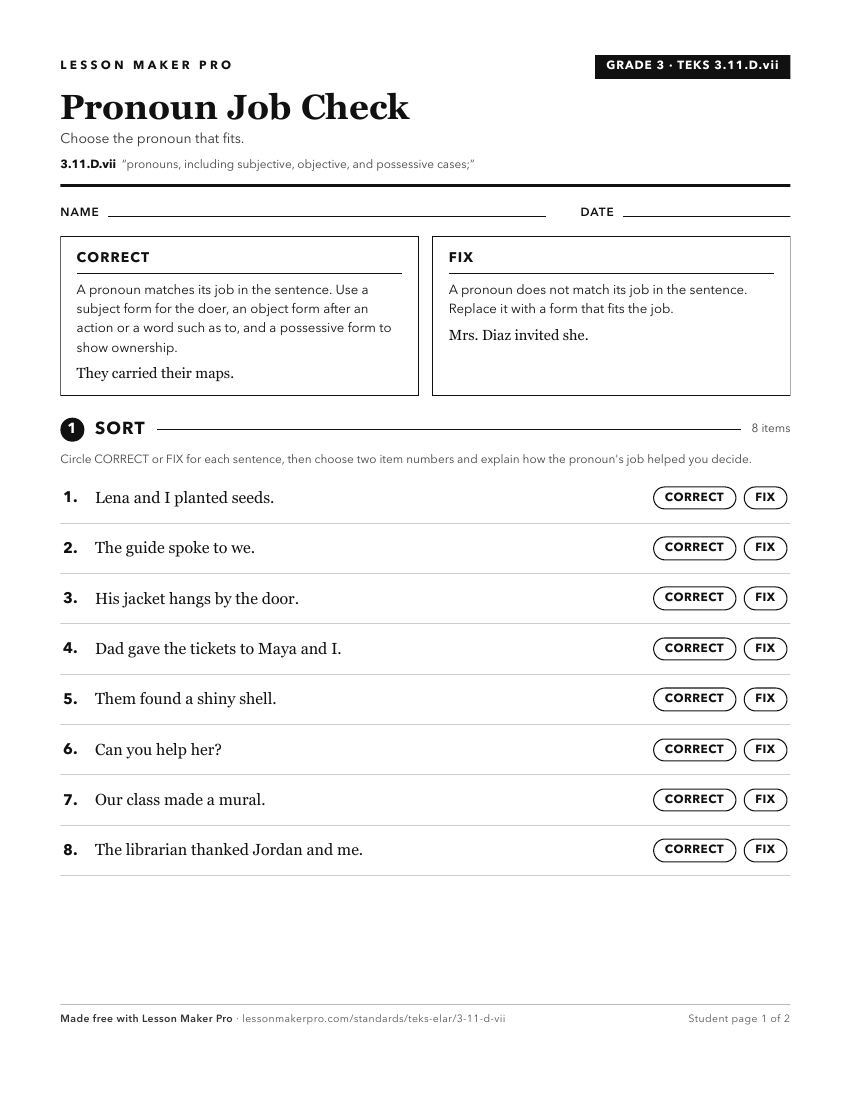
A ready-to-print activity worksheet aligned to 3.11.D.vii, with an answer key for the teacher on its own page. No account needed.
PDF, US Letter, prints cleanly in black and white.
Download the worksheetKeep exploring
Related Standards
Turn this exact standard into a lesson
Grade, subject, topic, and the complete standard are prefilled. Create one free, no account needed.
Also for this standard:Make a WorksheetMake a QuizMake a Sub Lesson