TEKS ELAR 2.11.D.vi
The Standard
prepositions and prepositional phrases
Texas Essential Knowledge and Skills for English Language Arts and Reading · The student uses the writing process recursively to compose multiple texts that are legible and uses appropriate conventions.
Teacher's field guide
What This Standard Means
What Students Need to Do
- Students find words and phrases that show relationships such as place, time, or direction. They edit their drafts by adding, replacing, or moving these phrases so sentences are clear.
What Mastery Looks Like
- A student can identify the preposition and the noun that completes its phrase. The student can edit a draft by adding or changing a phrase to show where, when, or how something happens.
Common Misconceptions
- Students may label every location word as a preposition, even when it acts as another part of speech. They may omit the noun after a preposition or choose a phrase that makes the sentence unclear.
How to Assess It
- Give students: “The puppy slept the table.” Ask them to edit the sentence by adding a preposition, then underline the complete phrase.
Lesson moves
Ways to Teach It
Place a toy around the room, then have students write and revise sentences describing its location with complete prepositional phrases.
Ask students to write three directions from the classroom door to their seat, then compare which prepositional phrases make the route clearest.
Play Preposition Switch by giving pairs sentence cards and phrase cards to combine, read aloud, and check for meaning.
Examine a school lunch menu or event flyer, then circle phrases that tell when or where something is available.
Free download
Printable 2.11.D.vi Worksheet
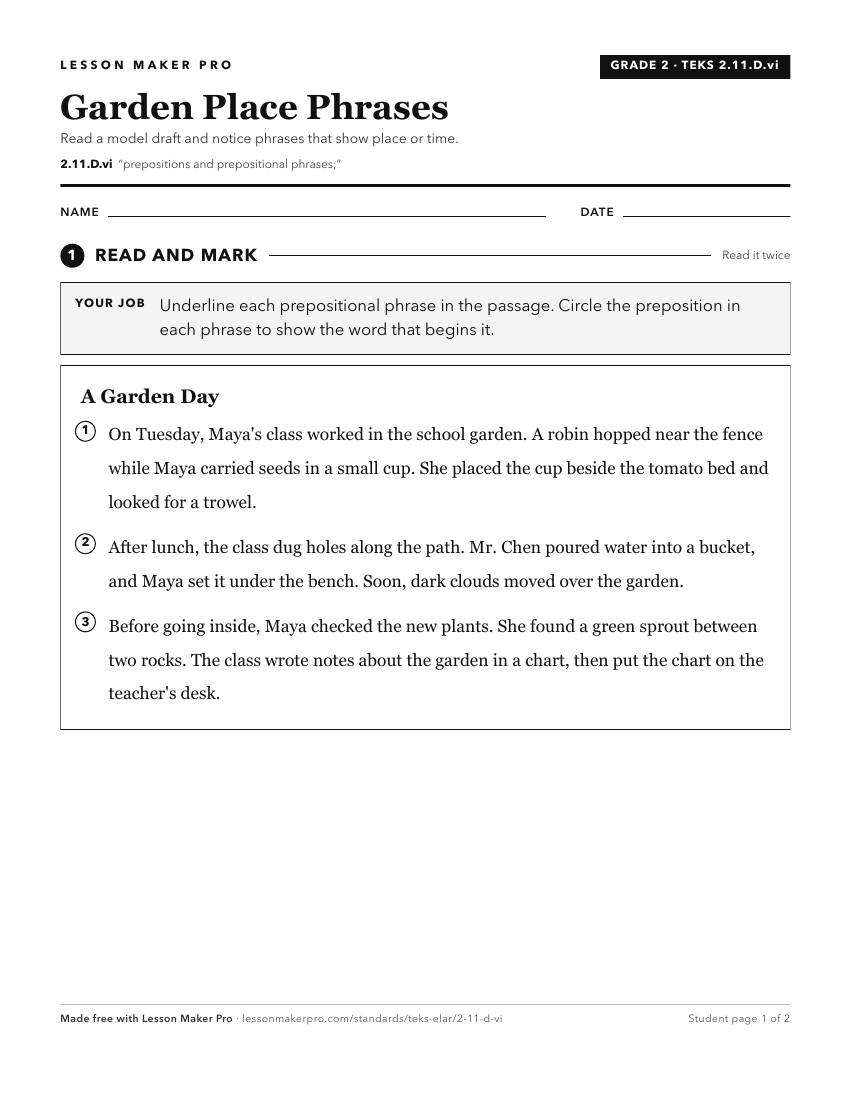
A ready-to-print activity worksheet aligned to 2.11.D.vi, with an answer key for the teacher on its own page. No account needed.
PDF, US Letter, prints cleanly in black and white.
Download the worksheetKeep exploring
Related Standards
Turn this exact standard into a lesson
Grade, subject, topic, and the complete standard are prefilled. Create one free, no account needed.
Also for this standard:Make a WorksheetMake a QuizMake a Sub Lesson