TEKS ELAR 6.10
Knowledge and Skills Statement (Standard Cluster)
The student uses the writing process recursively to compose multiple texts that are legible and uses appropriate conventions.
Texas Essential Knowledge and Skills for English Language Arts and Reading
Cluster contents
Student Expectations in This Statement
6.10 is a knowledge and skills statement. These are the student expectations under it.
- 6.10.A
plan a first draft by selecting a genre appropriate for a particular topic, purpose, and audience using a range of strategies such as discussion, background rea...
- 6.10.B.i
organizing with purposeful structure, including an introduction, transitions, coherence within and across paragraphs, and a conclusion
- 6.10.B.ii
developing an engaging idea reflecting depth of thought with specific facts and details
- 6.10.C
revise drafts for clarity, development, organization, style, word choice, and sentence variety
- 6.10.D.i
complete complex sentences with subject-verb agreement and avoidance of splices, run-ons, and fragments
- 6.10.D.ii
consistent, appropriate use of verb tenses
- 6.10.D.iii
conjunctive adverbs
- 6.10.D.iv
prepositions and prepositional phrases and their influence on subject-verb agreement
- 6.10.D.ix
correct spelling, including commonly confused terms such as its/it's, affect/effect, there/their/they're, and to/two/too
- 6.10.D.v
pronouns, including relative
- 6.10.D.vi
subordinating conjunctions to form complex sentences and correlative conjunctions such as either/or and neither/nor
- 6.10.D.vii
capitalization of proper nouns, including abbreviations, initials, acronyms, and organizations
- 6.10.D.viii
punctuation marks, including commas in complex sentences, transitions, and introductory elements
- 6.10.E
publish written work for appropriate audiences.
Teacher's field guide
What This Cluster Means
What Students Need to Do
- Students plan a piece by matching the genre to the topic, purpose, and audience. They draft organized paragraphs with clear ideas, transitions, facts, and details. They revise, edit, and publish while checking sentence structure, grammar, spelling, capitalization, and punctuation.
What Mastery Looks Like
- A student can choose a fitting genre, plan for a clear audience, and organize ideas into connected paragraphs. The final piece has specific details, varied sentences, accurate conventions, and purposeful word choice. The student can explain revisions and publish a clean copy.
Common Misconceptions
- Students often treat revision as proofreading instead of improving ideas, structure, and clarity. They may shift verb tense, join sentences with commas, overlook agreement after prepositional phrases, or confuse words such as its and it's.
How to Assess It
- Give students a six-sentence draft with a weak opening, vague detail, a run-on, a tense shift, and a comma error. Have them revise it and label each change.
Lesson moves
Ways to Teach It
Cut apart a model essay, then have groups arrange the introduction, body paragraphs, transitions, and conclusion and defend their sequence.
Ask students how audience changes tone and details, then have them rewrite one paragraph for a principal and a close friend.
Run an editing relay where teams correct fragments, run-ons, tense shifts, agreement errors, confused words, pronouns, conjunctions, capitalization, and commas.
Have students write and publish a school announcement for families, using an appropriate format, clear details, and a final edited copy.
Free download
Printable 6.10 Worksheet
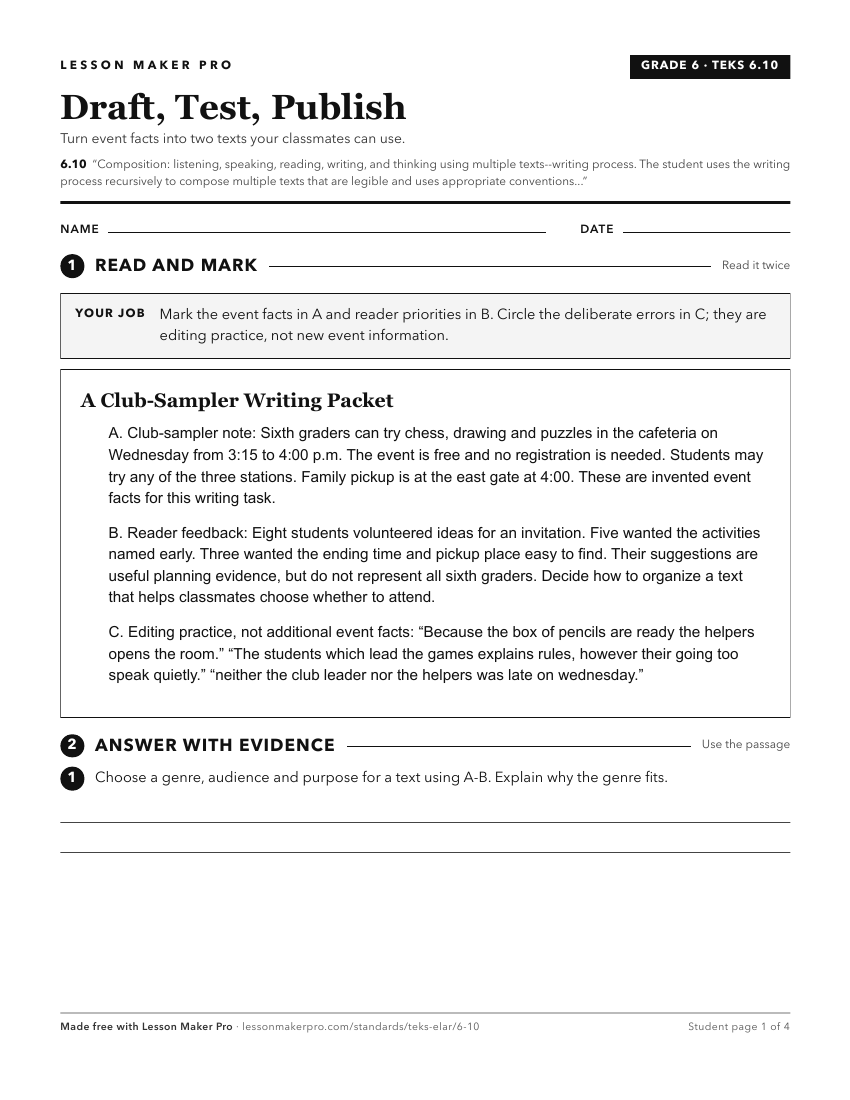
A ready-to-print activity worksheet aligned to 6.10, with an answer key for the teacher on its own page. No account needed.
PDF, US Letter, prints cleanly in black and white.
Download the worksheetKeep exploring
Related Standards
Turn this cluster into a lesson
Grade, subject, topic, and the complete cluster are prefilled. Create one free, no account needed.
Also for this cluster:Make a WorksheetMake a QuizMake a Sub Lesson