TEKS ELAR 8.10
Knowledge and Skills Statement (Standard Cluster)
The student uses the writing process recursively to compose multiple texts that are legible and uses appropriate conventions.
Texas Essential Knowledge and Skills for English Language Arts and Reading
Cluster contents
Student Expectations in This Statement
8.10 is a knowledge and skills statement. These are the student expectations under it.
- 8.10.A
plan a first draft by selecting a genre appropriate for a particular topic, purpose, and audience using a range of strategies such as discussion, background rea...
- 8.10.B.i
organizing with purposeful structure, including an introduction, transitions, coherence within and across paragraphs, and a conclusion
- 8.10.B.ii
developing an engaging idea reflecting depth of thought with specific facts, details, and examples
- 8.10.C
revise drafts for clarity, development, organization, style, word choice, and sentence variety
- 8.10.D.i
complete complex sentences with subject-verb agreement and avoidance of splices, run-ons, and fragments
- 8.10.D.ii
consistent, appropriate use of verb tenses and active and passive voice
- 8.10.D.iii
prepositions and prepositional phrases and their influence on subject-verb agreement
- 8.10.D.iv
pronoun-antecedent agreement
- 8.10.D.v
correct capitalization
- 8.10.D.vi
punctuation, including commas in non-restrictive phrases and clauses, semicolons, colons, and parentheses
- 8.10.D.vii
correct spelling, including commonly confused terms such as its/it's, affect/effect, there/their/they're, and to/two/too
- 8.10.E
publish written work for appropriate audiences.
Teacher's field guide
What This Cluster Means
What Students Need to Do
- Students choose a suitable genre for a topic, purpose, and audience, then plan and draft using discussion, reading, or personal experience. They organize and support ideas, revise for meaning and style, edit conventions, and publish for a real audience.
What Mastery Looks Like
- A student produces a focused piece with a clear opening, logical paragraphs, useful transitions, specific support, and a fitting conclusion. The student improves ideas and style, corrects convention errors, and prepares the final version for its intended audience.
Common Misconceptions
- Students often treat revision as fixing spelling rather than improving ideas, structure, and clarity. They may shift tense, write fragments or run-ons, misuse pronouns, or confuse words such as its and it's. Some assume one genre works for every purpose and audience.
How to Assess It
- Exit ticket: Write six sentences arguing whether phones should be allowed during lunch for the principal. Include two details, a transition, a complex sentence, and a conclusion, then revise and edit in another color.
Lesson moves
Ways to Teach It
Give groups sentence strips from a mixed-up essay, then have them arrange the introduction, body paragraphs, transitions, and conclusion and defend their choices.
Compare a text to a friend with an email to the principal, then discuss how audience changes genre, details, tone, and word choice.
Run an editing relay with cards containing fragments, splices, tense shifts, pronoun errors, punctuation errors, and commonly confused words for teams to correct.
Write and publish a one-page guide for new students, using two student interviews as evidence and formatting the piece for the school website.
Free download
Printable 8.10 Worksheet
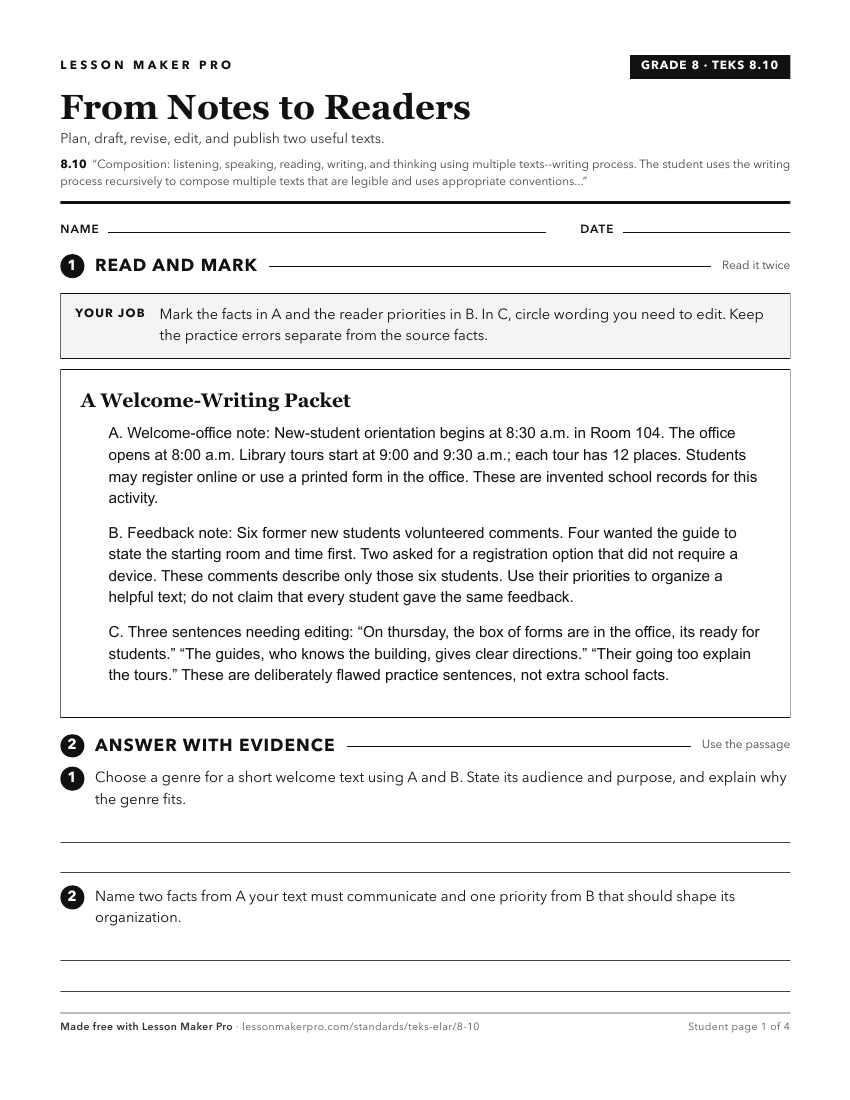
A ready-to-print activity worksheet aligned to 8.10, with an answer key for the teacher on its own page. No account needed.
PDF, US Letter, prints cleanly in black and white.
Download the worksheetKeep exploring
Related Standards
Turn this cluster into a lesson
Grade, subject, topic, and the complete cluster are prefilled. Create one free, no account needed.
Also for this cluster:Make a WorksheetMake a QuizMake a Sub Lesson