TEKS ELAR 8.10.D.ii
The Standard
consistent, appropriate use of verb tenses and active and passive voice
Texas Essential Knowledge and Skills for English Language Arts and Reading · The student uses the writing process recursively to compose multiple texts that are legible and uses appropriate conventions.
Teacher's field guide
What This Standard Means
What Students Need to Do
- Students edit drafts so verb tense stays consistent unless a time shift is clear. They choose active or passive voice based on the writer's purpose and emphasis.
What Mastery Looks Like
- A student can spot an unintended tense shift and revise it without changing the meaning. The student can switch between active and passive voice and explain which version fits the context.
Common Misconceptions
- Students may change tense whenever a new sentence begins or mix past and present while describing one event. They may label every sentence with a form of "be" as passive or assume active voice is always better.
How to Assess It
- Exit ticket: Edit, "The storm knocked down a tree, and crews remove it before noon." Then rewrite the second clause in passive voice and explain when that version would fit.
Lesson moves
Ways to Teach It
Give pairs sentence strips from a mixed-tense paragraph, then have them replace verb cards to make the timeline consistent.
Compare "The committee canceled the game" with "The game was canceled," then ask students which emphasis suits a school announcement and why.
Run an editing relay where teams correct tense shifts and convert marked sentences between active and passive voice.
Have students edit a mock news brief, choosing passive voice when the actor is unknown and active voice when responsibility matters.
Free download
Printable 8.10.D.ii Worksheet
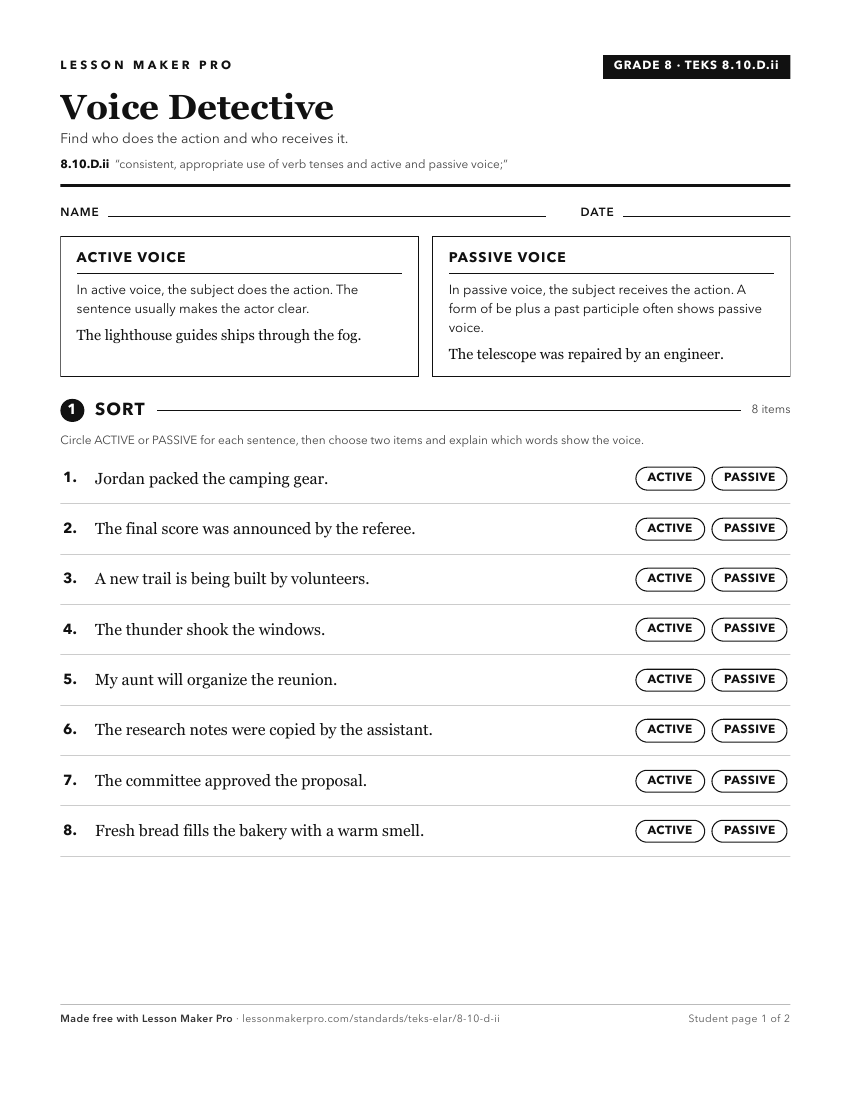
A ready-to-print activity worksheet aligned to 8.10.D.ii, with an answer key for the teacher on its own page. No account needed.
PDF, US Letter, prints cleanly in black and white.
Download the worksheetKeep exploring
Related Standards
Turn this exact standard into a lesson
Grade, subject, topic, and the complete standard are prefilled. Create one free, no account needed.
Also for this standard:Make a WorksheetMake a QuizMake a Sub Lesson