TEKS ELAR 1.11.D.i
The Standard
complete sentences with subject-verb agreement
Texas Essential Knowledge and Skills for English Language Arts and Reading · edit drafts using standard English conventions, including:
Teacher's field guide
What This Standard Means
What Students Need to Do
- Students write a whole thought that names who or what and tells what happens. They reread each sentence and choose a verb that matches one subject or several subjects.
What Mastery Looks Like
- A student writes a whole thought that tells who or what and what that subject does. The verb matches whether the subject is one person or thing, or more than one.
Common Misconceptions
- Students may treat a fragment such as "The big dog" as a full sentence. They may mismatch singular and plural forms, writing "The dogs runs" or "They is playing."
How to Assess It
- Give students the fragments "My friends" and "plays outside," then ask them to combine and correct them. Students should write, "My friends play outside."
Lesson moves
Ways to Teach It
Give pairs noun and verb cards, then have students build matching sentences and read them aloud.
Ask students to explain why "The cat sleep" sounds wrong, then write a corrected sentence.
Play Sentence Fix-It by displaying mismatched sentences and awarding points when teams correct both the fragment and verb.
Have students write two classroom rule signs, such as "We listen" and "Our teacher helps us."
Free download
Printable 1.11.D.i Worksheet
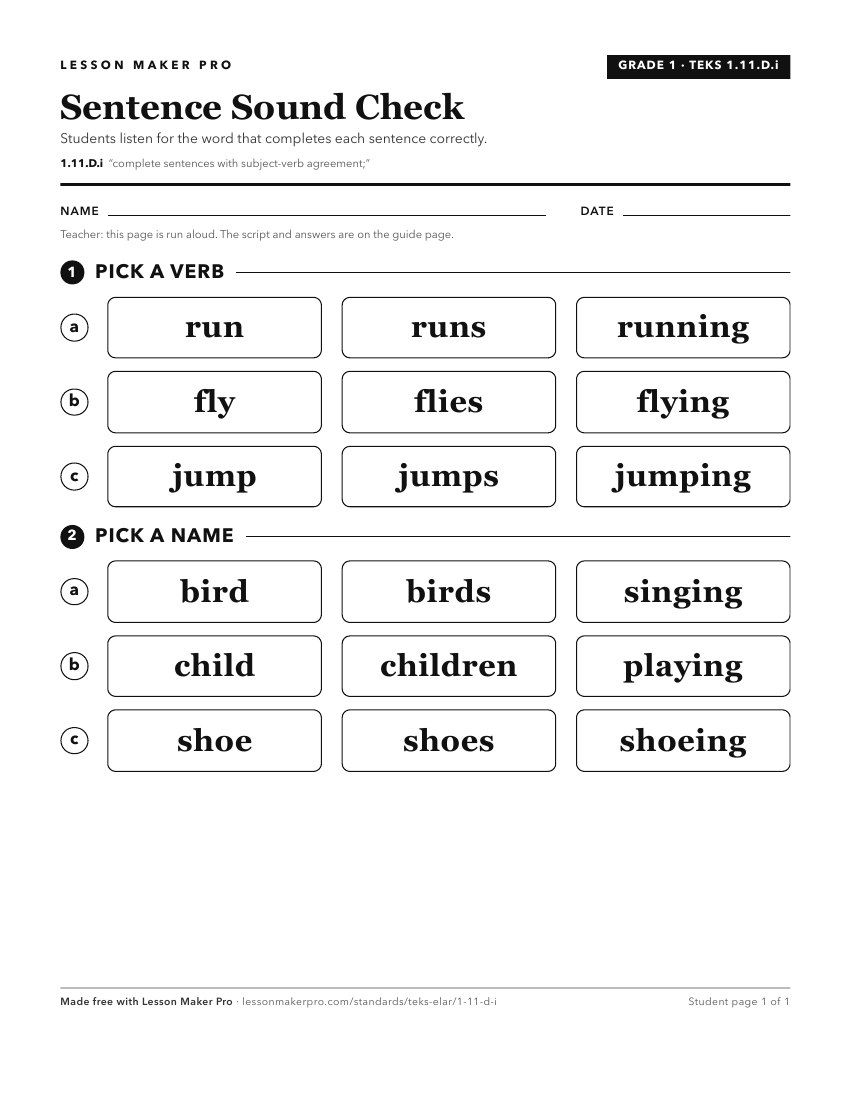
A ready-to-print activity worksheet aligned to 1.11.D.i, with an answer key for the teacher on its own page. No account needed.
PDF, US Letter, prints cleanly in black and white.
Download the worksheetKeep exploring
Related Standards
- 6.10.D.i
complete complex sentences with subject-verb agreement and avoidance of splices, run-ons, and fragments;
- 8.10.D.i
complete complex sentences with subject-verb agreement and avoidance of splices, run-ons, and fragments;
- 2.11.D.i
The 2nd Grade version of this standard.
- 3.11.D.i
complete simple and compound sentences with subject-verb agreement;
Turn this exact standard into a lesson
Grade, subject, topic, and the complete standard are prefilled. Create one free, no account needed.
Also for this standard:Make a WorksheetMake a QuizMake a Sub Lesson