TEKS ELAR 8.10.D.i
The Standard
complete complex sentences with subject-verb agreement and avoidance of splices, run-ons, and fragments
Texas Essential Knowledge and Skills for English Language Arts and Reading · The student uses the writing process recursively to compose multiple texts that are legible and uses appropriate conventions.
Teacher's field guide
What This Standard Means
What Students Need to Do
- Students revise drafts so each sentence expresses a complete thought and has correctly matched subjects and verbs. They connect clauses with suitable punctuation and conjunctions instead of leaving fragments or joining thoughts incorrectly.
What Mastery Looks Like
- A student can find and fix fragments, fused sentences, comma splices, and agreement errors in a draft. The student can explain why the revised punctuation, conjunction, and verb form are correct.
Common Misconceptions
- Students often treat a dependent clause, such as one beginning with “because” or “although,” as a full sentence. They may join two complete thoughts with only a comma. They may also match the verb to the nearest noun instead of the true subject.
How to Assess It
- Give this exit ticket: “Although the players on our team practices daily, they lost the opener, they remained confident.” Students rewrite it correctly and label each subject and verb.
Lesson moves
Ways to Teach It
Give pairs independent and dependent clause strips, then have them build complete sentences using conjunction cards and punctuation tiles.
Ask students to explain when a comma can join clauses and when a conjunction or period is needed.
Play Sentence Repair Relay, with teams correcting posted sentences and naming each error before earning a point.
Have students edit a mock school announcement for fragments, run-ons, comma splices, and subject-verb agreement before it is posted.
Free download
Printable 8.10.D.i Worksheet
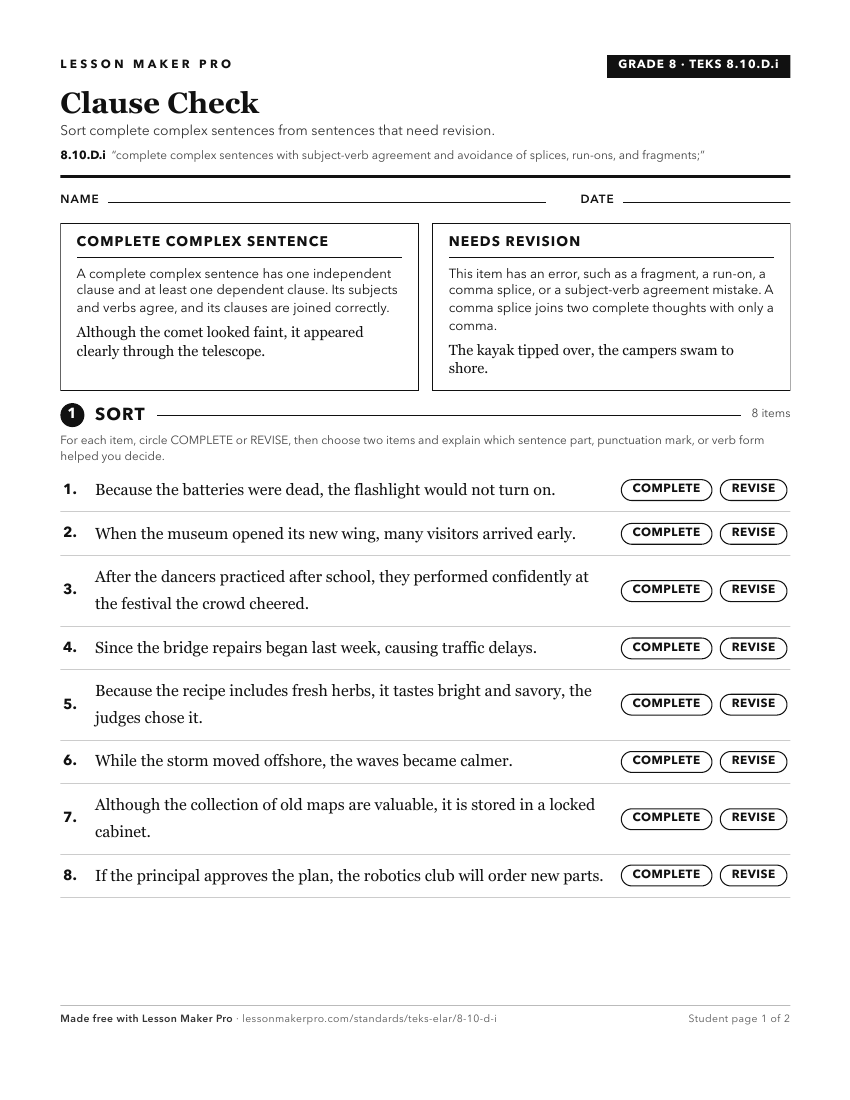
A ready-to-print activity worksheet aligned to 8.10.D.i, with an answer key for the teacher on its own page. No account needed.
PDF, US Letter, prints cleanly in black and white.
Download the worksheetKeep exploring
Related Standards
- 7.10.D.i
complete complex sentences with subject-verb agreement and avoidance of splices, run-ons, and fragments
- 4.11.D.i
complete simple and compound sentences with subject-verb agreement and avoidance of splices, run-ons, and fragments;
- 6.10.D.i
The 6th Grade version of this standard.
- 5.11.D.i
complete simple and compound sentences with subject-verb agreement and avoidance of splices, run-ons, and fragments;
Turn this exact standard into a lesson
Grade, subject, topic, and the complete standard are prefilled. Create one free, no account needed.
Also for this standard:Make a WorksheetMake a QuizMake a Sub Lesson