TEKS ELAR 8.10.D.vi
The Standard
punctuation, including commas in non-restrictive phrases and clauses, semicolons, colons, and parentheses
Texas Essential Knowledge and Skills for English Language Arts and Reading · The student uses the writing process recursively to compose multiple texts that are legible and uses appropriate conventions.
Teacher's field guide
What This Standard Means
What Students Need to Do
- Students revise sentences so extra, nonessential details are clearly separated from the main idea. They choose commas, semicolons, colons, or parentheses based on each mark’s specific job.
What Mastery Looks Like
- Students set off extra information with paired commas or parentheses without changing the main meaning. They use semicolons between related complete sentences and colons after complete statements that introduce lists or explanations.
Common Misconceptions
- Students may place only one comma around nonrestrictive information or add commas around details needed to identify the noun. They may use a semicolon before a list, place a colon after a fragment, or forget that parentheses come in pairs.
How to Assess It
- Give students this exit ticket: “My only brother who lives in Austin collects three things stamps coins and maps he stores them carefully (most days.” Ask them to correct and label each punctuation choice.
Lesson moves
Ways to Teach It
Give pairs sentence strips and punctuation cards; have them place commas, semicolons, colons, and parentheses, then justify each choice.
Post restrictive and nonrestrictive versions of a sentence; ask students to write how the punctuation changes the meaning.
Run Punctuation Relay: teams correct one error in a paragraph, pass the marker, and earn a point only with an accurate explanation.
Have students edit a school announcement or club flyer, adding a colon for a list and parentheses for useful side information.
Free download
Printable 8.10.D.vi Worksheet
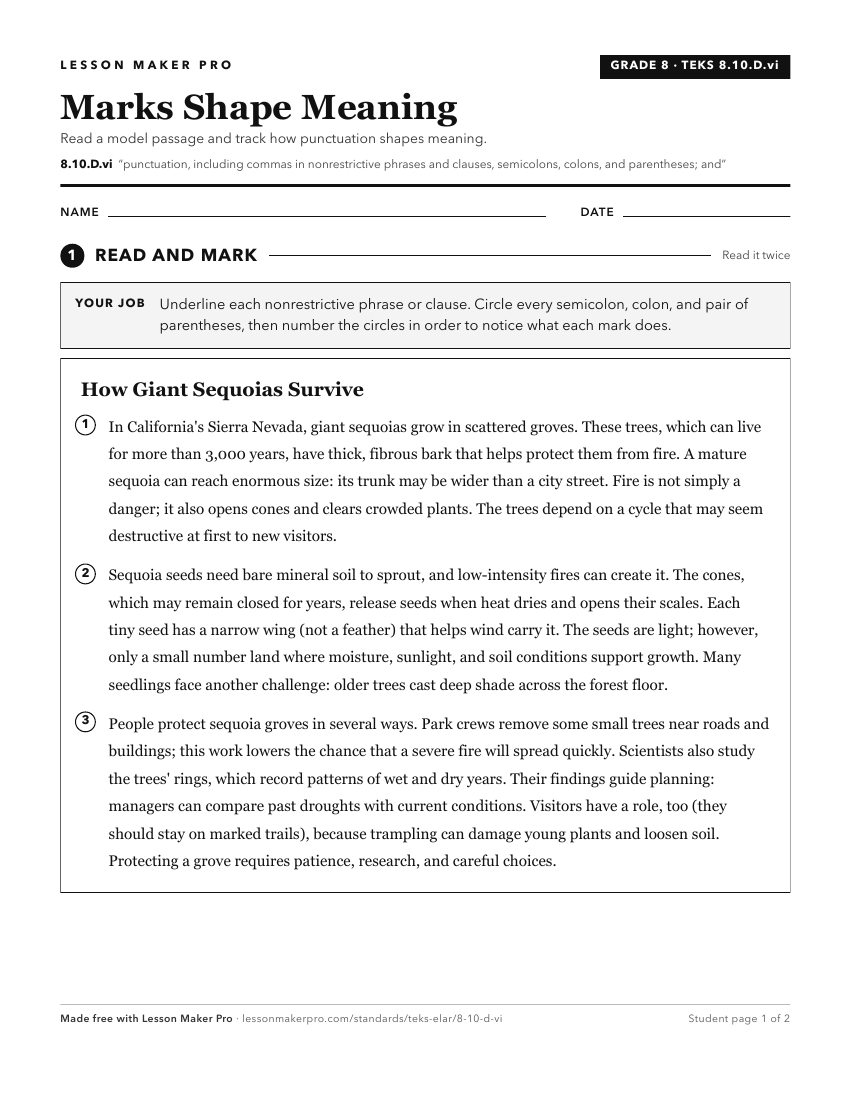
A ready-to-print activity worksheet aligned to 8.10.D.vi, with an answer key for the teacher on its own page. No account needed.
PDF, US Letter, prints cleanly in black and white.
Download the worksheetKeep exploring
Related Standards
- 7.10.D.viii
punctuation, including commas to set off words, phrases, and clauses, and semicolons
- 6.10.D.viii
punctuation marks, including commas in complex sentences, transitions, and introductory elements; and
- 3.11.D.x
punctuation marks, including apostrophes in contractions and possessives and commas in compound sentences and items in a series; and
- 4.11.D.x
punctuation marks, including apostrophes in possessives, commas in compound sentences, and quotation marks in dialogue; and
Turn this exact standard into a lesson
Grade, subject, topic, and the complete standard are prefilled. Create one free, no account needed.
Also for this standard:Make a WorksheetMake a QuizMake a Sub Lesson