TEKS ELAR 3.11.D.x
The Standard
punctuation marks, including apostrophes in contractions and possessives and commas in compound sentences and items in a series
Texas Essential Knowledge and Skills for English Language Arts and Reading · The student uses the writing process recursively to compose multiple texts that are legible and uses appropriate conventions.
Teacher's field guide
What This Standard Means
What Students Need to Do
- Students reread drafts and correct apostrophes and commas. They use apostrophes to show missing letters or ownership, and commas to separate list items or complete thoughts joined by a conjunction.
What Mastery Looks Like
- A student can find and fix missing or misplaced apostrophes and commas in a draft. The student can explain whether each mark shows ownership, missing letters, list items, or joined complete thoughts.
Common Misconceptions
- Students often add apostrophes to ordinary plurals or place them in the wrong spot in contractions. They may insert a comma every time they see “and,” or leave commas out of a series.
How to Assess It
- Exit ticket: Edit these sentences: “Mias dog doesnt like baths and he hides under the bed.” “We packed soap towels and brushes.” Circle each change and label its purpose.
Lesson moves
Ways to Teach It
Give pairs sentence strips and punctuation cards, then have them place apostrophes and commas and explain each choice.
Ask students to explain how punctuation changes the meaning of “the dogs bowl” and “the dog’s bowl.”
Run an editing relay where teams correct one punctuation error at a time in a prepared paragraph, then justify the change.
Have students write a class supply request using a three-item list, one contraction, one possessive, and one compound sentence.
Free download
Printable 3.11.D.x Worksheet
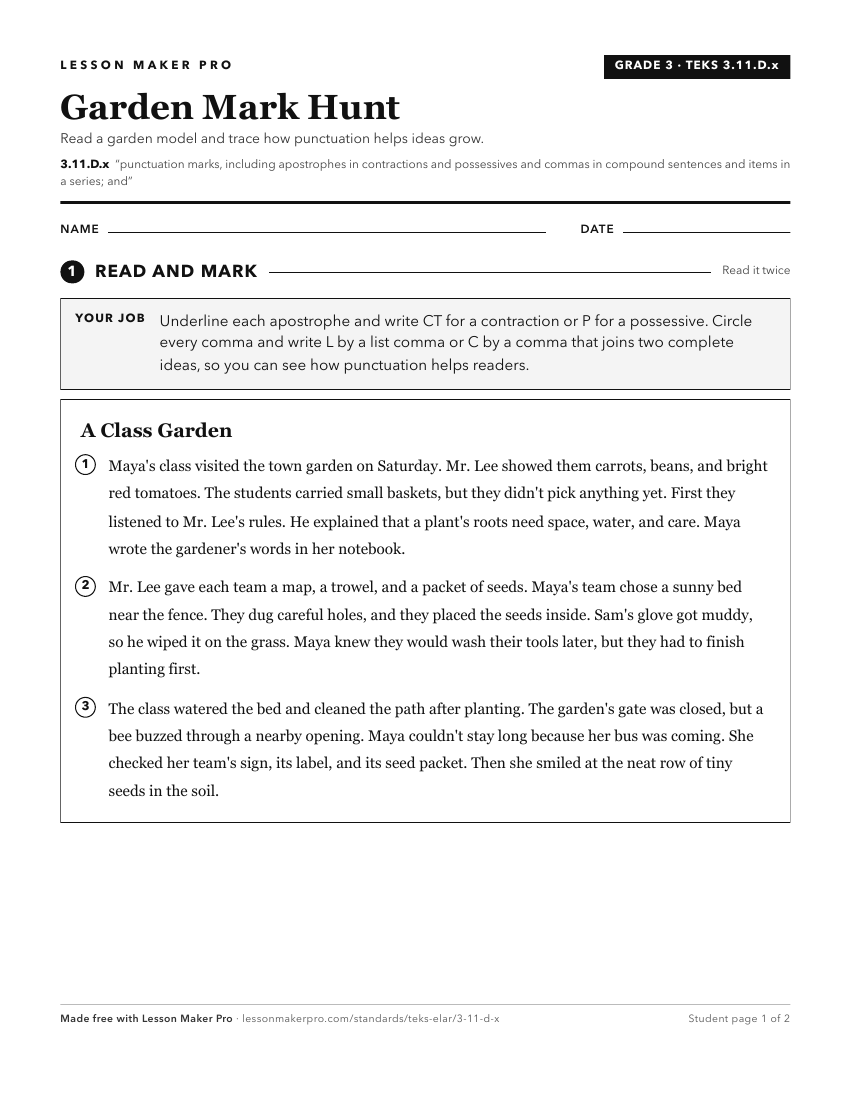
A ready-to-print activity worksheet aligned to 3.11.D.x, with an answer key for the teacher on its own page. No account needed.
PDF, US Letter, prints cleanly in black and white.
Download the worksheetKeep exploring
Related Standards
- 2.11.D.x
end punctuation, apostrophes in contractions, and commas with items in a series and in dates; and
- 8.10.D.vi
punctuation, including commas in non-restrictive phrases and clauses, semicolons, colons, and parentheses; and
- 6.10.D.viii
punctuation marks, including commas in complex sentences, transitions, and introductory elements; and
- 4.11.D.x
punctuation marks, including apostrophes in possessives, commas in compound sentences, and quotation marks in dialogue; and
Turn this exact standard into a lesson
Grade, subject, topic, and the complete standard are prefilled. Create one free, no account needed.
Also for this standard:Make a WorksheetMake a QuizMake a Sub Lesson