TEKS ELAR 2.11.D.x
The Standard
end punctuation, apostrophes in contractions, and commas with items in a series and in dates
Texas Essential Knowledge and Skills for English Language Arts and Reading · The student uses the writing process recursively to compose multiple texts that are legible and uses appropriate conventions.
Teacher's field guide
What This Standard Means
What Students Need to Do
- Students reread their own writing and decide which punctuation marks are needed. They correct sentence endings, shortened word pairs, lists, and written dates.
What Mastery Looks Like
- Students choose the correct ending mark based on sentence meaning. They place apostrophes where letters were removed and use commas to separate listed items and parts of a date.
Common Misconceptions
- Students may use a period for every sentence, even questions or exclamations. They may put the apostrophe between the two joined words. They may omit commas or place one after every word in a list or date.
How to Assess It
- Give students four sentences with missing or incorrect punctuation, including a question, a contraction, a list, and a date. Ask them to edit each sentence.
Lesson moves
Ways to Teach It
Give pairs sentence strips and punctuation cards, then have them place each mark correctly and explain each choice.
Ask students to write three sentences about lunch, including one question, one contraction, and a list of three foods.
Play a punctuation relay where teams correct one sentence at a time on chart paper, then pass the marker.
Have students edit a pretend birthday invitation containing contractions, a date, a supply list, and missing ending marks.
Free download
Printable 2.11.D.x Worksheet
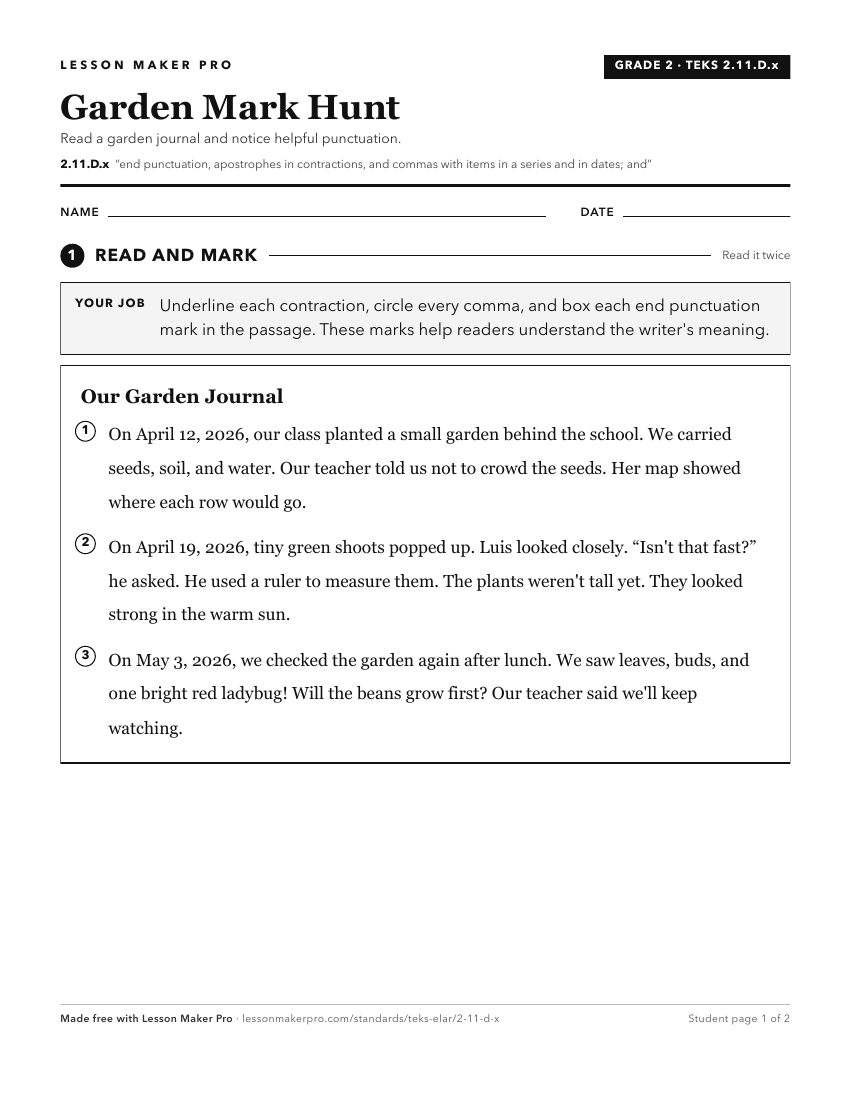
A ready-to-print activity worksheet aligned to 2.11.D.x, with an answer key for the teacher on its own page. No account needed.
PDF, US Letter, prints cleanly in black and white.
Download the worksheetKeep exploring
Related Standards
- 5.11.D.x
punctuation marks, including commas in compound and complex sentences, quotation marks in dialogue, and italics and underlining for titles and emphasis; and
- 8.10.D.vi
punctuation, including commas in non-restrictive phrases and clauses, semicolons, colons, and parentheses; and
- 3.11.D.x
punctuation marks, including apostrophes in contractions and possessives and commas in compound sentences and items in a series; and
- 4.11.D.x
punctuation marks, including apostrophes in possessives, commas in compound sentences, and quotation marks in dialogue; and
Turn this exact standard into a lesson
Grade, subject, topic, and the complete standard are prefilled. Create one free, no account needed.
Also for this standard:Make a WorksheetMake a QuizMake a Sub Lesson