TEKS ELAR 6.10.D.viii
The Standard
punctuation marks, including commas in complex sentences, transitions, and introductory elements
Texas Essential Knowledge and Skills for English Language Arts and Reading · The student uses the writing process recursively to compose multiple texts that are legible and uses appropriate conventions.
Teacher's field guide
What This Standard Means
What Students Need to Do
- Students edit sentences and drafts by adding or removing commas. They use commas after opening dependent clauses, transitions, and introductory phrases without adding unnecessary commas.
What Mastery Looks Like
- Students correctly place commas after opening dependent clauses, transitions, and phrases. They can explain each comma and remove commas that interrupt a sentence incorrectly.
Common Misconceptions
- Students may place a comma before every dependent clause, even when it comes last. They may also omit commas after opening transitions or separate a subject from its verb.
How to Assess It
- Give this exit ticket: “Add commas where needed: Although the rain stopped the field stayed muddy. However we played anyway. Our shoes dried because the sun came out.”
Lesson moves
Ways to Teach It
Give pairs clause strips and comma tiles, then have them build complex sentences and place each comma correctly.
Ask students to compare “Because I practiced, I improved” and “I improved because I practiced,” then explain the comma difference.
Run a comma card sort with sentences labeled correct, missing comma, or extra comma, then check answers as a class.
Have students edit a school announcement by adding commas after opening transitions, phrases, and dependent clauses.
Free download
Printable 6.10.D.viii Worksheet
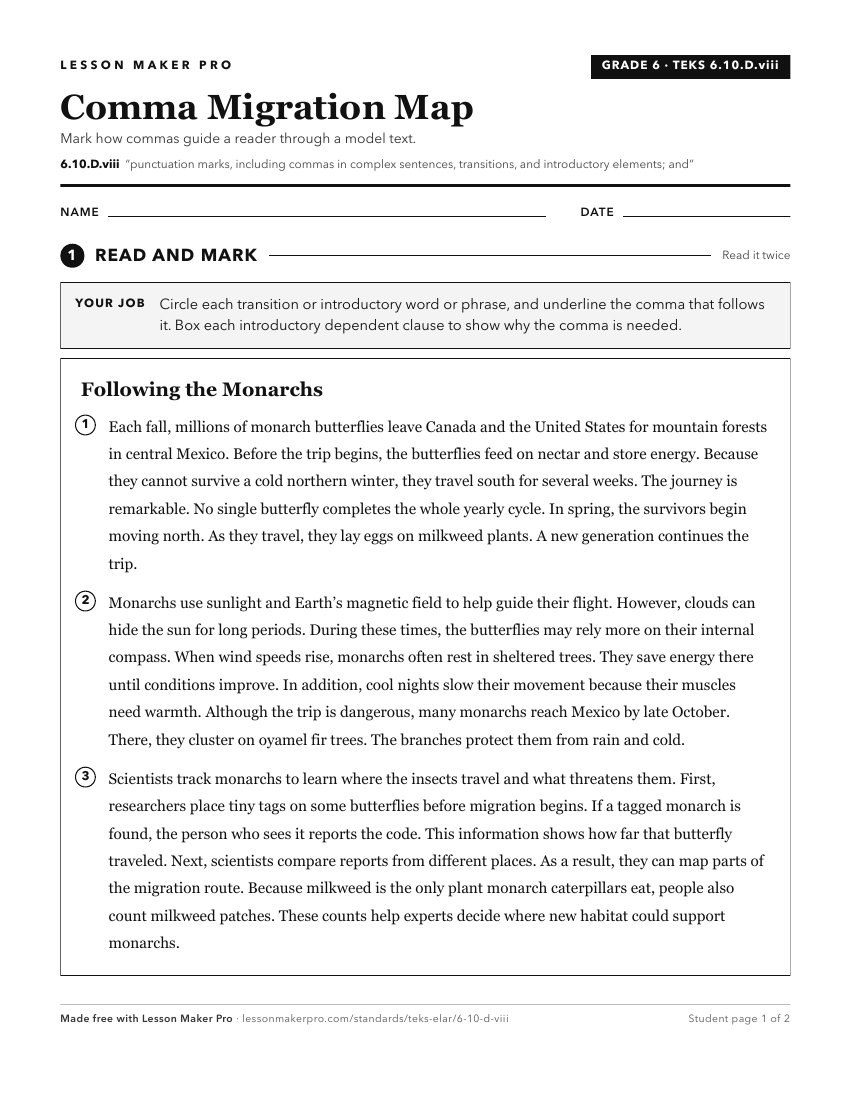
A ready-to-print activity worksheet aligned to 6.10.D.viii, with an answer key for the teacher on its own page. No account needed.
PDF, US Letter, prints cleanly in black and white.
Download the worksheetKeep exploring
Related Standards
- 5.11.D.x
punctuation marks, including commas in compound and complex sentences, quotation marks in dialogue, and italics and underlining for titles and emphasis; and
- 8.10.D.vi
punctuation, including commas in non-restrictive phrases and clauses, semicolons, colons, and parentheses; and
- 3.11.D.x
punctuation marks, including apostrophes in contractions and possessives and commas in compound sentences and items in a series; and
- 4.11.D.x
punctuation marks, including apostrophes in possessives, commas in compound sentences, and quotation marks in dialogue; and
Turn this exact standard into a lesson
Grade, subject, topic, and the complete standard are prefilled. Create one free, no account needed.
Also for this standard:Make a WorksheetMake a QuizMake a Sub Lesson