TEKS ELAR 7.10.D.viii
The Standard
punctuation, including commas to set off words, phrases, and clauses, and semicolons
Texas Essential Knowledge and Skills for English Language Arts and Reading · Composition: listening, speaking, reading, writing, and thinking using multiple texts
Teacher's field guide
What This Standard Means
What Students Need to Do
- Students edit drafts by placing commas around interrupting or nonessential words, phrases, and clauses. They use semicolons to connect closely related complete sentences.
What Mastery Looks Like
- Students correctly set off interrupting and nonessential information with commas. They join two closely related complete sentences with a semicolon and avoid creating fragments or run-ons.
Common Misconceptions
- Students may place commas wherever they pause while reading. They may use a semicolon before a fragment, after a coordinating conjunction, or between unrelated sentences.
How to Assess It
- Exit ticket: Edit “Our coach however canceled practice” and “The field was flooded we practiced indoors,” then explain each punctuation choice.
Lesson moves
Ways to Teach It
Give pairs sentence strips, comma cards, and semicolon cards, then have them place each mark and justify the placement.
Ask students to explain how punctuation changes meaning in “My cousin Sam arrived” and “My cousin, Sam, arrived.”
Run a punctuation relay where teams edit sentence cards and earn a point only when they explain the rule correctly.
Have students edit a school announcement, using commas for added information and a semicolon to connect two related complete thoughts.
Free download
Printable 7.10.D.viii Worksheet
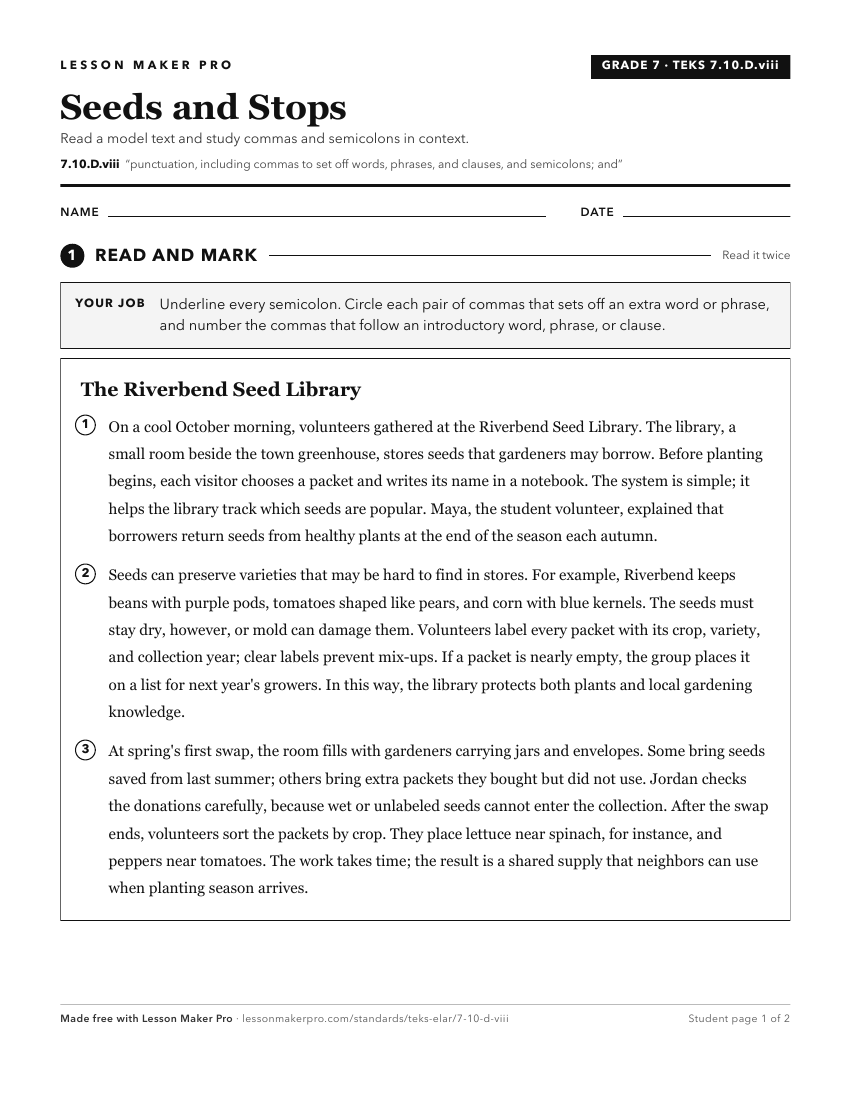
A ready-to-print activity worksheet aligned to 7.10.D.viii, with an answer key for the teacher on its own page. No account needed.
PDF, US Letter, prints cleanly in black and white.
Download the worksheetKeep exploring
Related Standards
- 5.11.D.x
punctuation marks, including commas in compound and complex sentences, quotation marks in dialogue, and italics and underlining for titles and emphasis; and
- 8.10.D.vi
punctuation, including commas in non-restrictive phrases and clauses, semicolons, colons, and parentheses; and
- 6.10.D.viii
punctuation marks, including commas in complex sentences, transitions, and introductory elements; and
- 4.11.D.x
punctuation marks, including apostrophes in possessives, commas in compound sentences, and quotation marks in dialogue; and
Turn this exact standard into a lesson
Grade, subject, topic, and the complete standard are prefilled. Create one free, no account needed.
Also for this standard:Make a WorksheetMake a QuizMake a Sub Lesson