TEKS ELAR 8.10.D.iii
The Standard
prepositions and prepositional phrases and their influence on subject-verb agreement
Texas Essential Knowledge and Skills for English Language Arts and Reading · The student uses the writing process recursively to compose multiple texts that are legible and uses appropriate conventions.
Teacher's field guide
What This Standard Means
What Students Need to Do
- Students identify the true subject when a prepositional phrase appears between the subject and verb. They revise verbs to agree with that subject, not a nearby noun.
What Mastery Looks Like
- Students correctly edit sentences such as “The box of pencils is missing.” They can explain why “box,” not “pencils,” controls the verb.
Common Misconceptions
- Students often match the verb to the nearest noun instead of the true subject. They may also mistake the object of a preposition for the subject.
How to Assess It
- Exit ticket: Correct “The basket of apples sit on the table.” Underline the subject, circle the verb, and bracket the prepositional phrase.
Lesson moves
Ways to Teach It
Give pairs word cards to build sentences, then have them remove each prepositional phrase and check subject-verb agreement.
Ask students to compare “The list of names is long” and “The names on the list are familiar,” then explain each verb choice.
Play Agreement Detective with projected sentences, awarding points for identifying the subject, crossing out the prepositional phrase, and correcting the verb.
Have students edit a mock school announcement containing agreement errors, such as “A group of volunteers are meeting after school.”
Free download
Printable 8.10.D.iii Worksheet
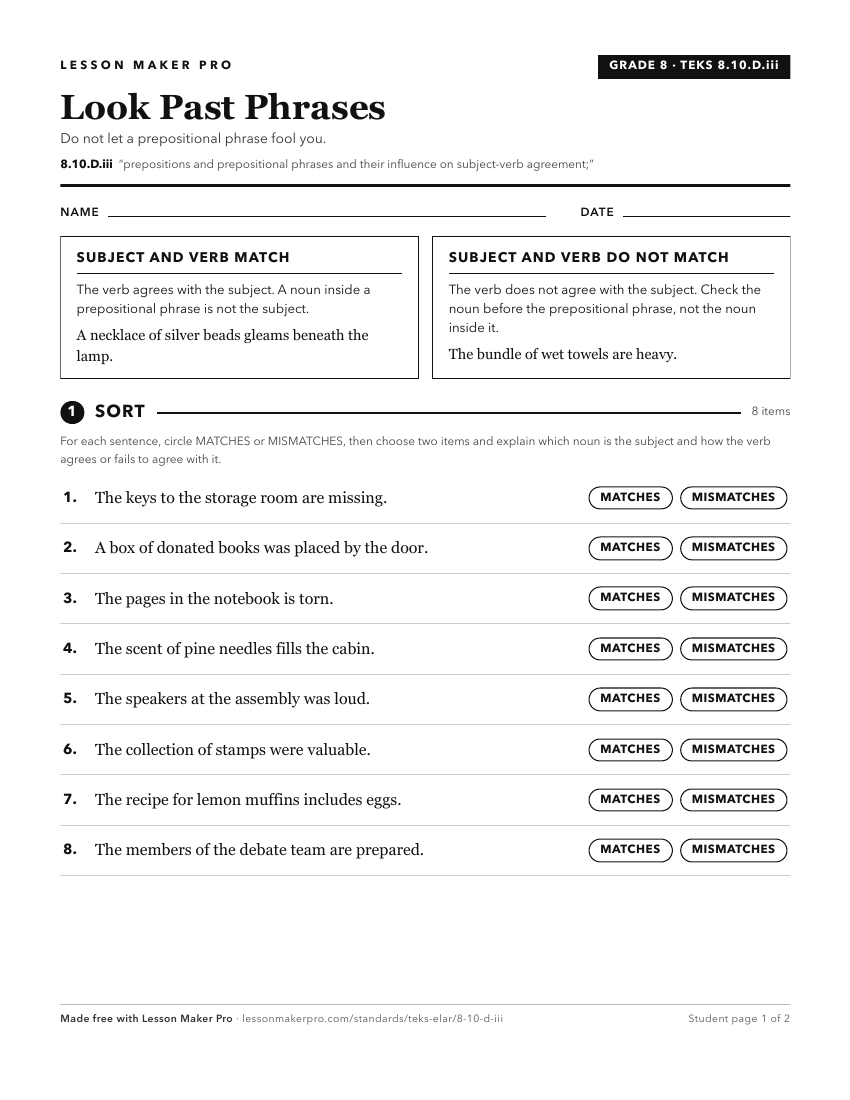
A ready-to-print activity worksheet aligned to 8.10.D.iii, with an answer key for the teacher on its own page. No account needed.
PDF, US Letter, prints cleanly in black and white.
Download the worksheetKeep exploring
Related Standards
Turn this exact standard into a lesson
Grade, subject, topic, and the complete standard are prefilled. Create one free, no account needed.
Also for this standard:Make a WorksheetMake a QuizMake a Sub Lesson