TEKS ELAR 8.10.C
The Standard
revise drafts for clarity, development, organization, style, word choice, and sentence variety
Texas Essential Knowledge and Skills for English Language Arts and Reading
Teacher's field guide
What This Standard Means
What Students Need to Do
- Students reread drafts and identify places where readers may get confused, lose interest, or need more support. They add, remove, replace, combine, and reorder material to improve the whole piece.
What Mastery Looks Like
- A student can spot weak or confusing parts of a draft and make purposeful changes. The revised version has stronger support, a logical flow, precise language, and varied sentence patterns.
Common Misconceptions
- Students often treat revision as fixing spelling and punctuation only. They may swap words for longer synonyms without improving meaning, or vary sentences by making every sentence longer.
How to Assess It
- Give students a weak six-sentence paragraph. Ask them to make three meaningful revisions and label how each change helps the reader.
Lesson moves
Ways to Teach It
Print a draft, have pairs color-code evidence, transitions, vague words, and sentence openings, then cut and reorder sentences.
Ask, “Which revision most improves the reader’s understanding, and why?” Students compare two versions and cite one exact change.
Run a Revision Relay: teams draw cards labeled add, delete, move, replace, or combine and revise one shared paragraph.
Have students revise a confusing school announcement for families, making the purpose, sequence, and tone easy to understand.
Free download
Printable 8.10.C Worksheet
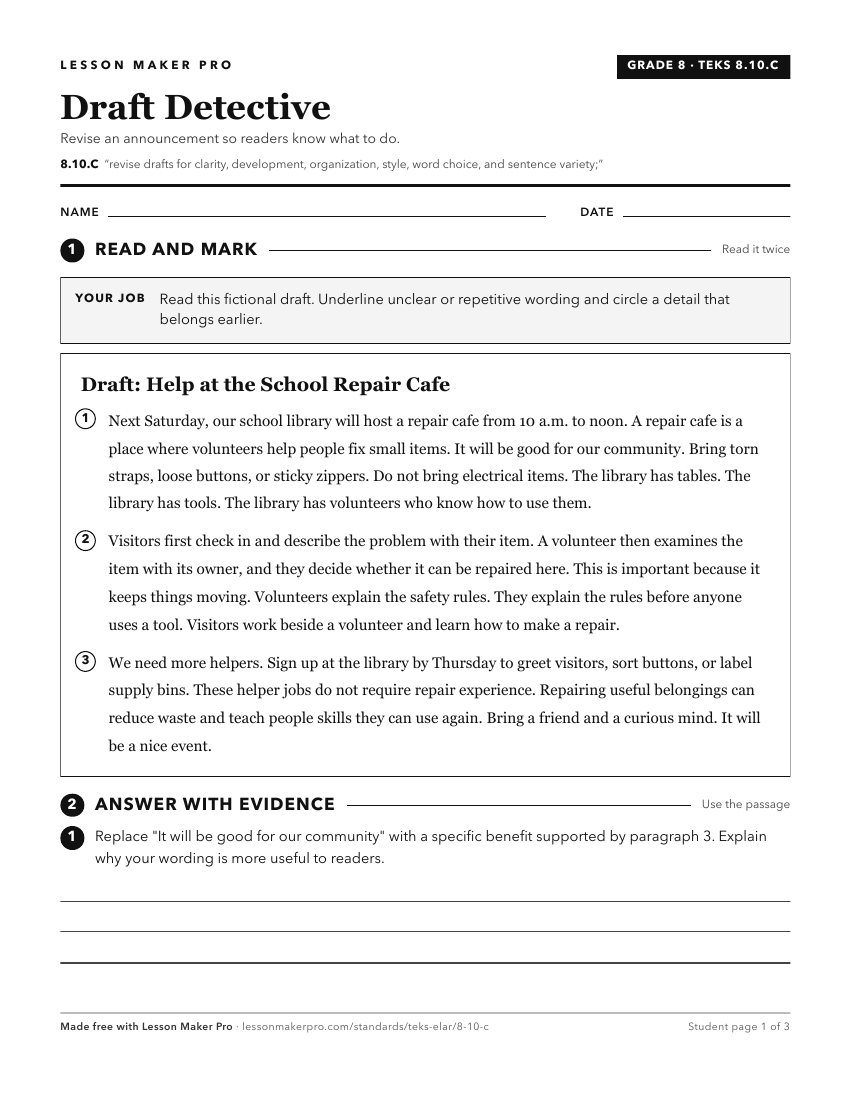
A ready-to-print activity worksheet aligned to 8.10.C, with an answer key for the teacher on its own page. No account needed.
PDF, US Letter, prints cleanly in black and white.
Download the worksheetKeep exploring
Related Standards
- 7.10.C
revise drafts for clarity, development, organization, style, word choice, and sentence variety
- 5.11.C
revise drafts to improve sentence structure and word choice by adding, deleting, combining, and rearranging ideas for coherence and clarity;
- 4.11.C
revise drafts to improve sentence structure and word choice by adding, deleting, combining, and rearranging ideas for coherence and clarity;
- 6.10.C
The 6th Grade version of this standard.
Turn this exact standard into a lesson
Grade, subject, topic, and the complete standard are prefilled. Create one free, no account needed.
Also for this standard:Make a WorksheetMake a QuizMake a Sub Lesson