TEKS ELAR 7.10.C
The Standard
revise drafts for clarity, development, organization, style, word choice, and sentence variety
Texas Essential Knowledge and Skills for English Language Arts and Reading · Composition: listening, speaking, reading, writing, and thinking using multiple texts
Teacher's field guide
What This Standard Means
What Students Need to Do
- Students reread and reshape drafts so ideas are clear, complete, and easy to follow. They improve details, order, voice, word choice, and sentence patterns across several rounds of revision.
What Mastery Looks Like
- Students can explain why each revision improves the draft. Their final writing has a clear focus, logical order, useful details, precise words, and varied sentence structures.
Common Misconceptions
- Students may treat revision as correcting spelling and punctuation only. They may also add details that do not support the main idea or vary sentences without improving flow.
How to Assess It
- Give students a short, weak paragraph and ask them to make three labeled revisions: one for clarity, one for development, and one for sentence variety.
Lesson moves
Ways to Teach It
Print a draft, cut it into paragraphs, and have pairs reorder the pieces, then add transitions that make the sequence clear.
Ask students to identify one confusing sentence in a partner's draft and write a specific revision that makes the meaning clearer.
Play Revision Relay, where teams rotate through a paragraph and improve one feature at each station: details, order, words, or sentences.
Have students revise a school announcement so families can quickly understand the event, schedule, location, and required materials.
Free download
Printable 7.10.C Worksheet
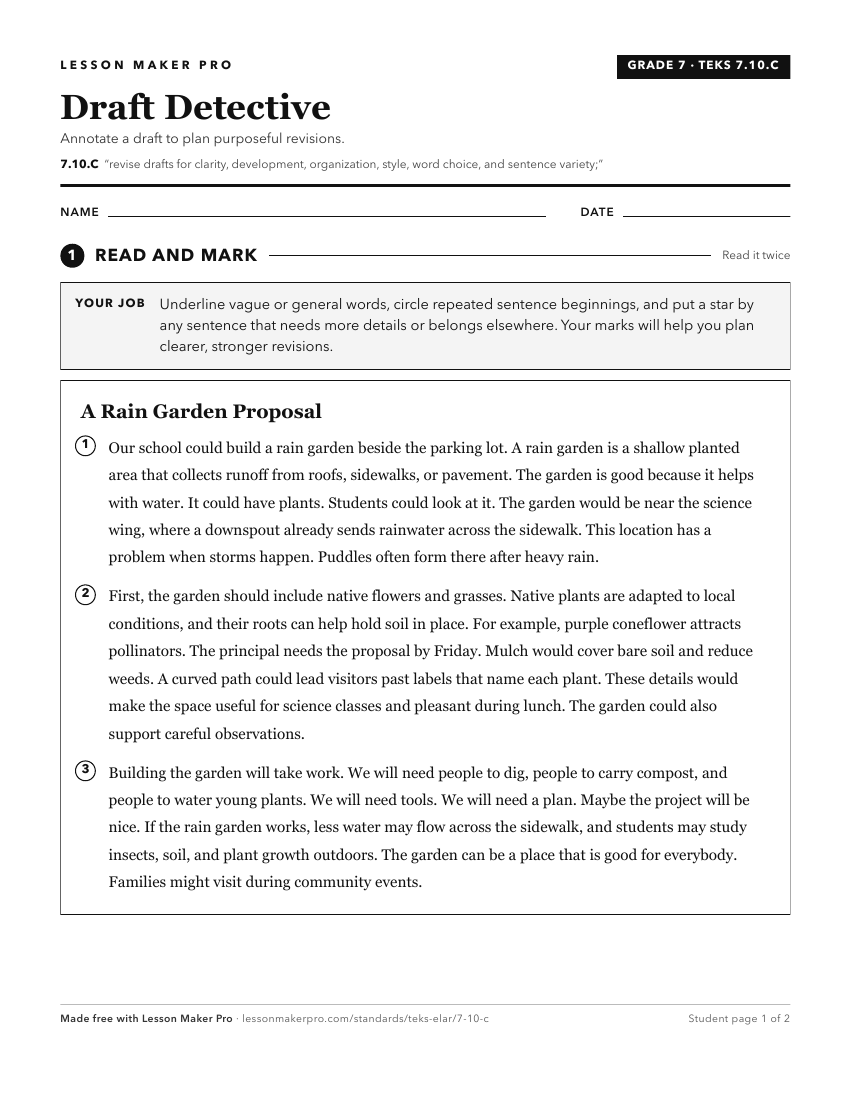
A ready-to-print activity worksheet aligned to 7.10.C, with an answer key for the teacher on its own page. No account needed.
PDF, US Letter, prints cleanly in black and white.
Download the worksheetKeep exploring
Related Standards
- 5.11.C
revise drafts to improve sentence structure and word choice by adding, deleting, combining, and rearranging ideas for coherence and clarity;
- 6.10.C
revise drafts for clarity, development, organization, style, word choice, and sentence variety;
- 8.10.C
revise drafts for clarity, development, organization, style, word choice, and sentence variety;
- 3.11.C
revise drafts to improve sentence structure and word choice by adding, deleting, combining, and rearranging ideas for coherence and clarity;
Turn this exact standard into a lesson
Grade, subject, topic, and the complete standard are prefilled. Create one free, no account needed.
Also for this standard:Make a WorksheetMake a QuizMake a Sub Lesson