TEKS ELAR 8.10.D.iv
The Standard
pronoun-antecedent agreement
Texas Essential Knowledge and Skills for English Language Arts and Reading · The student uses the writing process recursively to compose multiple texts that are legible and uses appropriate conventions.
Teacher's field guide
What This Standard Means
What Students Need to Do
- Students revise sentences so each pronoun clearly refers to the intended noun and matches it in number and person. They apply the same check while editing drafts.
What Mastery Looks Like
- A student can mark each pronoun and identify the noun it replaces. The student can correct mismatches without changing the sentence’s meaning.
Common Misconceptions
- Students often match a pronoun to the nearest noun instead of the noun it replaces, as in “The basket of apples lost their handle.” They may switch person or use a singular pronoun for two joined antecedents.
How to Assess It
- Give two items: “The basket of apples lost their handle” and “Maya and Lena forgot her notes.” Students underline each antecedent, circle each pronoun, and rewrite both sentences correctly.
Lesson moves
Ways to Teach It
Give pairs sentence strips with antecedents and pronouns, then have them build correct matches and repair mismatched pairs.
Ask students to compare two revisions of an unclear sentence and defend which pronoun makes the antecedent clearest.
Run a pronoun repair relay where teams correct projected sentences and earn a point only after naming the antecedent.
Have students edit a school announcement or club flyer for pronoun agreement, then rewrite any sentence with an unclear reference.
Free download
Printable 8.10.D.iv Worksheet
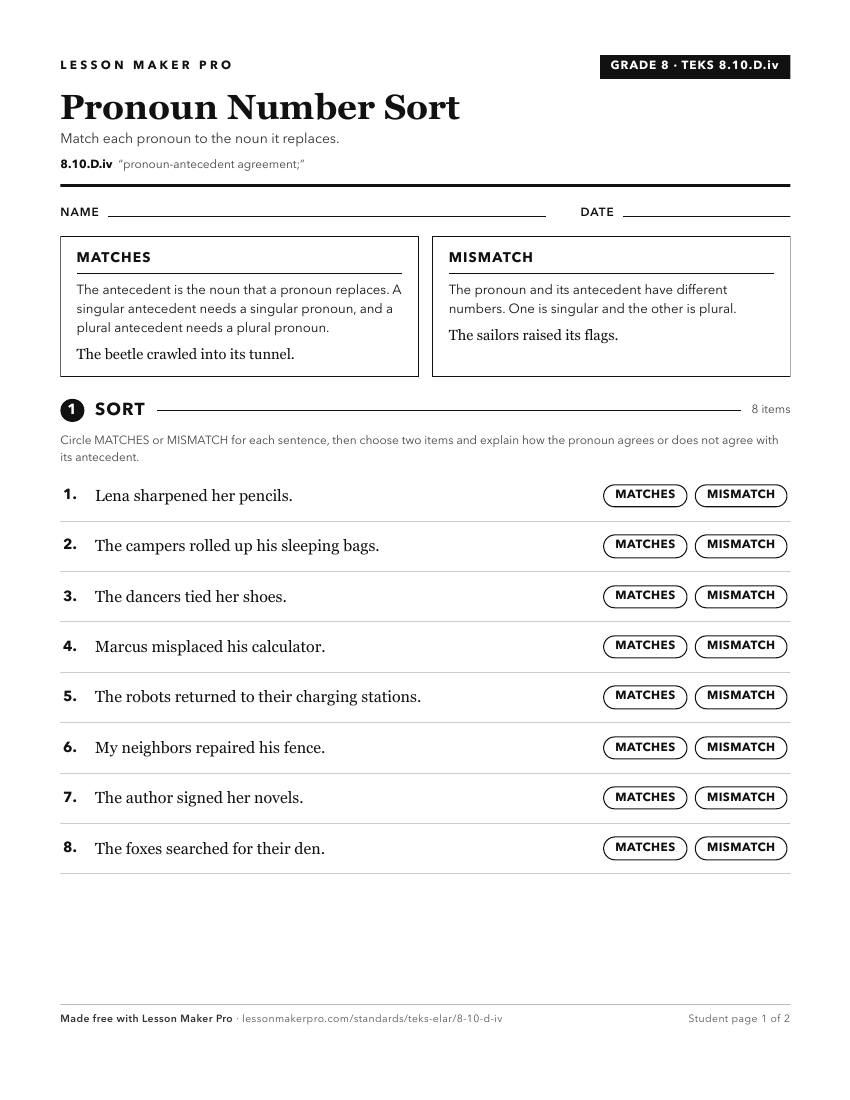
A ready-to-print activity worksheet aligned to 8.10.D.iv, with an answer key for the teacher on its own page. No account needed.
PDF, US Letter, prints cleanly in black and white.
Download the worksheetKeep exploring
Related Standards
Turn this exact standard into a lesson
Grade, subject, topic, and the complete standard are prefilled. Create one free, no account needed.
Also for this standard:Make a WorksheetMake a QuizMake a Sub Lesson