TEKS ELAR 7.10.D.v
The Standard
pronoun-antecedent agreement
Texas Essential Knowledge and Skills for English Language Arts and Reading · Composition: listening, speaking, reading, writing, and thinking using multiple texts
Teacher's field guide
What This Standard Means
What Students Need to Do
- Students locate the noun or noun phrase each pronoun refers to. They choose or revise pronouns so number and person stay consistent throughout a sentence or draft.
What Mastery Looks Like
- Students can identify the antecedent for each pronoun and make both agree in number and person. They can correct mismatches in sentences and their own drafts.
Common Misconceptions
- Students may match a pronoun to the nearest noun instead of the noun it replaces. They may also change number or point of view, such as shifting from you to they.
How to Assess It
- Give this exit ticket: “Maria and Tessa packed her lunches because you expected a long rehearsal.” Ask students to correct each mismatch and connect every pronoun to its antecedent.
Lesson moves
Ways to Teach It
Give pairs sentence strips with mismatched nouns and pronouns; students replace pronouns, then explain each change on a sticky note.
Ask students to compare “Each robot lost its wheel” and “All robots lost their wheels,” then write the agreement rule.
Play Agreement Relay: teams correct sentence cards, including compound antecedents and shifts between first, second, and third person.
Have students edit a mock club announcement for mismatched pronouns, then post the corrected version on the class bulletin board.
Free download
Printable 7.10.D.v Worksheet
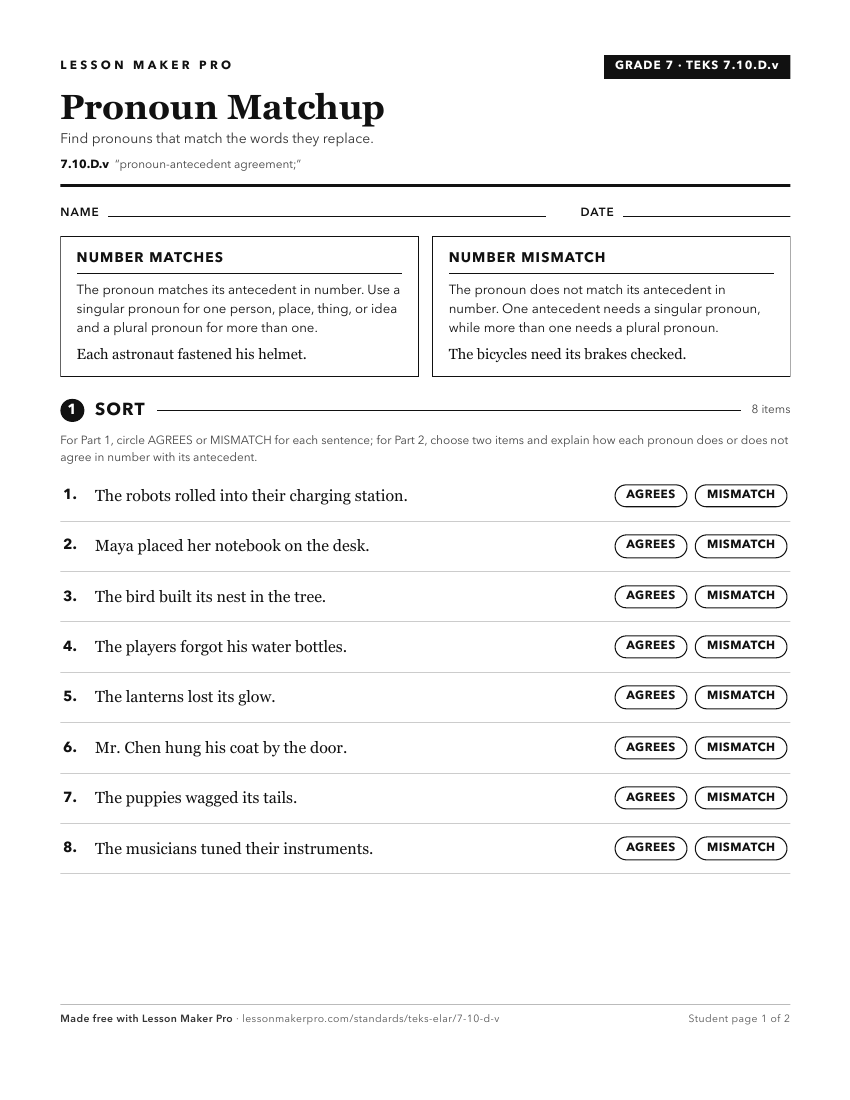
A ready-to-print activity worksheet aligned to 7.10.D.v, with an answer key for the teacher on its own page. No account needed.
PDF, US Letter, prints cleanly in black and white.
Download the worksheetKeep exploring
Related Standards
Turn this exact standard into a lesson
Grade, subject, topic, and the complete standard are prefilled. Create one free, no account needed.
Also for this standard:Make a WorksheetMake a QuizMake a Sub Lesson