TEKS ELAR 6.10.D.v
The Standard
pronouns, including relative
Texas Essential Knowledge and Skills for English Language Arts and Reading · The student uses the writing process recursively to compose multiple texts that are legible and uses appropriate conventions.
Teacher's field guide
What This Standard Means
What Students Need to Do
- Students edit drafts so relative pronouns connect descriptive clauses clearly to nouns. They choose among who, whom, whose, which, and that based on meaning and sentence structure.
What Mastery Looks Like
- Students can find and fix incorrect relative pronouns in their own drafts and sample sentences. They choose who, whom, whose, which, or that based on the noun and the pronoun's job in the clause.
Common Misconceptions
- Students use who for objects or which for people. They confuse who with whom, treat whose as applying only to people, or leave the pronoun's noun unclear.
How to Assess It
- Exit ticket: Correct the pronouns in “The scientist which visited brought a robot,” “The inventor who robot won spoke,” and “I thanked the mentor who we invited.” Label the noun each corrected pronoun refers to.
Lesson moves
Ways to Teach It
Give pairs noun cards and clause cards, then have them connect each pair with a who, whom, whose, which, or that card.
Write three sentences about classmates or fictional characters, using who, whose, and whom, then explain why each pronoun fits.
Play Pronoun Repair, where teams race to replace incorrect pronouns in sentences and identify each pronoun's noun.
Edit a school club announcement, correcting each relative pronoun before placing the clean version beside the original.
Free download
Printable 6.10.D.v Worksheet
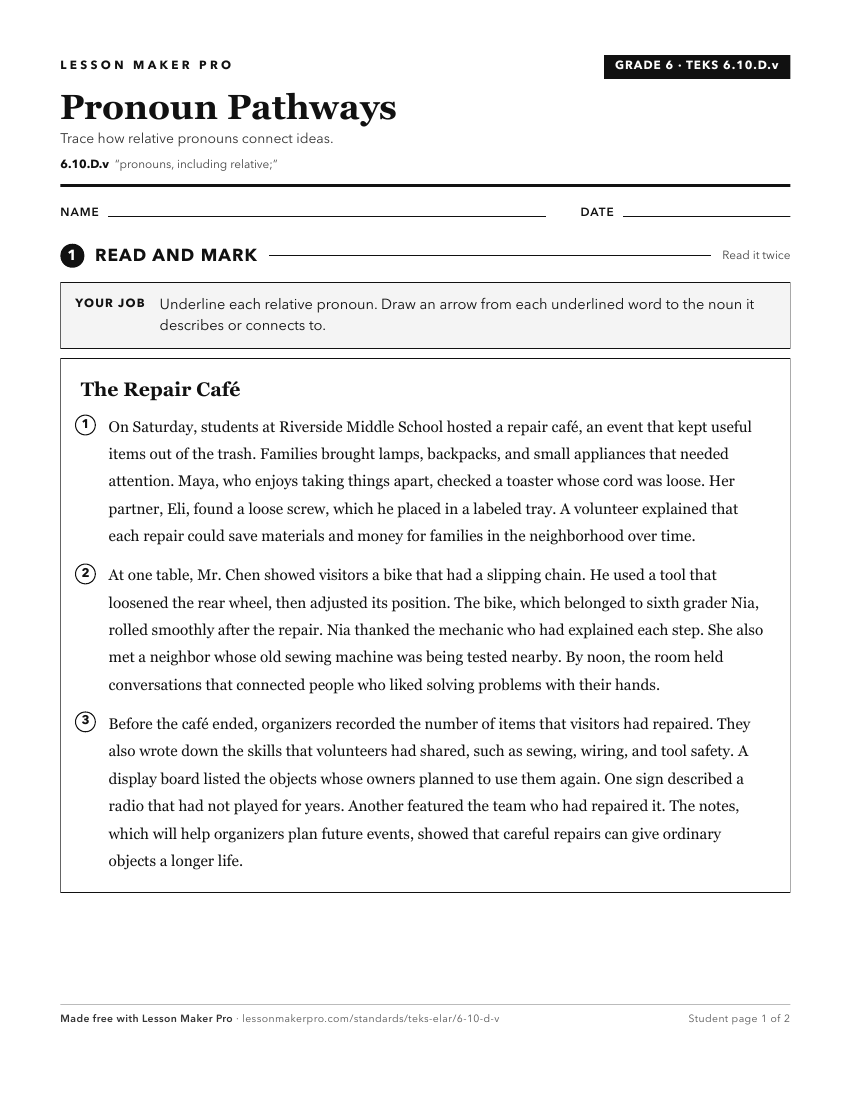
A ready-to-print activity worksheet aligned to 6.10.D.v, with an answer key for the teacher on its own page. No account needed.
PDF, US Letter, prints cleanly in black and white.
Download the worksheetKeep exploring
Related Standards
Turn this exact standard into a lesson
Grade, subject, topic, and the complete standard are prefilled. Create one free, no account needed.
Also for this standard:Make a WorksheetMake a QuizMake a Sub Lesson