TEKS ELAR 4.11.D.vii
The Standard
pronouns, including reflexive
Texas Essential Knowledge and Skills for English Language Arts and Reading · The student uses the writing process recursively to compose multiple texts that are legible and uses appropriate conventions.
Teacher's field guide
What This Standard Means
What Students Need to Do
- Students choose a pronoun that matches the person, number, and noun it refers to. They revise sentences so the pronoun correctly points back to the subject.
What Mastery Looks Like
- Students correctly use forms such as “myself,” “herself,” and “themselves” when the subject and object refer to the same person or thing. They edit mismatched or nonstandard forms in a draft.
Common Misconceptions
- Students may write nonstandard forms such as “hisself” or “theirselves.” They may also use “myself” instead of “I” or “me,” or mismatch the pronoun and its antecedent.
How to Assess It
- Give students four sentences with pronoun errors and one correct sentence. Ask them to correct the errors and circle the noun each pronoun refers to.
Lesson moves
Ways to Teach It
Give pairs subject cards and pronoun cards, then have them match “the girls” with “themselves” and explain each match.
Ask students to explain the difference between “Mia dressed herself” and “Mia dressed her” using who receives the action.
Play Pronoun Repair by showing incorrect sentences, such as “He taught hisself,” and awarding points for accurate corrections.
Have students write three safety instructions using reflexive pronouns, such as “Protect yourself by wearing goggles.”
Free download
Printable 4.11.D.vii Worksheet
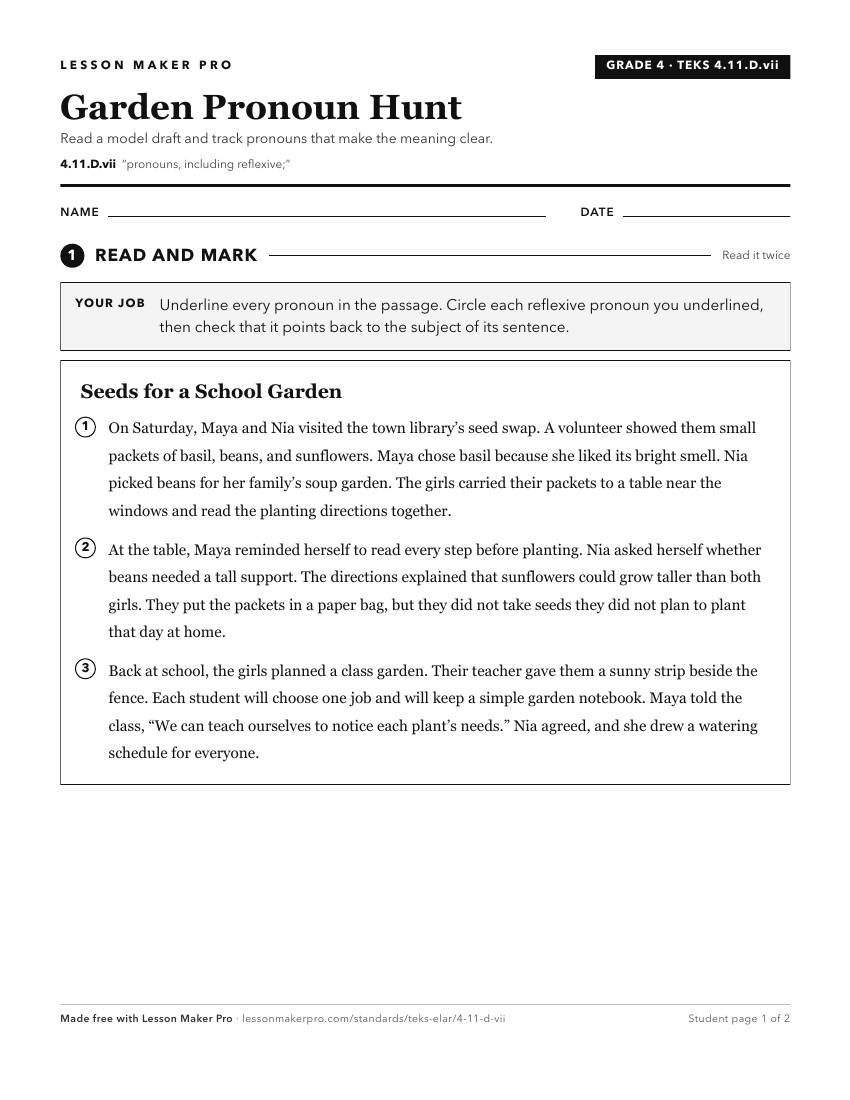
A ready-to-print activity worksheet aligned to 4.11.D.vii, with an answer key for the teacher on its own page. No account needed.
PDF, US Letter, prints cleanly in black and white.
Download the worksheetKeep exploring
Related Standards
Turn this exact standard into a lesson
Grade, subject, topic, and the complete standard are prefilled. Create one free, no account needed.
Also for this standard:Make a WorksheetMake a QuizMake a Sub Lesson