TEKS ELAR 1.11
Knowledge and Skills Statement (Standard Cluster)
The student uses the writing process recursively to compose multiple texts that are legible and uses appropriate conventions.
Texas Essential Knowledge and Skills for English Language Arts and Reading
Cluster contents
Student Expectations in This Statement
1.11 is a knowledge and skills statement. These are the student expectations under it.
- 1.11.A
plan a first draft by generating ideas for writing such as by drawing and brainstorming
- 1.11.B.i
organizing with structure
- 1.11.B.ii
developing an idea with specific and relevant details
- 1.11.C
revise drafts by adding details in pictures or words
- 1.11.D.i
complete sentences with subject-verb agreement
- 1.11.D.ii
past and present verb tense
- 1.11.D.iii
singular, plural, common, and proper nouns
- 1.11.D.iv
adjectives, including articles
- 1.11.D.ix
punctuation marks at the end of declarative, exclamatory, and interrogative sentences
- 1.11.D.v
adverbs that convey time
- 1.11.D.vi
prepositions
- 1.11.D.vii
pronouns, including subjective, objective, and possessive cases
- 1.11.D.viii
capitalization for the beginning of sentences and the pronoun "I"
- 1.11.D.x
correct spelling of words with grade-appropriate orthographic patterns and rules and high-frequency words with adult assistance
- 1.11.E
publish and share writing.
Teacher's field guide
What This Cluster Means
What Students Need to Do
- Students plan ideas with talk, drawings, or lists, then create organized drafts in pictures and words. They add useful details, correct grammar, spelling, capitals, and punctuation, then publish and share their writing.
What Mastery Looks Like
- Students create a clear plan, then produce an organized, legible draft with specific details. They reread, improve pictures or words, correct grade-level conventions with support, and share a finished copy.
Common Misconceptions
- Students may treat the first draft as finished or add details that do not fit the main idea. They may write fragments, switch verb tense, or miss capitals, end punctuation, plural endings, and high-frequency word spellings.
How to Assess It
- Ask students to draw a plan, write three connected sentences, add one useful detail, then check capitals, verbs, spelling, and end punctuation.
Lesson moves
Ways to Teach It
Give students picture sequence cards to arrange, then have them draw and write a beginning, middle, and ending.
Ask, "What detail would help a reader picture your favorite place?" Students discuss answers, then add one detail to a draft.
Play an editing hunt where partners find and fix missing capitals, incorrect verbs, misspelled high-frequency words, and wrong end marks.
Have students write and publish a classroom invitation that includes the event, time, place, and a clear message.
Free download
Printable 1.11 Worksheet
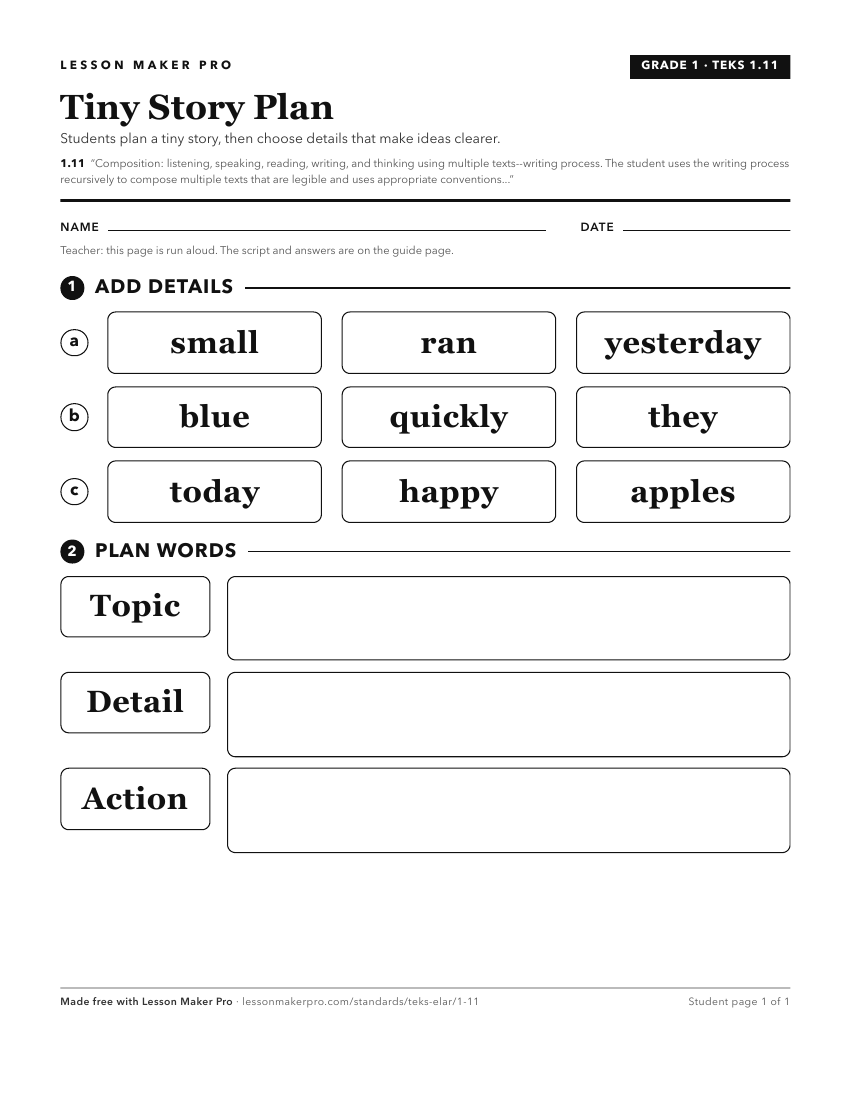
A ready-to-print activity worksheet aligned to 1.11, with an answer key for the teacher on its own page. No account needed.
PDF, US Letter, prints cleanly in black and white.
Download the worksheetKeep exploring
Related Standards
Turn this cluster into a lesson
Grade, subject, topic, and the complete cluster are prefilled. Create one free, no account needed.
Also for this cluster:Make a WorksheetMake a QuizMake a Sub Lesson