TEKS ELAR 1.11.D.ix
The Standard
punctuation marks at the end of declarative, exclamatory, and interrogative sentences
Texas Essential Knowledge and Skills for English Language Arts and Reading · edit drafts using standard English conventions, including:
Teacher's field guide
What This Standard Means
What Students Need to Do
- Students reread their own drafts one sentence at a time. They decide whether each sentence tells, asks, or shows strong feeling, then add the matching end mark.
What Mastery Looks Like
- A student correctly ends statements, questions, and sentences showing strong feeling. During editing, the student notices missing or incorrect marks and can explain each choice.
Common Misconceptions
- Students may put a period after every sentence or choose marks based only on how loudly they read. They may use a question mark whenever they see words like who or what. Some add several exclamation points instead of one.
How to Assess It
- Exit ticket: Add one end mark to each sentence: The bus is here__ Is the bus here__ Hooray, the bus is here__
Lesson moves
Ways to Teach It
Give pairs three sentence strips and period, question mark, and exclamation point cards; students read each strip aloud and place the matching card.
Write three sentences about recess: one that tells, one that asks, and one with strong feeling; partners explain each end mark.
Label three corners with punctuation marks; read a sentence, then students move to the matching corner and explain their choice.
Copy three signs from around the school without end marks; students edit each sign and discuss how punctuation changes the reader's voice.
Free download
Printable 1.11.D.ix Worksheet
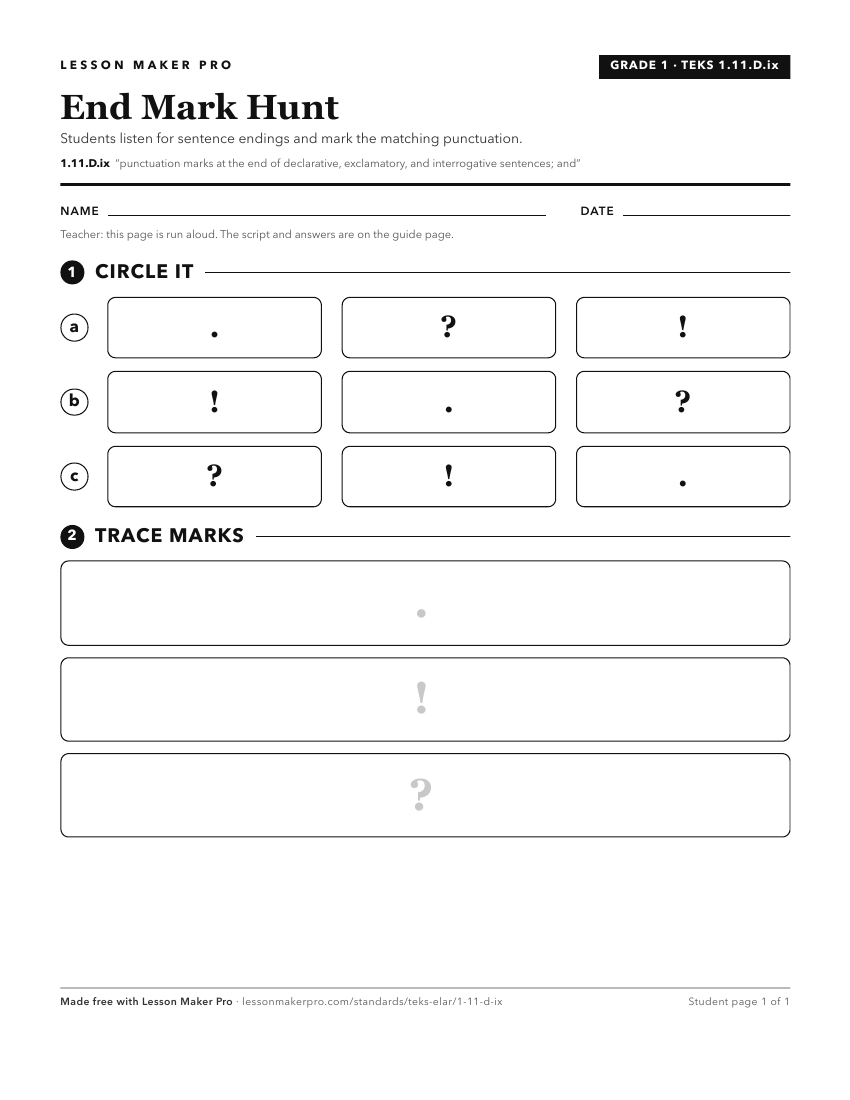
A ready-to-print activity worksheet aligned to 1.11.D.ix, with an answer key for the teacher on its own page. No account needed.
PDF, US Letter, prints cleanly in black and white.
Download the worksheetKeep exploring
Related Standards
- 5.11.D.x
punctuation marks, including commas in compound and complex sentences, quotation marks in dialogue, and italics and underlining for titles and emphasis; and
- 8.10.D.vi
punctuation, including commas in non-restrictive phrases and clauses, semicolons, colons, and parentheses; and
- K.10.D.viii
punctuation marks at the end of declarative sentences; and
- 6.10.D.viii
punctuation marks, including commas in complex sentences, transitions, and introductory elements; and
Turn this exact standard into a lesson
Grade, subject, topic, and the complete standard are prefilled. Create one free, no account needed.
Also for this standard:Make a WorksheetMake a QuizMake a Sub Lesson