TEKS ELAR K.10.D.viii
The Standard
punctuation marks at the end of declarative sentences
Texas Essential Knowledge and Skills for English Language Arts and Reading · The student uses the writing process recursively to compose multiple texts that are legible and uses appropriate conventions.
Teacher's field guide
What This Standard Means
What Students Need to Do
- Students reread their writing with an adult and find where each telling sentence ends. They add a period after each complete thought.
What Mastery Looks Like
- A student rereads a draft, notices where a telling sentence ends, and adds a period. With an adult prompt, the student can explain that the period shows the thought is finished.
Common Misconceptions
- Students may leave off the period or place it after every line rather than after the complete thought. They may also confuse periods with question marks or add several periods.
How to Assess It
- Give students three short telling sentences without punctuation. Ask them to circle where each sentence ends and add the correct mark.
Lesson moves
Ways to Teach It
Give students word cards to arrange into complete telling sentences, then place a large paper period after each finished thought.
Write “My dog is brown” and ask, “Where does the thought finish, and what mark belongs there?”
Play Period Detective by having students find and correct missing periods in five sentences posted around the room.
Examine a classroom sign or simple note, then circle the periods and discuss how they help readers know when to stop.
Free download
Printable K.10.D.viii Worksheet
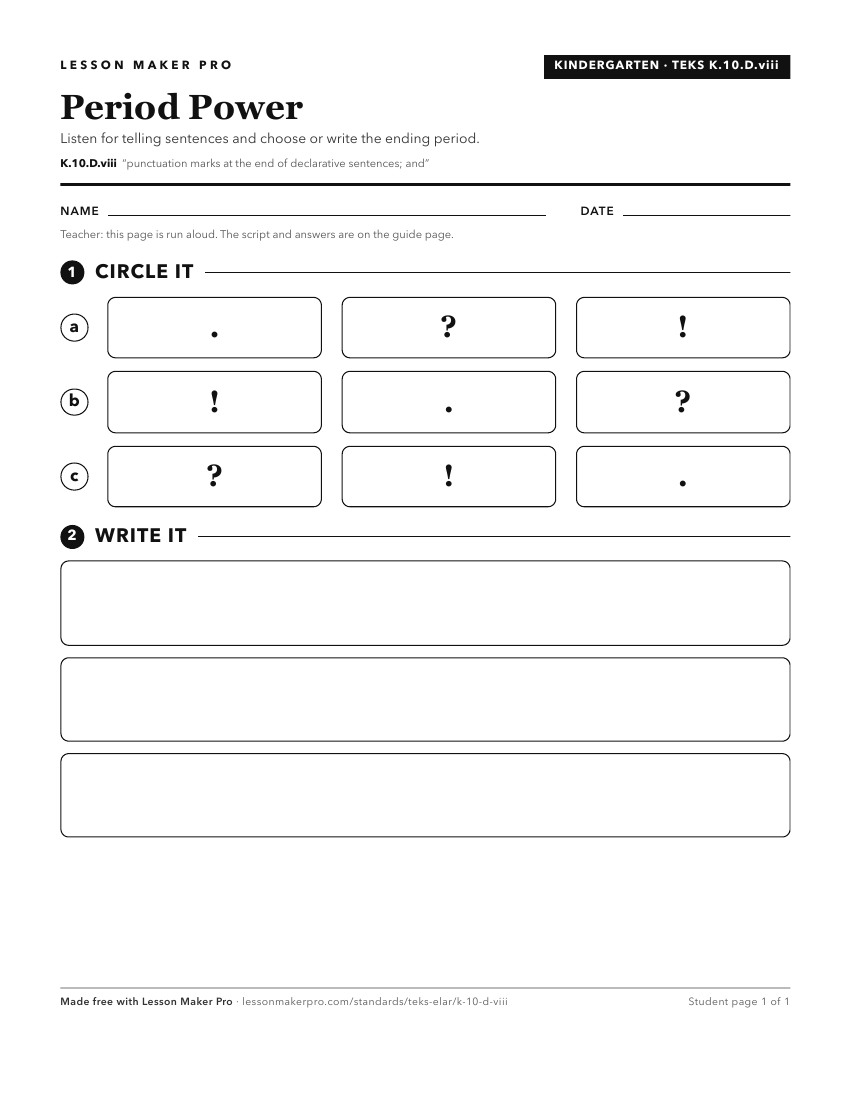
A ready-to-print activity worksheet aligned to K.10.D.viii, with an answer key for the teacher on its own page. No account needed.
PDF, US Letter, prints cleanly in black and white.
Download the worksheetKeep exploring
Related Standards
- 8.10.D.vi
punctuation, including commas in non-restrictive phrases and clauses, semicolons, colons, and parentheses; and
- 1.11.D.ix
punctuation marks at the end of declarative, exclamatory, and interrogative sentences; and
- 6.10.D.viii
punctuation marks, including commas in complex sentences, transitions, and introductory elements; and
- 4.11.D.x
punctuation marks, including apostrophes in possessives, commas in compound sentences, and quotation marks in dialogue; and
Turn this exact standard into a lesson
Grade, subject, topic, and the complete standard are prefilled. Create one free, no account needed.
Also for this standard:Make a WorksheetMake a QuizMake a Sub Lesson