Mississippi Science ZOO.2
Standard Cluster
Students will understand the structure and function of phylum Porifera and phylum Cnidaria and how each adapts to their environments. Differentiate among asymmetry, radial symmetry, and bilateral symmetry in an animal’s body plan. Identify the anatomy and physiology of a sponge, including how specialized cells within sponges work cooperatively without forming tissues to capture and digest food. Describe the importance of phylum Porifera in aquatic habitats. Create a model, either physical or digital, illustrating the anatomy of a sponge, tracing the flow of water. Enrichment: Use an engineering design process to determine the quantity of water that may be absorbed per unit in a natural sponge versus a synthetic sponge. * Contrast the polyp lifestyle of most Cnidarians with the medusa lifestyle of jellyfish, including how they both utilize a single body opening. Describe how nematocysts (stinging cells) of Cnidarians are used for capturing food and for defense. Enrichment: Utilize an engineering design process to create a simulated nematocyst, including possible biomimicry use. * Describe the ecological importance of and human impacts on coral reefs. Create a digital or physical model illustrating the anatomy of a cnidarian, citing similarities and differences between polyps and medusas.
2026 Mississippi College- and Career-Readiness Standards for Science · Phyla Porifera and Cnidaria
Cluster contents
Standards in This Cluster
ZOO.2 is a cluster heading. These are the individual standards under it.
- ZOO.2.1
Differentiate among asymmetry, radial symmetry, and bilateral symmetry in an animal’s body plan.
- ZOO.2.2
Identify the anatomy and physiology of a sponge, including how specialized cells within sponges work cooperatively without forming tissues to capture and digest...
- ZOO.2.3
Describe the importance of phylum Porifera in aquatic habitats.
- ZOO.2.4
Create a model, either physical or digital, illustrating the anatomy of a sponge, tracing the flow of water.
- ZOO.2.5
Enrichment: Use an engineering design process to determine the quantity of water that may be absorbed per unit in a natural sponge versus a synthetic sponge. *
- ZOO.2.6
Contrast the polyp lifestyle of most Cnidarians with the medusa lifestyle of jellyfish, including how they both utilize a single body opening.
- ZOO.2.7
Describe how nematocysts (stinging cells) of Cnidarians are used for capturing food and for defense.
- ZOO.2.8
Enrichment: Utilize an engineering design process to create a simulated nematocyst, including possible biomimicry use. *
- ZOO.2.9
Describe the ecological importance of and human impacts on coral reefs.
- ZOO.2.10
Create a digital or physical model illustrating the anatomy of a cnidarian, citing similarities and differences between polyps and medusas.
Teacher's field guide
What This Cluster Means
What Students Need to Do
- Students sort animal body plans as asymmetric, radial, or bilateral. They trace water through a sponge and explain how specialized cells work together to feed without forming tissues. They compare polyps and jellyfish, explain how stinging cells work, and describe how sponges and coral reefs support aquatic life.
What Mastery Looks Like
- A student labels a sponge model with pores, choanocytes, amoebocytes, and an osculum, then traces the path of water and food. They show the single body opening on both a polyp and a jellyfish and explain how stinging cells help capture prey. They can explain how damage to a coral reef affects animals that use it for shelter.
Common Misconceptions
- Students may think sponges hold water like kitchen sponges, rather than moving it through their bodies. They may assume sponges have tissues because their cells have different jobs. They may think jellyfish have separate mouths and anuses, or that coral is a plant.
How to Assess It
- On an exit ticket, give students a simple sponge outline. Ask them to draw and label the water path, name the cells that catch food, and state one difference between a polyp and a jellyfish.
Lesson moves
Ways to Teach It
Build a sponge from clay and beads; mark pores, choanocytes, amoebocytes, and osculum, then trace water and food paths with yarn.
Draw an attached coral polyp and a swimming jellyfish, then write how each uses one opening and stinging cells to eat.
Sort cards showing an irregular sponge, jellyfish, butterfly, and earthworm by body symmetry, then explain one choice to a partner.
Show a photo of muddy runoff entering a reef and ask students to trace how sediment could harm coral and reduce fish shelter.
Free download
Printable ZOO.2 Worksheet
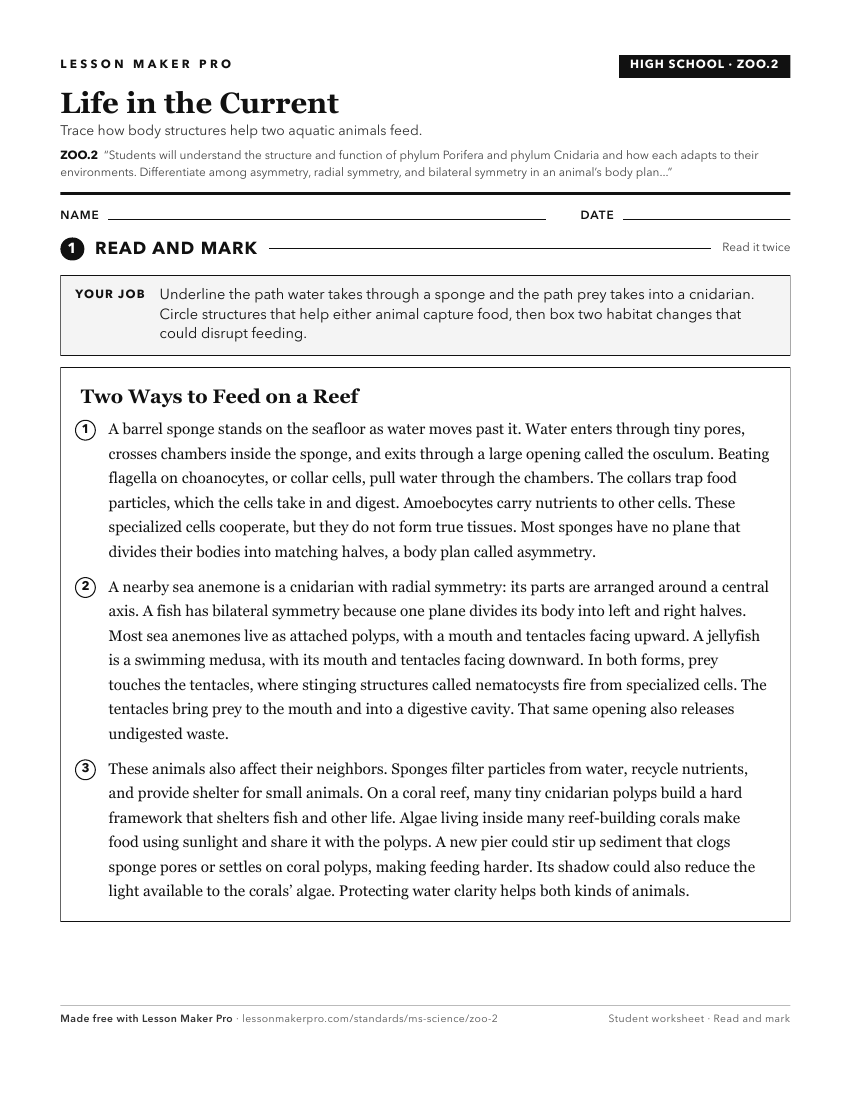
A ready-to-print activity worksheet aligned to ZOO.2, with an answer key for the teacher on its own page. No account needed.
PDF, US Letter, prints cleanly in black and white.
Download the worksheetKeep exploring
Related Standards
- ZOO.3
Students will understand the structure and function of phylum Mollusca, and how they adapt to their environments.
- ZOO.4
Students will describe the evolution of structure and function of phylum Platyhelminthes, phylum Nematoda, and phylum Annelida.
- ZOO.6
Students will understand the structure and function of phylum Echinodermata, and how they demonstrate the characteristics of living things.
- ZOO.5
Students will understand the basic structure and function of phylum Arthropoda, and how they demonstrate the characteristics of living things.
Turn this cluster into a lesson
Grade, subject, topic, and the complete cluster are prefilled. Create one free, no account needed.
Also for this cluster:Make a WorksheetMake a QuizMake a Sub Lesson