Mississippi Science ZOO.2.4
The Standard
- ZOO.2
- Students will understand the structure and function of phylum Porifera and phylum Cnidaria and how each adapts to their environments.
Create a model, either physical or digital, illustrating the anatomy of a sponge, tracing the flow of water.
2026 Mississippi College- and Career-Readiness Standards for Science · Phyla Porifera and Cnidaria
Teacher's field guide
What This Standard Means
What Students Need to Do
- Students build a physical or digital model of a simple sponge. They label its parts and trace water from side pores, through the central cavity, and out the top opening.
What Mastery Looks Like
- A student labels the ostia, spongocoel, choanocytes, and osculum. Their arrows show water entering the ostia, passing the choanocytes, and leaving the osculum. They explain that choanocytes move water and catch food.
Common Misconceptions
- Students may draw water entering through the osculum and leaving through the side pores. They may mistake the central cavity for a stomach or leave choanocytes out of the model.
How to Assess It
- Give students a blank outline of a simple sponge. Ask them to label the ostia, spongocoel, choanocytes, and osculum, draw water-flow arrows, and explain what choanocytes do.
Lesson moves
Ways to Teach It
Build a hollow clay sponge with side pores and a top opening, then thread blue yarn through it to show water flow.
Show a sponge diagram with reversed arrows and ask students to write which arrows they would change and why.
Give pairs four label cards and arrow stickers to place on a blank sponge diagram, then have them check each other's work.
Show a photo of a sponge attached to a reef and ask students to mark where food-rich water enters and exits.
Free download
Printable ZOO.2.4 Worksheet
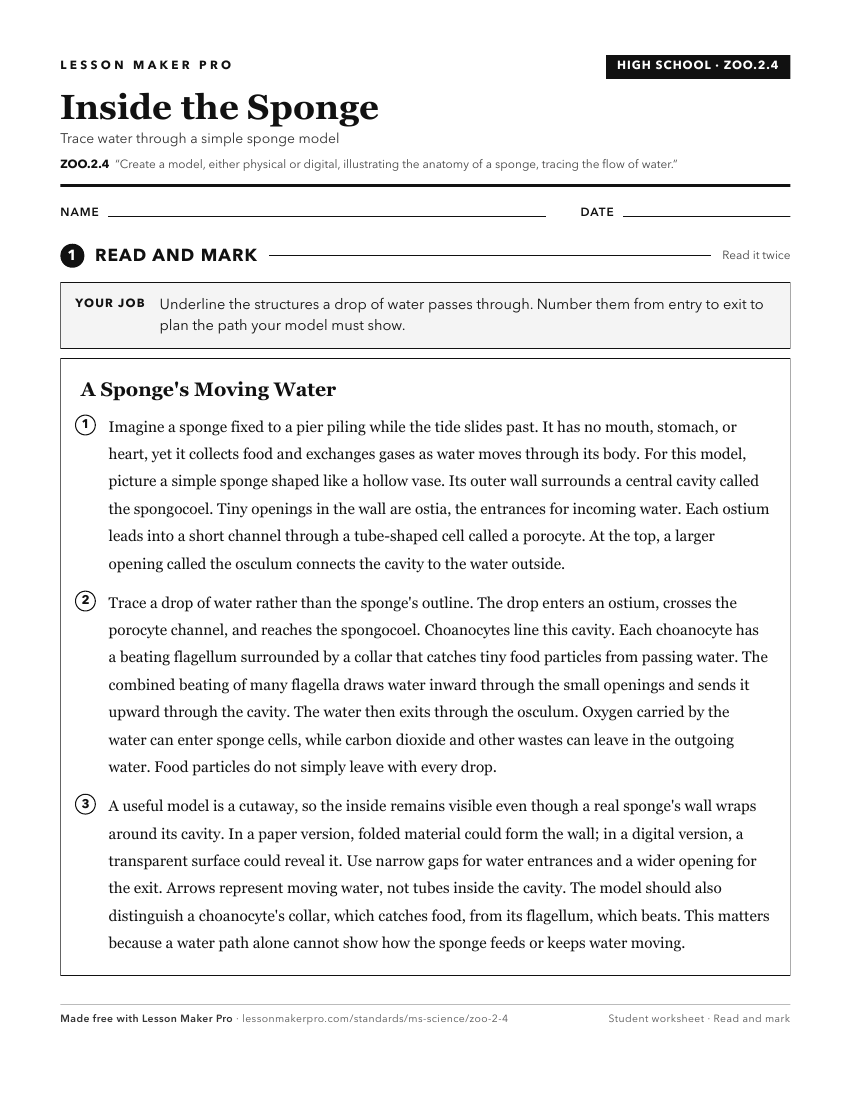
A ready-to-print activity worksheet aligned to ZOO.2.4, with an answer key for the teacher on its own page. No account needed.
PDF, US Letter, prints cleanly in black and white.
Download the worksheetKeep exploring
Related Standards
- HAP.14.5
Develop and use models to illustrate the path of urine through the urinary tract.
- E.4.9C.2
Develop and use models of natural processes to explain the effect of the movement of water on the ocean shore zone, including beaches, barrier islands, estuarie...
- ZOO.2.5
Enrichment: Use an engineering design process to determine the quantity of water that may be absorbed per unit in a natural sponge versus a synthetic sponge. *
- ZOO.2.10
Create a digital or physical model illustrating the anatomy of a cnidarian, citing similarities and differences between polyps and medusas.
Turn this exact standard into a lesson
Grade, subject, topic, and the complete standard are prefilled. Create one free, no account needed.
Also for this standard:Make a WorksheetMake a QuizMake a Sub Lesson