Mississippi Science ZOO.2.10
The Standard
- ZOO.2
- Students will understand the structure and function of phylum Porifera and phylum Cnidaria and how each adapts to their environments.
Create a digital or physical model illustrating the anatomy of a cnidarian, citing similarities and differences between polyps and medusas.
2026 Mississippi College- and Career-Readiness Standards for Science · Phyla Porifera and Cnidaria
Teacher's field guide
What This Standard Means
What Students Need to Do
- Students build labeled models of a polyp and a medusa. They show the mouth, tentacles, and central cavity, then explain what the forms share and how they differ.
What Mastery Looks Like
- Both models show tentacles around a single mouth and a central gastrovascular cavity. The polyp is attached with its mouth facing up. The medusa has a bell shape and its mouth faces down.
Common Misconceptions
- Students may draw a separate mouth and anus, though cnidarians have one opening. They may put tentacles only on medusas or assume every cnidarian has both forms.
How to Assess It
- On an index card, draw and label a polyp and a medusa. Mark the mouth, tentacles, and cavity on each, then write one similarity and one difference.
Lesson moves
Ways to Teach It
Build a clay polyp and a paper-cup medusa, using pipe cleaners for tentacles and a cutaway to show each cavity.
Show photos of a sea anemone and a jellyfish, then ask: Which parts match, and which way does each mouth face?
Give pairs anatomy label cards to place on blank polyp and medusa diagrams, then have them check each other's work.
Use a printed jellyfish warning sign; mark stinging cells on both models' tentacles and explain why touching either form could sting.
Free download
Printable ZOO.2.10 Worksheet
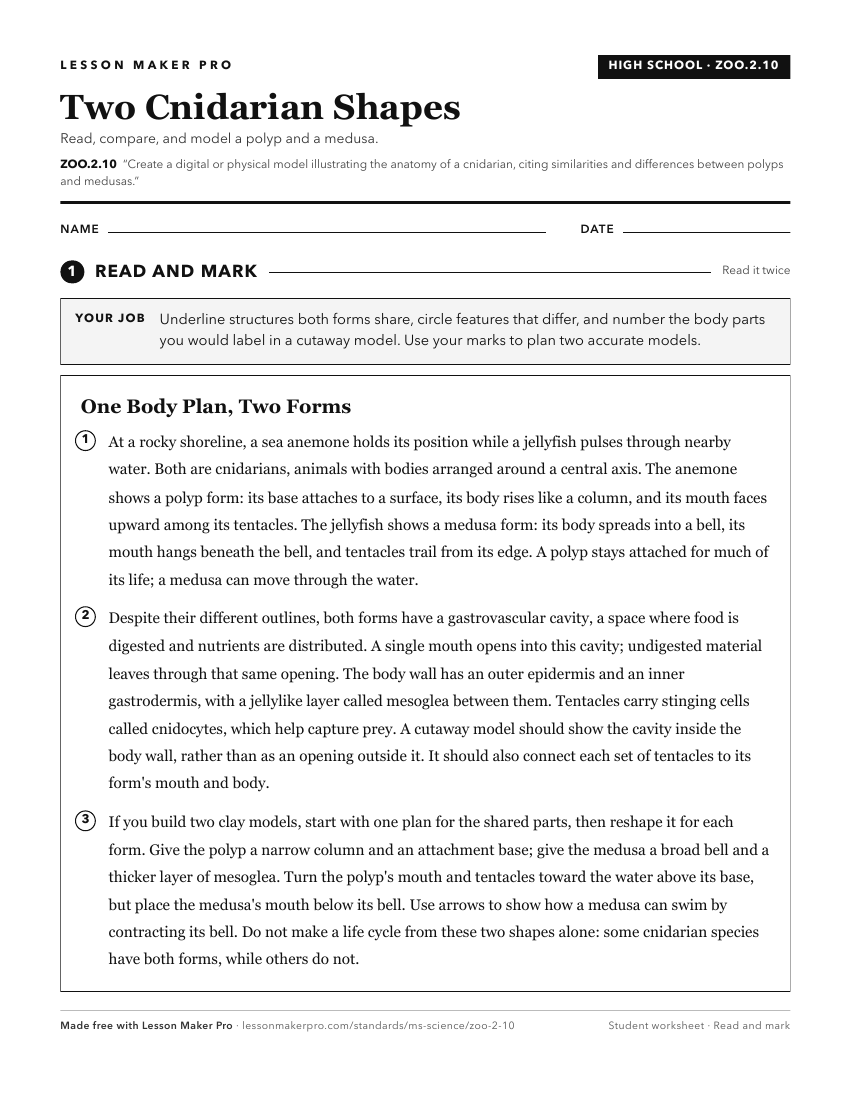
A ready-to-print activity worksheet aligned to ZOO.2.10, with an answer key for the teacher on its own page. No account needed.
PDF, US Letter, prints cleanly in black and white.
Download the worksheetKeep exploring
Related Standards
- MAQ.6.6
Dissect representative taxa (e.g., clam and squid), collect data, compare their internal and external anatomy, analyze, explain, and communicate results.
- ZOO.2.4
Create a model, either physical or digital, illustrating the anatomy of a sponge, tracing the flow of water.
- ZOO.3.7
Create a model comparing the anatomy of gastropods, bivalves, and cephalopods.
- ZOO.2.6
Contrast the polyp lifestyle of most Cnidarians with the medusa lifestyle of jellyfish, including how they both utilize a single body opening.
Turn this exact standard into a lesson
Grade, subject, topic, and the complete standard are prefilled. Create one free, no account needed.
Also for this standard:Make a WorksheetMake a QuizMake a Sub Lesson