Mississippi Science ZOO.2.6
The Standard
- ZOO.2
- Students will understand the structure and function of phylum Porifera and phylum Cnidaria and how each adapts to their environments.
Contrast the polyp lifestyle of most Cnidarians with the medusa lifestyle of jellyfish, including how they both utilize a single body opening.
2026 Mississippi College- and Career-Readiness Standards for Science · Phyla Porifera and Cnidaria
Teacher's field guide
What This Standard Means
What Students Need to Do
- Students compare an attached, mouth-up polyp with a swimming, mouth-down medusa. They trace food entering and undigested waste leaving through the same opening in both.
What Mastery Looks Like
- Given drawings of a sea anemone and a jellyfish, students identify the polyp and medusa by body shape and position. They mark the opening on each and show food going in and waste coming out.
Common Misconceptions
- Students may draw a separate anus on a jellyfish or think waste leaves through its tentacles. They may call every polyp a baby jellyfish, missing that sea anemones remain polyps as adults.
How to Assess It
- Show drawings of an attached sea anemone and a swimming jellyfish. Ask students to name each body form, mark its opening, and draw arrows for food entering and waste leaving.
Lesson moves
Ways to Teach It
Tape yarn tentacles to two paper cups; stand one opening-up on a desk and hang one opening-down from string.
Ask: How does food enter and undigested waste leave a sea anemone and a jellyfish if each has only one opening?
Give pairs six cards labeled attached, swimming, mouth up, mouth down, sea anemone, and jellyfish; have them sort by polyp or medusa.
Show photos of an anemone on a pier piling and a jellyfish offshore; ask how each positions its tentacles to catch prey.
Free download
Printable ZOO.2.6 Worksheet
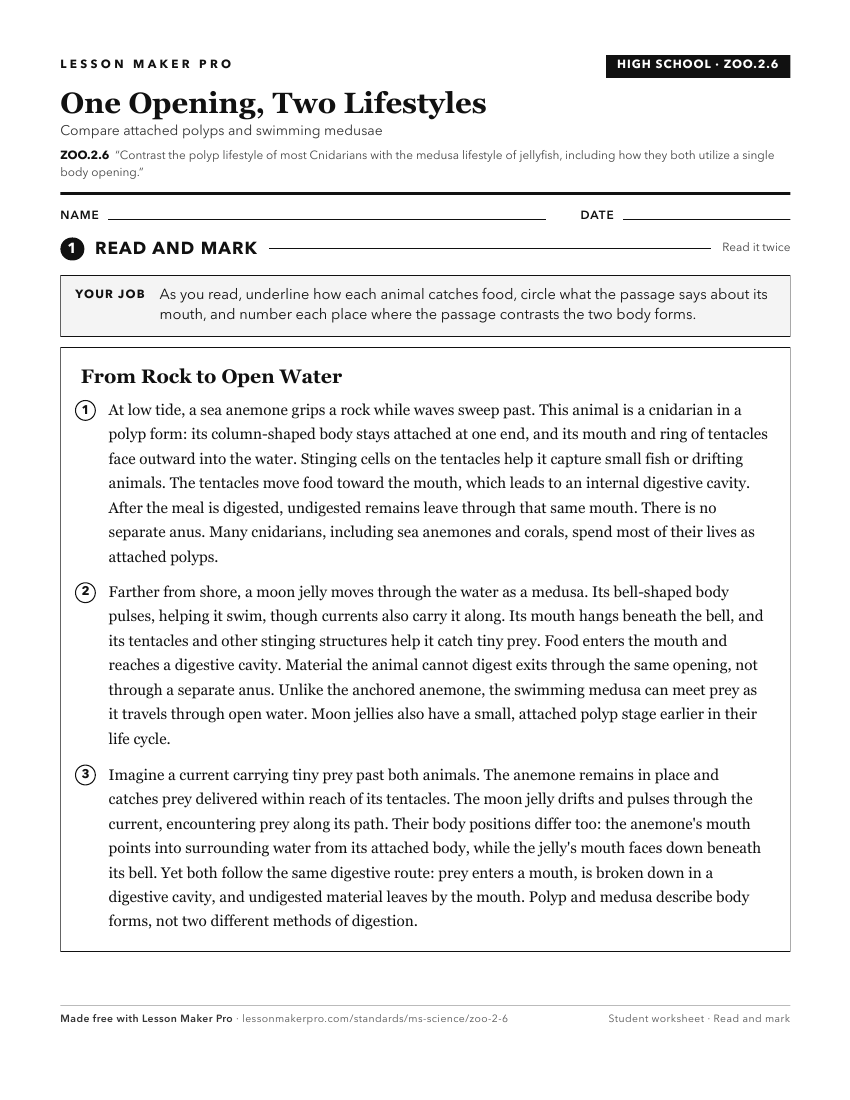
A ready-to-print activity worksheet aligned to ZOO.2.6, with an answer key for the teacher on its own page. No account needed.
PDF, US Letter, prints cleanly in black and white.
Download the worksheetKeep exploring
Related Standards
- ZOO.2.7
Describe how nematocysts (stinging cells) of Cnidarians are used for capturing food and for defense.
- MAQ.6.5
Explain various life cycles found among animals (e.g., polyp and medusa in cnidarians, multiple hosts and stages in the platyhelminthic life cycle, and arthropo...
- MAQ.6.4
Compare and contrast major body plans (e.g., asymmetry, radial, bilateral symmetry, acoelomate, pseudocoelomate, and eucoelomate).
- ZOO.2.10
Create a digital or physical model illustrating the anatomy of a cnidarian, citing similarities and differences between polyps and medusas.
Turn this exact standard into a lesson
Grade, subject, topic, and the complete standard are prefilled. Create one free, no account needed.
Also for this standard:Make a WorksheetMake a QuizMake a Sub Lesson