Mississippi Science ZOO.2.7
The Standard
- ZOO.2
- Students will understand the structure and function of phylum Porifera and phylum Cnidaria and how each adapts to their environments.
Describe how nematocysts (stinging cells) of Cnidarians are used for capturing food and for defense.
2026 Mississippi College- and Career-Readiness Standards for Science · Phyla Porifera and Cnidaria
Teacher's field guide
What This Standard Means
What Students Need to Do
- Students explain how a cnidarian uses stinging cells on its tentacles to catch prey and defend itself. They describe how a nematocyst fires a thread that can deliver venom.
What Mastery Looks Like
- A student can trace what happens when a shrimp touches a jellyfish tentacle: the thread fires, the shrimp is immobilized, and the tentacle moves it to the mouth. They can explain how the same sting may deter a predator.
Common Misconceptions
- Students may call the nematocyst a whole cell, rather than a capsule inside a stinging cell. They may also think the thread pulls prey into the mouth or that stings are used only for defense.
How to Assess It
- Ask students to sketch a tentacle touching a shrimp. Have them label the stinging cell, nematocyst, and fired thread, then write one sentence explaining how it helps catch food.
Lesson moves
Ways to Teach It
Build a tentacle model with a paper cup, coiled string, and Velcro; pull out the string to snag a pom-pom shrimp.
Ask: How could one jellyfish tentacle help catch a shrimp but protect the jellyfish from a fish?
Give pairs shrimp, fish, and swimmer scenario cards to sort by food capture or defense, then have them explain each choice.
Show a beach jellyfish warning sign and ask students why touching a washed-up tentacle could still cause a sting.
Free download
Printable ZOO.2.7 Worksheet
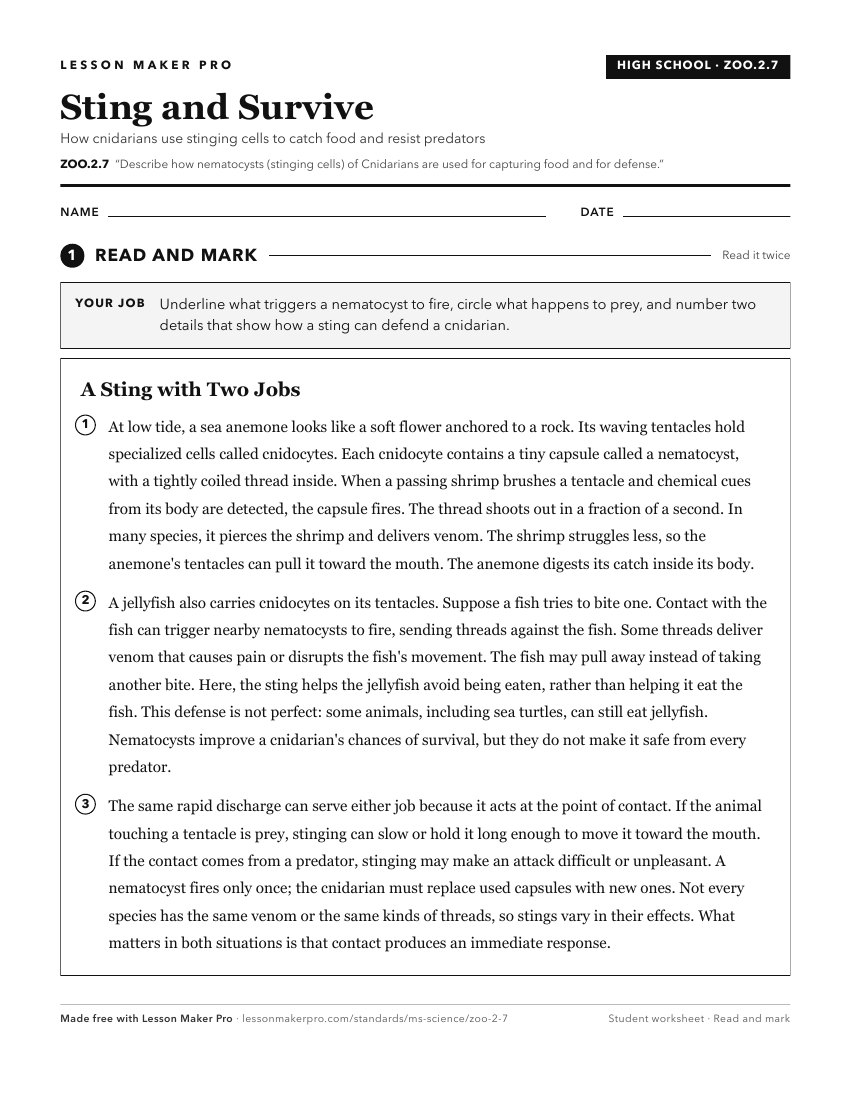
A ready-to-print activity worksheet aligned to ZOO.2.7, with an answer key for the teacher on its own page. No account needed.
PDF, US Letter, prints cleanly in black and white.
Download the worksheetKeep exploring
Related Standards
- ZOO.3.4
Describe how the radula is used in feeding.
- ZOO.6.3
Describe sea urchins’ and sea cucumbers’ defense structures and behaviors.
- ZOO.8.5
Describe how snakes use chemosensory to locate and track prey.
- ZOO.2.6
Contrast the polyp lifestyle of most Cnidarians with the medusa lifestyle of jellyfish, including how they both utilize a single body opening.
Turn this exact standard into a lesson
Grade, subject, topic, and the complete standard are prefilled. Create one free, no account needed.
Also for this standard:Make a WorksheetMake a QuizMake a Sub Lesson