Mississippi Science ZOO.8.5
The Standard
- ZOO.8
- Students will understand the structure and function of phylum Chordata, classes Amphibia and Reptilia, and how they demonstrate the characteristics of living things.
Describe how snakes use chemosensory to locate and track prey.
2026 Mississippi College- and Career-Readiness Standards for Science · Phylum Chordata, Classes Amphibia, and Reptilia
Teacher's field guide
What This Standard Means
What Students Need to Do
- Students explain how a snake flicks its forked tongue to collect chemicals from the air and ground. They describe how the tongue carries those samples to the vomeronasal organ in the roof of the mouth.
What Mastery Looks Like
- Given a diagram with stronger prey chemicals on one side, a student predicts which way the snake will turn. They explain how comparing samples from the two tongue tips helps it follow prey it cannot see.
Common Misconceptions
- Students may think the tongue detects chemicals on its own or that its fork grabs prey. Some think all snakes track prey using heat-sensing pits, but not all snakes have them.
How to Assess It
- Exit ticket: A snake’s left tongue tip collects more prey chemicals than its right. Which way should it turn, and which organ checks the samples?
Lesson moves
Ways to Teach It
Tape a paper mouse trail to a desk; pairs compare chemical-strength cards on each side and steer a paper snake with a forked tongue.
Ask students to write why tongue flicks can reveal a hidden mouse trail and name the organ that detects the samples.
Give pairs three trail diagrams with different left and right chemical readings; have partners race to choose each snake’s next turn.
On a barn floor map with a marked mouse path, have students draw where a snake would sample chemical traces to follow it.
Free download
Printable ZOO.8.5 Worksheet
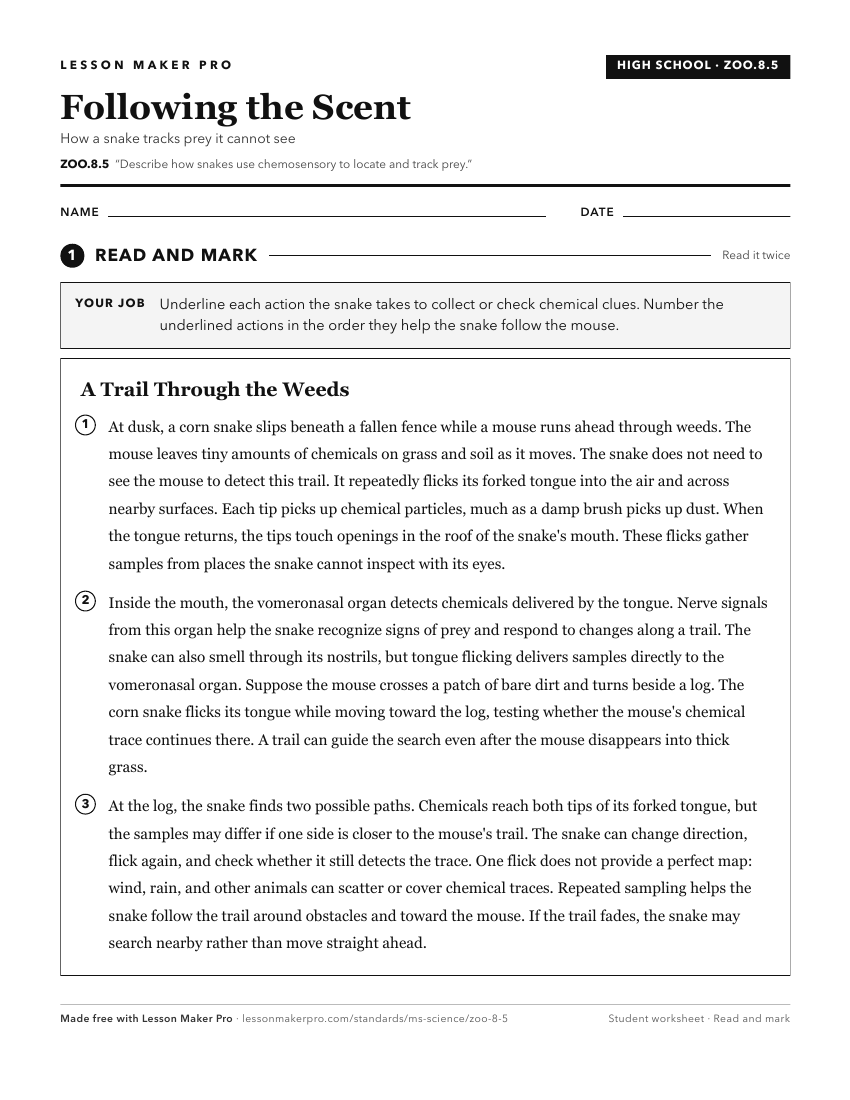
A ready-to-print activity worksheet aligned to ZOO.8.5, with an answer key for the teacher on its own page. No account needed.
PDF, US Letter, prints cleanly in black and white.
Download the worksheetKeep exploring
Related Standards
- L.K.1B.2
Identify and describe examples of how animals use their sensory body parts (eyes to detect light and movement, ears to detect sound, skin to detect temperature ...
- ZOO.9.5
Explain how birds of prey use their keen sense of sight to locate and attack prey.
- ZOO.2.7
Describe how nematocysts (stinging cells) of Cnidarians are used for capturing food and for defense.
- ZOO.7.4
Describe how the body and jaw design of sharks make them adept predators.
Turn this exact standard into a lesson
Grade, subject, topic, and the complete standard are prefilled. Create one free, no account needed.
Also for this standard:Make a WorksheetMake a QuizMake a Sub Lesson