Mississippi Science L.K.1B.2
The Standard
- L.K.1B
- Students will demonstrate an understanding of how animals (including humans) use their physical features and their senses to learn about their environment.
Identify and describe examples of how animals use their sensory body parts (eyes to detect light and movement, ears to detect sound, skin to detect temperature and touch, tongue to taste, and nose to detect smell).
2026 Mississippi College- and Career-Readiness Standards for Science · Hierarchical Organization
Teacher's field guide
What This Standard Means
What Students Need to Do
- Students name the body parts animals use to notice light, movement, sound, touch, warmth, tastes, and smells. They tell what an animal notices with each part.
What Mastery Looks Like
- Given a picture of a dog sniffing food, a student says its nose detects the smell. They can also explain that eyes spot movement, ears hear sounds, skin feels warmth or touch, and a tongue tastes food.
Common Misconceptions
- Some students say a nose tastes food or a tongue smells it. Others name fur instead of the skin beneath it as the part that feels warmth and touch.
How to Assess It
- Show a picture of a dog. Ask students which parts help it see a moving ball, hear a bell, feel a warm blanket, taste food, and smell food.
Lesson moves
Ways to Teach It
Place a stuffed rabbit by a wall, move a flashlight spot across the wall, then ring a bell; children point to its eyes or ears.
Show a picture of a cat sniffing a bowl and ask, 'What does its nose help it notice?'
Match picture cards of a dog hearing a bell, a cat smelling food, and a lizard feeling warm sand to body-part cards.
At lunch, ask children to notice their food's smell, then name the part a dog uses to smell its dinner.
Free download
Printable L.K.1B.2 Worksheet
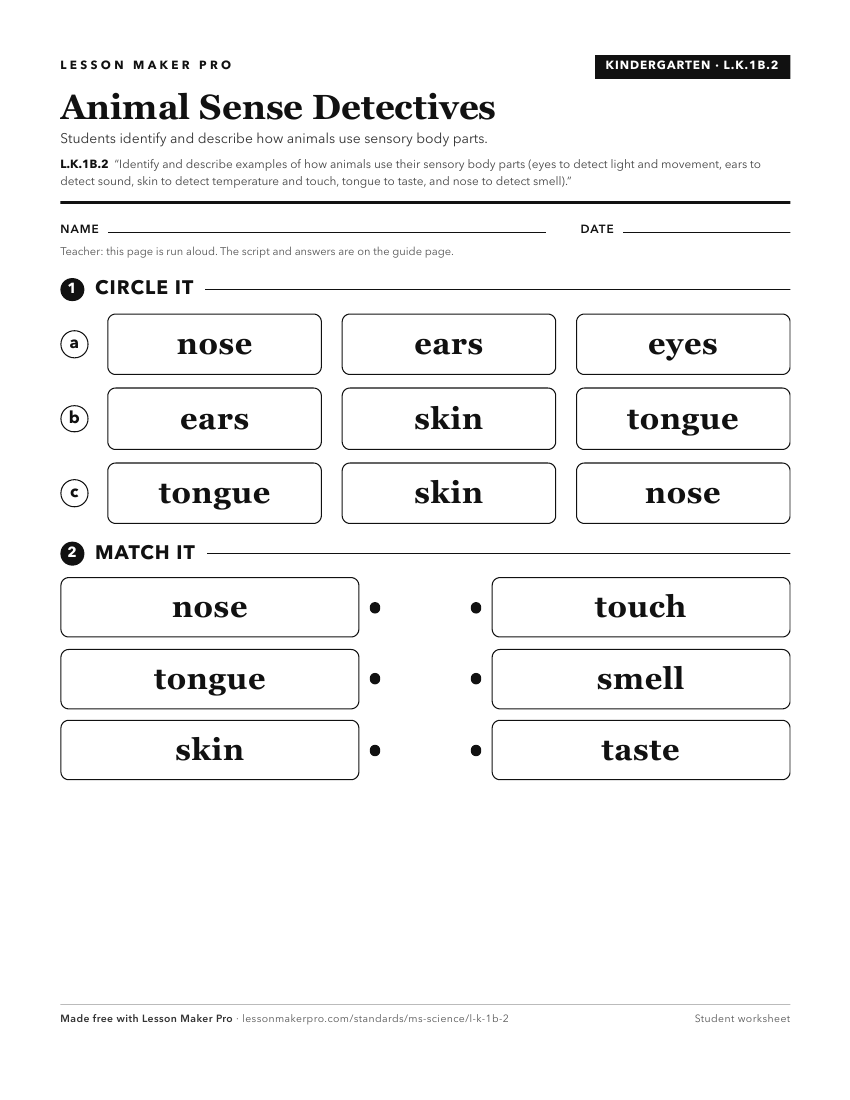
A ready-to-print activity worksheet aligned to L.K.1B.2, with an answer key for the teacher on its own page. No account needed.
PDF, US Letter, prints cleanly in black and white.
Download the worksheetKeep exploring
Related Standards
- L.K.1B.1
Develop and use models to exemplify how animals use their body parts to (a) obtain food and other resources, (b) protect themselves, and (c) move from place to ...
- L.3.1.1
Examine evidence to communicate information that the internal and external structures of animals (e.g., heart, stomach, bone, lung, brain, skin, ears, appendage...
- L.K.1B
Students will demonstrate an understanding of how animals (including humans) use their physical features and their senses to learn about their environment.
- L.3.1.3
Obtain and communicate examples of physical features or behaviors of vertebrates and invertebrates and how these characteristics help them survive in particular...
Turn this exact standard into a lesson
Grade, subject, topic, and the complete standard are prefilled. Create one free, no account needed.
Also for this standard:Make a WorksheetMake a QuizMake a Sub Lesson