Mississippi Science L.3.1.1
The Standard
- L.3.1
- Students will demonstrate an understanding of internal and external structures in plants and animals and how they relate to their growth, survival, behavior, and reproduction within an environment.
Examine evidence to communicate information that the internal and external structures of animals (e.g., heart, stomach, bone, lung, brain, skin, ears, appendages) function to support survival, growth, and behavior.
2026 Mississippi College- and Career-Readiness Standards for Science · Hierarchical Organization
Teacher's field guide
What This Standard Means
What Students Need to Do
- Students identify parts on the outside and inside of an animal. They use photos, diagrams, or observations to explain how those parts help the animal live, grow, or respond to its surroundings.
What Mastery Looks Like
- Given a rabbit photo and body diagram, a student identifies ears as external and lungs as internal. They explain that ears help detect danger and lungs take in air. They can also explain how the stomach breaks down food the rabbit needs to grow.
Common Misconceptions
- Students may label lungs as external because air enters through the nose. They may say a stomach makes food, rather than breaking it down. Others name a body part without explaining how it helps the animal.
How to Assess It
- Show a rabbit photo with raised ears near a fox and a body diagram with arrows showing air entering its lungs. Ask students to name one outside and one inside part, then use a detail from each image to explain how the parts help the rabbit survive.
Lesson moves
Ways to Teach It
Give pairs a rabbit photo, body diagram, and paper cutouts of ears, lungs, and stomach; have them place each cutout and label its job.
Show a rabbit photo and body diagram, then ask: How do its ears and lungs help it survive, and what evidence supports your answer?
Play a card match with pictures of animal parts and their jobs; students explain each match before keeping the pair.
Show a photo of a dog panting after a walk; ask students how its tongue helps keep it cool.
Free download
Printable L.3.1.1 Worksheet
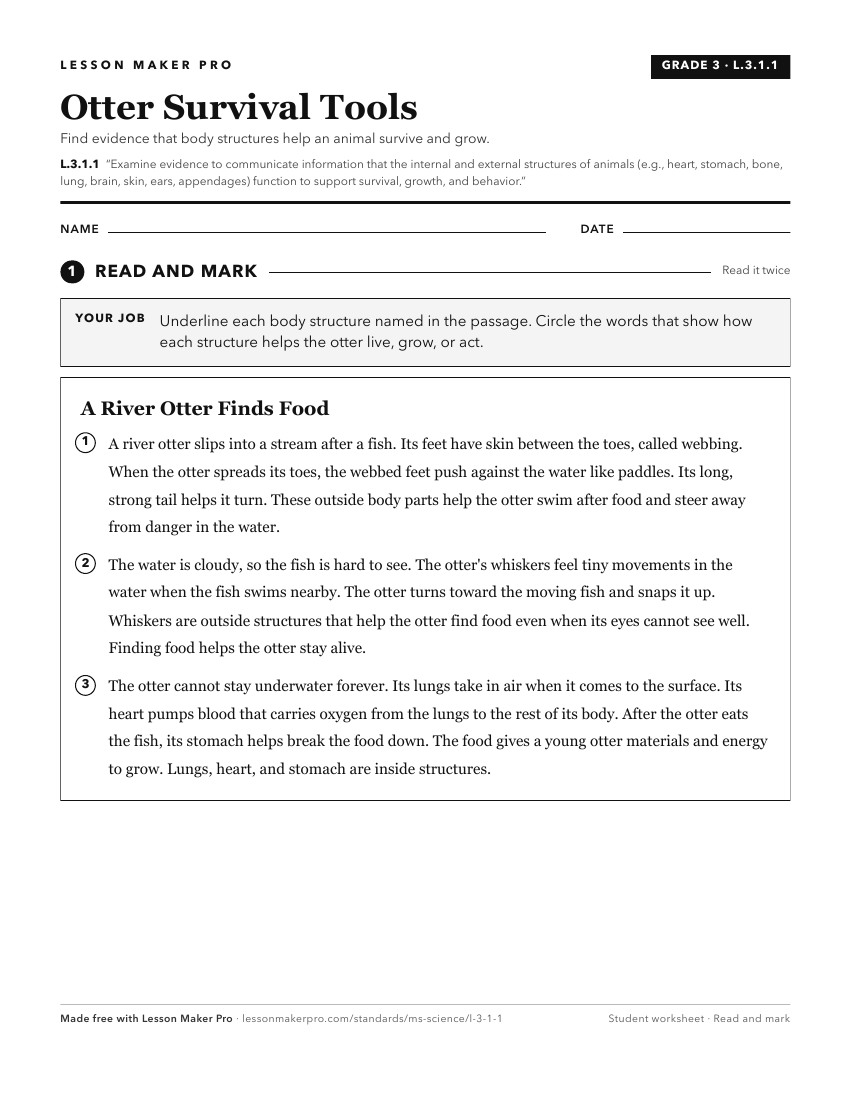
A ready-to-print activity worksheet aligned to L.3.1.1, with an answer key for the teacher on its own page. No account needed.
PDF, US Letter, prints cleanly in black and white.
Download the worksheetKeep exploring
Related Standards
- L.K.1B.1
Develop and use models to exemplify how animals use their body parts to (a) obtain food and other resources, (b) protect themselves, and (c) move from place to ...
- L.6.1.2
Obtain and communicate evidence to support the cell theory.
- L.3.1.2
Examine evidence to communicate information that the internal and external structures of plants (e.g., thorns, leaves, stems, roots, or colored petals) function...
- L.3.1
Students will demonstrate an understanding of internal and external structures in plants and animals and how they relate to their growth, survival, behavior, an...
Turn this exact standard into a lesson
Grade, subject, topic, and the complete standard are prefilled. Create one free, no account needed.
Also for this standard:Make a WorksheetMake a QuizMake a Sub Lesson