Mississippi Science L.K.1B.1
The Standard
- L.K.1B
- Students will demonstrate an understanding of how animals (including humans) use their physical features and their senses to learn about their environment.
Develop and use models to exemplify how animals use their body parts to (a) obtain food and other resources, (b) protect themselves, and (c) move from place to place.
2026 Mississippi College- and Career-Readiness Standards for Science · Hierarchical Organization
Teacher's field guide
What This Standard Means
What Students Need to Do
- Students draw or build an animal and show how its body parts help it get food or water, stay safe, and move. They point to each part and explain its job.
What Mastery Looks Like
- A student can draw a turtle with a mouth, shell, and legs. They can explain that it uses its mouth to eat plants, its shell for protection, and its legs to walk.
Common Misconceptions
- Students may say a turtle's shell helps it walk or name a body part without explaining what it does. Some draw the same parts on every animal, such as wings on a turtle.
How to Assess It
- Give students a turtle outline. Ask them to circle its mouth, shell, and legs, then tell you what each part helps the turtle do.
Lesson moves
Ways to Teach It
Give pairs clay to build a turtle with a mouth, shell, and legs; have them point to each part and explain its job.
Show a photo of a duck eating in a pond; ask, 'How does its beak help it eat, and how do its feet help it move?'
Lay out turtle mouth, shell, and leg cards; students match each to eating, staying safe, or walking, then explain their choices.
Show a photo of a squirrel holding an acorn; students sketch its paws carrying food and gripping a tree.
Free download
Printable L.K.1B.1 Worksheet
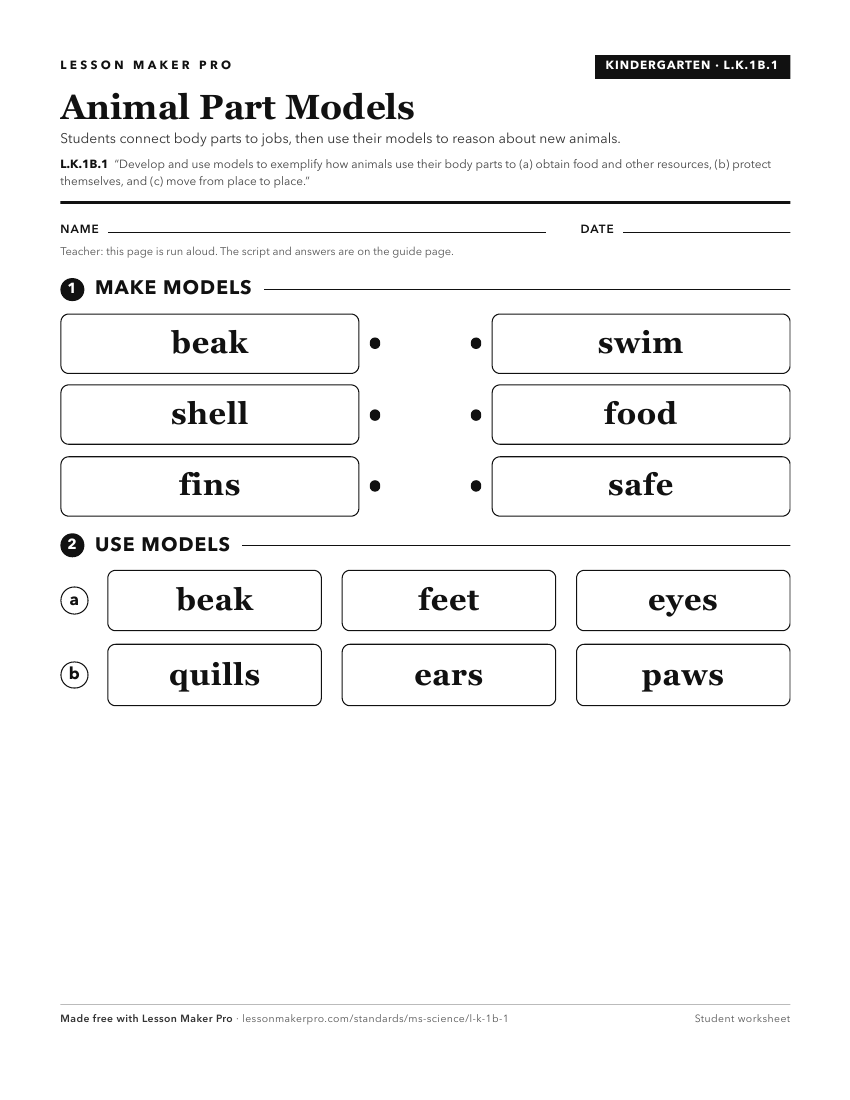
A ready-to-print activity worksheet aligned to L.K.1B.1, with an answer key for the teacher on its own page. No account needed.
PDF, US Letter, prints cleanly in black and white.
Download the worksheetKeep exploring
Related Standards
- L.K.1B.2
Identify and describe examples of how animals use their sensory body parts (eyes to detect light and movement, ears to detect sound, skin to detect temperature ...
- L.4.2.2
Develop and use models to explain the unique and diverse life cycles of organisms other than humans (e.g., flowering plants, frogs, or butterflies) including co...
- L.6.1.6
Develop and use models to show relationships among the increasing complexity of multicellular organisms (cells, tissues, organs, organ systems, organisms) and h...
- BIO.1C.1
Develop and use models to explore how specialized structures within cells (e.g., nucleus, cytoskeleton, endoplasmic reticulum, ribosomes, Golgi apparatus, lysos...
Turn this exact standard into a lesson
Grade, subject, topic, and the complete standard are prefilled. Create one free, no account needed.
Also for this standard:Make a WorksheetMake a QuizMake a Sub Lesson