Mississippi Science L.3.1
Standard Cluster
Students will demonstrate an understanding of internal and external structures in plants and animals and how they relate to their growth, survival, behavior, and reproduction within an environment. Examine evidence to communicate information that the internal and external structures of animals (e.g., heart, stomach, bone, lung, brain, skin, ears, appendages) function to support survival, growth, and behavior. Examine evidence to communicate information that the internal and external structures of plants (e.g., thorns, leaves, stems, roots, or colored petals) function to support survival, growth, behavior, and reproduction. Obtain and communicate examples of physical features or behaviors of vertebrates and invertebrates and how these characteristics help them survive in particular environments (e.g., animals hibernate, migrate, or estivate to stay alive when food is scarce, or temperatures are not favorable).
2026 Mississippi College- and Career-Readiness Standards for Science · Hierarchical Organization
Cluster contents
Standards in This Cluster
L.3.1 is a cluster heading. These are the individual standards under it.
- L.3.1.1
Examine evidence to communicate information that the internal and external structures of animals (e.g., heart, stomach, bone, lung, brain, skin, ears, appendage...
- L.3.1.2
Examine evidence to communicate information that the internal and external structures of plants (e.g., thorns, leaves, stems, roots, or colored petals) function...
- L.3.1.3
Obtain and communicate examples of physical features or behaviors of vertebrates and invertebrates and how these characteristics help them survive in particular...
Teacher's field guide
What This Cluster Means
What Students Need to Do
- Students use pictures and observations to explain how plant and animal parts help living things survive and grow. They explain how flowers help plants make seeds. They compare animals with and without backbones and connect features or behaviors to survival in a habitat.
What Mastery Looks Like
- A student explains that roots take in water, leaves make food, and lungs take in air. They explain how bright petals attract pollinators and how migration helps birds find food. They identify a bird as having a backbone and a snail as not having one.
Common Misconceptions
- Students may think roots eat soil or that bright petals only make flowers look pretty. They may mistake a snail’s shell for a backbone. They may describe migration as a body part rather than a behavior.
How to Assess It
- Give students a seedling photo, a bird skeleton diagram, and a snail photo. Ask how one part on each helps it survive and which animals have backbones.
Lesson moves
Ways to Teach It
Gently lift a store-bought seedling from its pot, inspect roots and leaves, then sketch how each helps the plant.
Show a photo of a bee on a flower and ask partners how bright petals might help the plant make seeds.
Give pairs cards showing lungs, a shell, roots, a backbone, and migration; have them match each to a survival benefit.
Use a local bird migration map and monthly sightings chart to ask why some birds leave when insects become scarce.
Free download
Printable L.3.1 Worksheet
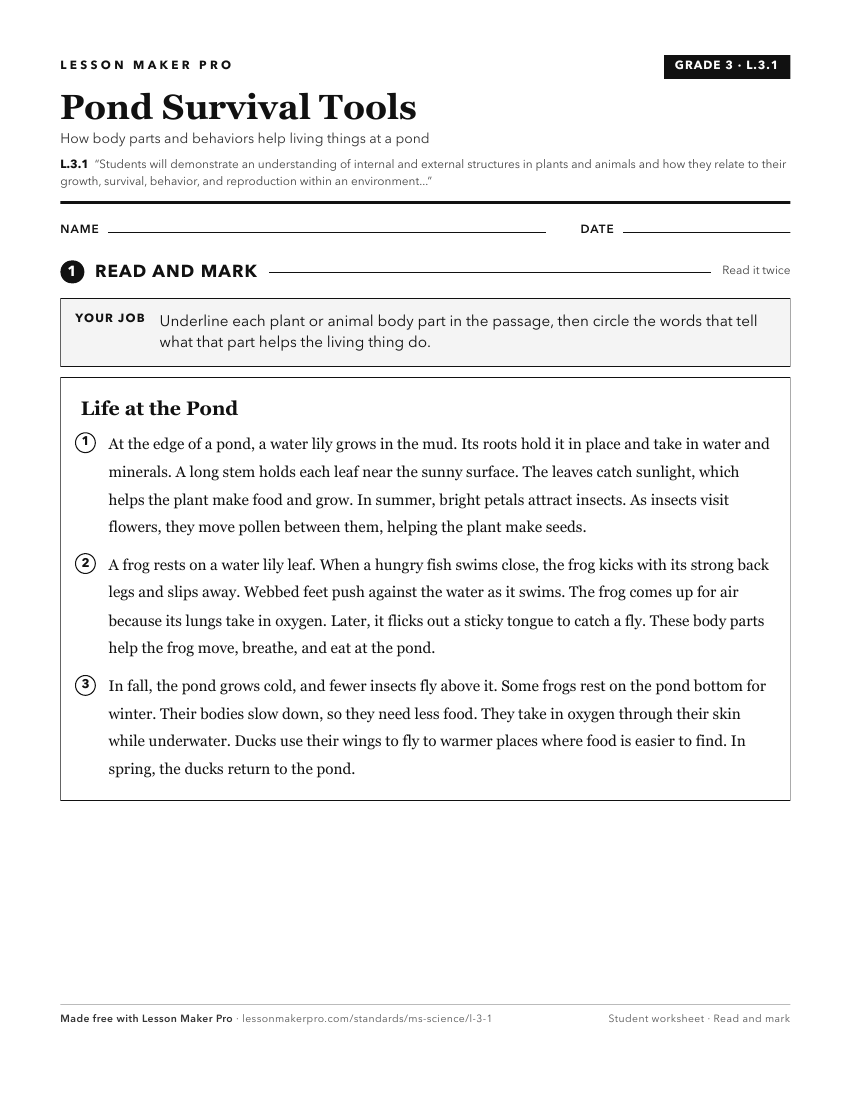
A ready-to-print activity worksheet aligned to L.3.1, with an answer key for the teacher on its own page. No account needed.
PDF, US Letter, prints cleanly in black and white.
Download the worksheetKeep exploring
Related Standards
- L.K.3A
Students will demonstrate an understanding of what animals and plants need to live and grow.
- FB.3
Students will demonstrate an understanding of how the structure of living organisms supports the essential functions of life.
- L.1.1
Students will demonstrate an understanding of the basic needs and structures of plants.
- L.1.4
Students will demonstrate an understanding of the ways plants adapt to their environment in order to survive.
Turn this cluster into a lesson
Grade, subject, topic, and the complete cluster are prefilled. Create one free, no account needed.
Also for this cluster:Make a WorksheetMake a QuizMake a Sub Lesson