Mississippi Science L.3.1.3
The Standard
- L.3.1
- Students will demonstrate an understanding of internal and external structures in plants and animals and how they relate to their growth, survival, behavior, and reproduction within an environment.
Obtain and communicate examples of physical features or behaviors of vertebrates and invertebrates and how these characteristics help them survive in particular environments (e.g., animals hibernate, migrate, or estivate to stay alive when food is scarce, or temperatures are not favorable).
2026 Mississippi College- and Career-Readiness Standards for Science · Hierarchical Organization
Teacher's field guide
What This Standard Means
What Students Need to Do
- Students find examples of animals with and without backbones. They explain how a body part or behavior helps each animal survive in a named environment. They share their examples aloud or in writing.
What Mastery Looks Like
- A student can identify a pond turtle as a vertebrate and explain how its shell protects it from predators. They can identify a desert snail as an invertebrate and explain how staying inactive during dry weather keeps it from drying out.
Common Misconceptions
- Students may mistake a snail's shell for a backbone. They may confuse migration with hibernation or think every animal in a cold place hibernates.
How to Assess It
- Show a pond turtle photo and a desert snail card that says it seals its shell in dry weather. Ask students which animal has a backbone, then have them explain how one feature or behavior helps each animal survive.
Lesson moves
Ways to Teach It
Give pairs animal photo cards with short facts; have them sort by backbone and match each to a habitat and survival clue.
Ask, 'How does sealing its shell help a desert snail survive a dry spell?' Have students write a two-sentence explanation.
Play a clue match: students pair 'hibernates in winter,' 'migrates south,' and 'estivates in drought' with ground squirrel, monarch, and desert snail cards.
Watch schoolyard birds and ants; sketch a beak and antennae, then explain how each helps its animal find food.
Free download
Printable L.3.1.3 Worksheet
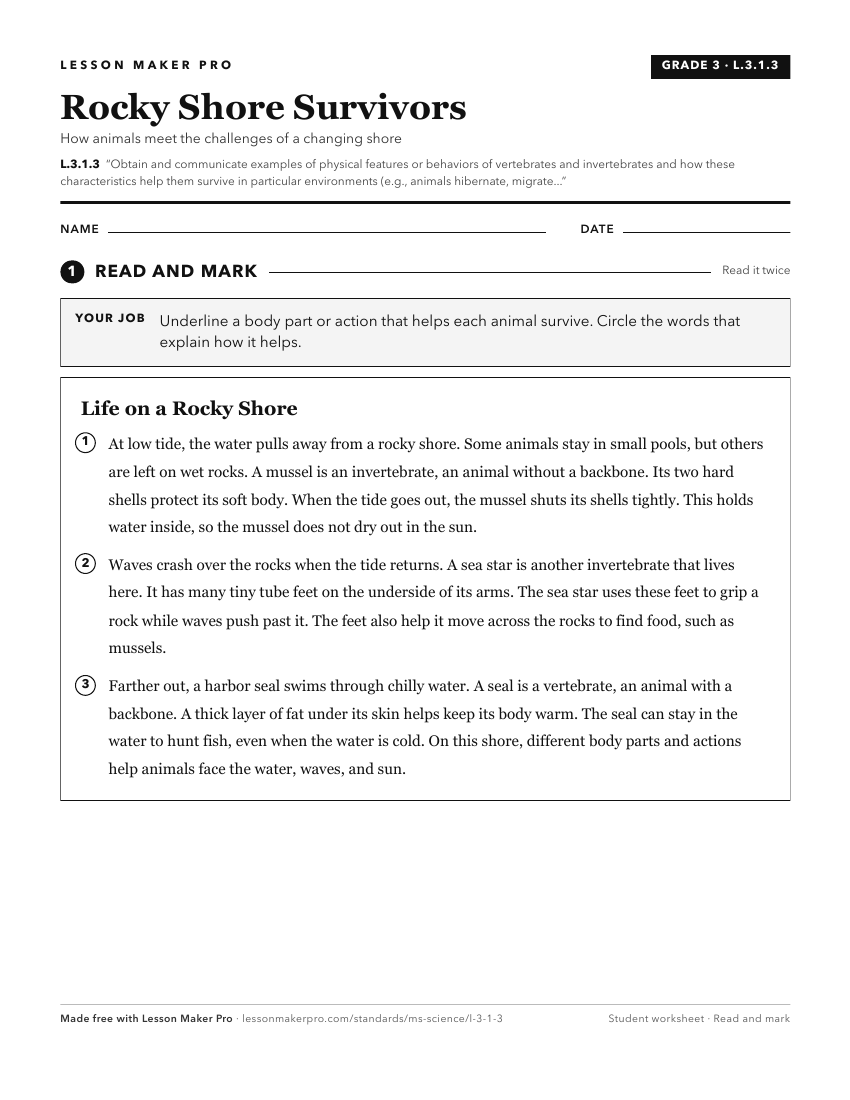
A ready-to-print activity worksheet aligned to L.3.1.3, with an answer key for the teacher on its own page. No account needed.
PDF, US Letter, prints cleanly in black and white.
Download the worksheetKeep exploring
Related Standards
- L.K.1B.1
Develop and use models to exemplify how animals use their body parts to (a) obtain food and other resources, (b) protect themselves, and (c) move from place to ...
- L.2.4.1
Evaluate and communicate findings from informational text or other media to describe how plants and animals use adaptations to survive (e.g., ducks use webbed f...
- L.3.4.2
Ask questions to predict how natural or human-caused changes in a habitat cause plants and animals to respond in different ways, including hibernating, migratin...
- MAQ.7.6
Using key morphological and physiological adaptations found within aquatic vertebrate taxa, assess how animals interact with their environment to determine thei...
Turn this exact standard into a lesson
Grade, subject, topic, and the complete standard are prefilled. Create one free, no account needed.
Also for this standard:Make a WorksheetMake a QuizMake a Sub Lesson