Mississippi Science MAQ.7.6
The Standard
- MAQ.7
- Students will investigate characteristics of aquatic chordates.
Using key morphological and physiological adaptations found within aquatic vertebrate taxa, assess how animals interact with their environment to determine their ecological roles.
2026 Mississippi College- and Career-Readiness Standards for Science · Vertebrate Consumers
Teacher's field guide
What This Standard Means
What Students Need to Do
- Students use body features and body processes to explain how aquatic vertebrates feed, breathe, and survive in their habitats. They use those clues to work out an animal’s role in a food web.
What Mastery Looks Like
- Given a shark with pointed teeth and sensory pores, a student can explain how it finds and catches fish, then identify it as a predator. They can tell the difference between a structure, such as a gill, and a process, such as taking oxygen from water.
Common Misconceptions
- Students may assume sharp teeth make an animal a top predator, even though teeth alone do not show its place in a food web. They may think dolphins breathe underwater because they live there.
How to Assess It
- Exit ticket: A reef shark has sensory pores that detect electrical signals from buried fish and pointed teeth that grip prey. Name one structure, one body process, and its likely feeding role, using a clue from the description.
Lesson moves
Ways to Teach It
Give pairs shark and sea turtle photos, trait cards, and food cards; have them build chains showing how each animal gets food.
Ask: Why can a dolphin hunt fish underwater but still need to surface? Use echolocation and lungs in your answer.
Match gills, salt glands, echolocation, and pointed teeth cards to breathing, salt removal, locating prey, and catching prey cards.
Show a map of seagrass loss; ask students how shrinking grazing habitat could affect green sea turtles.
Free download
Printable MAQ.7.6 Worksheet
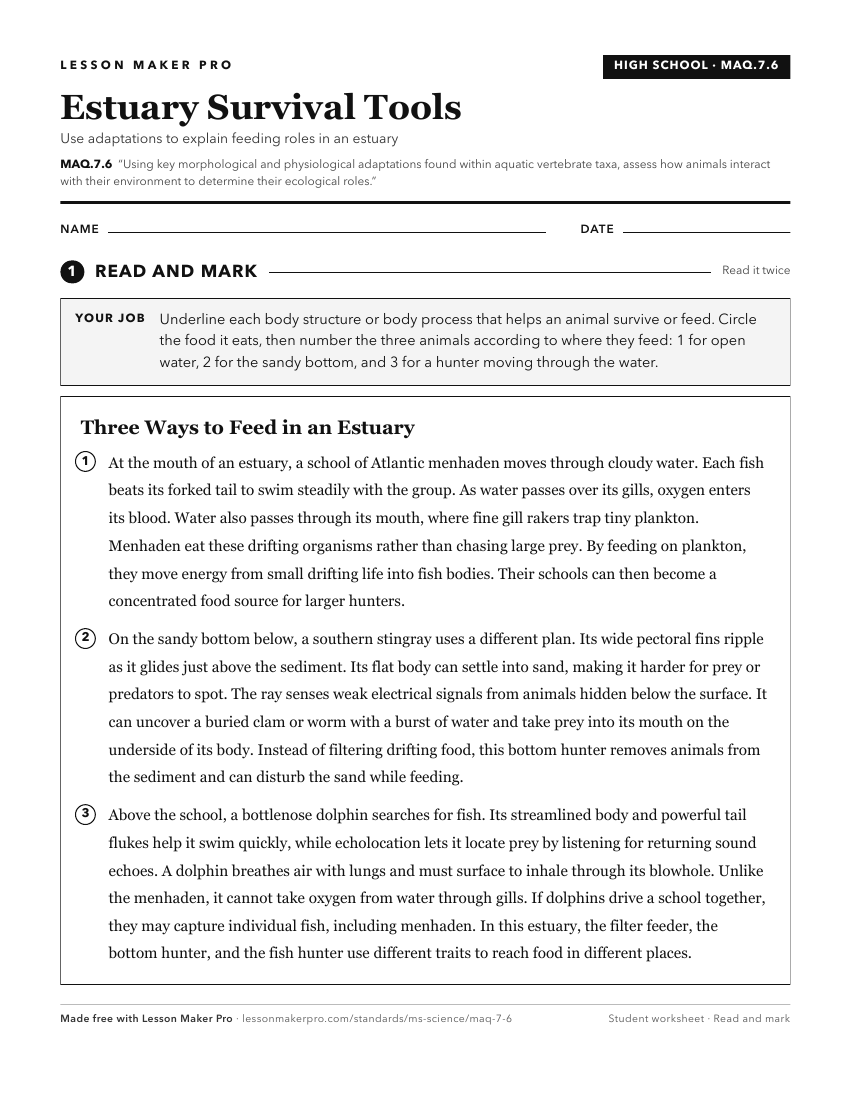
A ready-to-print activity worksheet aligned to MAQ.7.6, with an answer key for the teacher on its own page. No account needed.
PDF, US Letter, prints cleanly in black and white.
Download the worksheetKeep exploring
Related Standards
- L.2.4.1
Evaluate and communicate findings from informational text or other media to describe how plants and animals use adaptations to survive (e.g., ducks use webbed f...
- MAQ.4.2
Recognize representative examples of plants and animals that would be specifically adapted to the aquatic ecosystems and identify adaptations necessary to survi...
- L.3.1.3
Obtain and communicate examples of physical features or behaviors of vertebrates and invertebrates and how these characteristics help them survive in particular...
- MAQ.6.7
Using key morphological and physiological adaptations found within animal taxa, assess how animals interact with their environment to determine their ecological...
Turn this exact standard into a lesson
Grade, subject, topic, and the complete standard are prefilled. Create one free, no account needed.
Also for this standard:Make a WorksheetMake a QuizMake a Sub Lesson