Mississippi Science MAQ.6.7
The Standard
- MAQ.6
- Students will investigate characteristics of aquatic invertebrates.
Using key morphological and physiological adaptations found within animal taxa, assess how animals interact with their environment to determine their ecological roles.
2026 Mississippi College- and Career-Readiness Standards for Science · Invertebrate Consumers
Teacher's field guide
What This Standard Means
What Students Need to Do
- Students examine an aquatic invertebrate’s body parts and body processes to explain how it feeds in its habitat. They use those clues to identify its food web role and predict its effect on nearby organisms.
What Mastery Looks Like
- A student connects a mussel’s gills and water pumping to filtering plankton. They connect a sea star’s tube feet and outward-turning stomach to eating mussels. They predict that more sea stars could mean fewer mussels filtering plankton.
Common Misconceptions
- Students may think a mussel’s gills only help it breathe, missing how they catch food from moving water. They may assume slow-moving sea stars cannot hunt live prey.
How to Assess It
- Show a photo of a sea star on a mussel with this caption: “Tube feet pull the shell open, and its stomach turns outward to digest the mussel.” Ask: “What is the sea star’s feeding role, and what might happen to mussel numbers if sea stars increase?”
Lesson moves
Ways to Teach It
Have pairs pump pepper-speckled water through a coffee filter with a bulb syringe, then explain how mussel gills trap food.
Ask: “If sea stars disappeared from a mussel bed, what might happen to mussels and plankton? Use traits from both animals as evidence.”
Play a matching game with cards showing mussel gills, urchin teeth, and sea star tube feet; pair each with food and feeding role cards.
Show a shellfish harvest warning for algal toxins; have students trace how filter feeding moves toxins from algae in water into mussels.
Free download
Printable MAQ.6.7 Worksheet
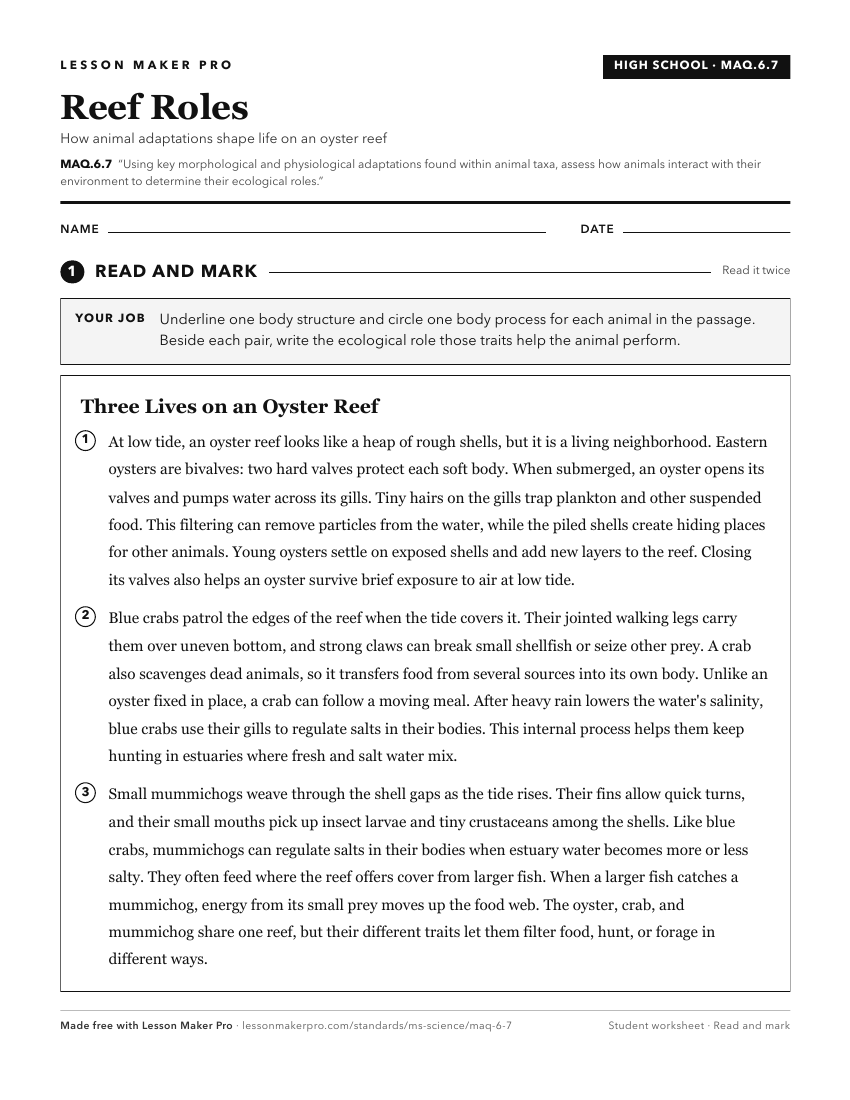
A ready-to-print activity worksheet aligned to MAQ.6.7, with an answer key for the teacher on its own page. No account needed.
PDF, US Letter, prints cleanly in black and white.
Download the worksheetKeep exploring
Related Standards
- L.2.3B.1
Evaluate and communicate findings from informational text or other media to describe and to compare how animals interact with other animals and plants in the en...
- L.2.4.1
Evaluate and communicate findings from informational text or other media to describe how plants and animals use adaptations to survive (e.g., ducks use webbed f...
- MAQ.7.7
Enrichment: Given a niche in a specific environment, use an engineering design process to design an animal, listing characteristics based on your knowledge of s...
- MAQ.7.6
Using key morphological and physiological adaptations found within aquatic vertebrate taxa, assess how animals interact with their environment to determine thei...
Turn this exact standard into a lesson
Grade, subject, topic, and the complete standard are prefilled. Create one free, no account needed.
Also for this standard:Make a WorksheetMake a QuizMake a Sub Lesson