Mississippi Science MAQ.7.7
The Standard
- MAQ.7
- Students will investigate characteristics of aquatic chordates.
Enrichment: Given a niche in a specific environment, use an engineering design process to design an animal, listing characteristics based on your knowledge of shared and derived characteristics, internal and external anatomy, and how the animal would adapt morphologically and physiologically relative to its ecological role and specific environment. *
2026 Mississippi College- and Career-Readiness Standards for Science · Vertebrate Consumers
Teacher's field guide
What This Standard Means
What Students Need to Do
- Students design a vertebrate for a specific habitat and feeding role. They label shared vertebrate traits, specialized features, and internal parts. They explain how the animal moves, eats, and handles its environment, then revise a feature that does not fit.
What Mastery Looks Like
- A student can sketch a seagrass fish with a backbone, shell-crushing jaws, broad fins, and gills that help it use oxygen in the water. They can explain what each part does, name a cost of broad fins in open water, and revise a weak feature.
Common Misconceptions
- Students may give a snail eater sharp tearing teeth rather than crushing jaws. They may use fins to explain survival in low oxygen instead of a change to breathing or oxygen use. They may call a backbone unique to their invented fish rather than a shared vertebrate trait.
How to Assess It
- Exit ticket: Sketch a fish that eats snails in a seagrass bed with low oxygen at night. Label its backbone, jaw, and one feature that helps it get or conserve oxygen, then explain one tradeoff.
Lesson moves
Ways to Teach It
Give pairs modeling clay and toothpicks to build a snail-eating seagrass fish, then label its backbone, jaw, gills, and fins.
Ask students to write how low nighttime oxygen might change their fish's breathing or activity, and what that change might cost.
Play habitat swap: move fish sketches from seagrass to open water, then have teams revise one feature for the new habitat.
Use a photo of a real seagrass bed to mark where the designed fish could find snails and where it could hide.
Free download
Printable MAQ.7.7 Worksheet
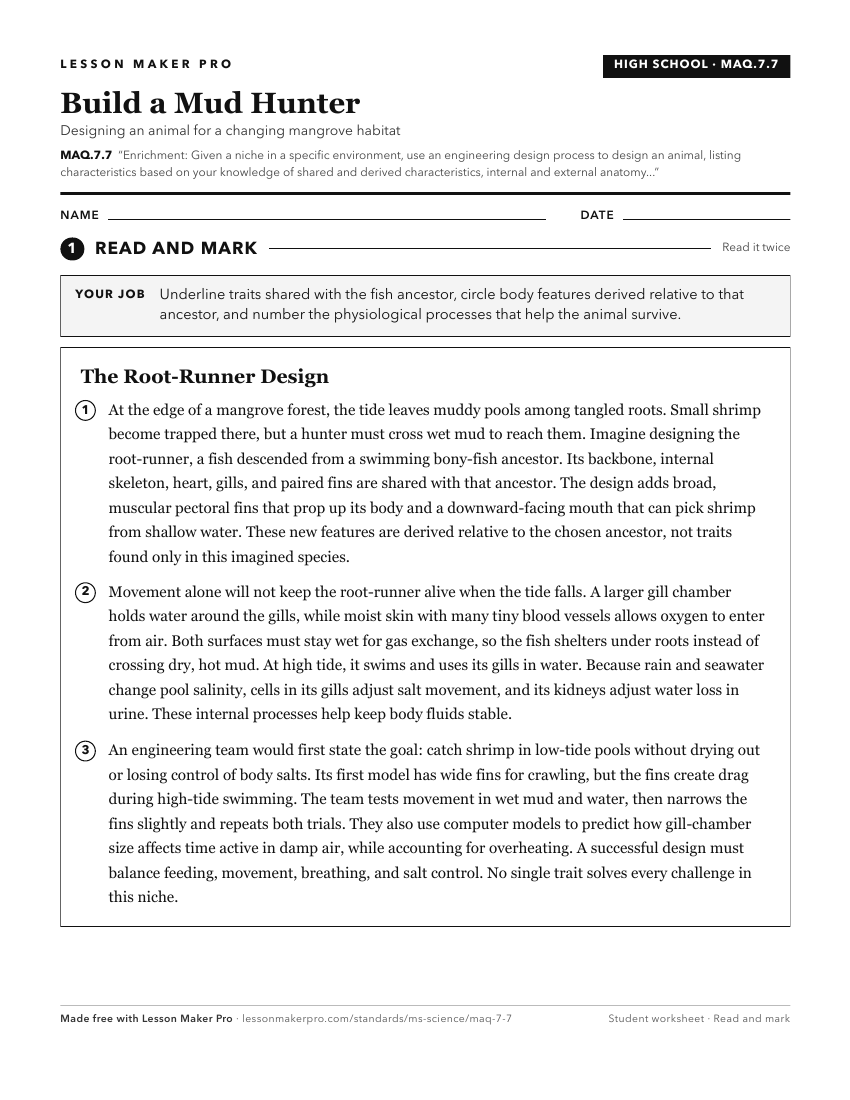
A ready-to-print activity worksheet aligned to MAQ.7.7, with an answer key for the teacher on its own page. No account needed.
PDF, US Letter, prints cleanly in black and white.
Download the worksheetKeep exploring
Related Standards
- MAQ.6.8
Enrichment: Given a niche in a specific environment, use an engineering design process to design an animal, listing characteristics based on your knowledge of s...
- BIO.5.8
Enrichment: Use an engineering design process to create a solution that addresses changing ecological conditions (e.g., climate change, invasive species, loss o...
- ZOO.10.7
Enrichment: Use an engineering design process to develop a possible solution to an environmental issue that currently exists in an ecosystem. *
- ZOO.1.6
Enrichment: Use an engineering design process to develop an artificial habitat to meet the requirements of a population that has been impacted by human activity...
Turn this exact standard into a lesson
Grade, subject, topic, and the complete standard are prefilled. Create one free, no account needed.
Also for this standard:Make a WorksheetMake a QuizMake a Sub Lesson