Mississippi Science L.3.4.2
The Standard
- L.3.4
- Students will demonstrate an understanding of how adaptations allow animals to satisfy life needs and respond both physically and behaviorally to their environment.
Ask questions to predict how natural or human-caused changes in a habitat cause plants and animals to respond in different ways, including hibernating, migrating, responding to light, death, or extinction (e.g., sea turtles, the dodo bird, or nocturnal species).
2026 Mississippi College- and Career-Readiness Standards for Science · Adaptation and Diversity
Teacher's field guide
What This Standard Means
What Students Need to Do
- Students ask how a habitat change affects food, water, shelter, or light. They predict how different plants and animals might respond, such as migrating, hibernating, growing toward light, or dying. They consider when a species might become extinct.
What Mastery Looks Like
- Given a pond drying up, a student asks whether frogs can reach another pond. They predict that frogs may move while water lilies may die, and explain that one dead plant does not mean its species is extinct.
Common Misconceptions
- Students may assume every animal can move away from a changed habitat. They may think a plant responds just like an animal, or that hibernation means an animal has died. Some call a species extinct when only one animal dies.
How to Assess It
- Exit ticket: “A dry summer empties a pond. Write one question you would ask. Predict what a frog and a water lily might do, and explain why.”
Lesson moves
Ways to Teach It
Put a potted plant in a box with one side open; students mark the light source and predict which way its stem will grow.
Draw a pond drained for construction; ask, “Where could frogs go, what might happen to water lilies, and what do we need to know?”
Match cards showing a drying pond, new porch light, and cleared woods with frog, moth, and deer cards; explain each predicted response.
Show a photo of a neighborhood streetlight; ask how moths and bats might respond at night and what students would need to know.
Free download
Printable L.3.4.2 Worksheet
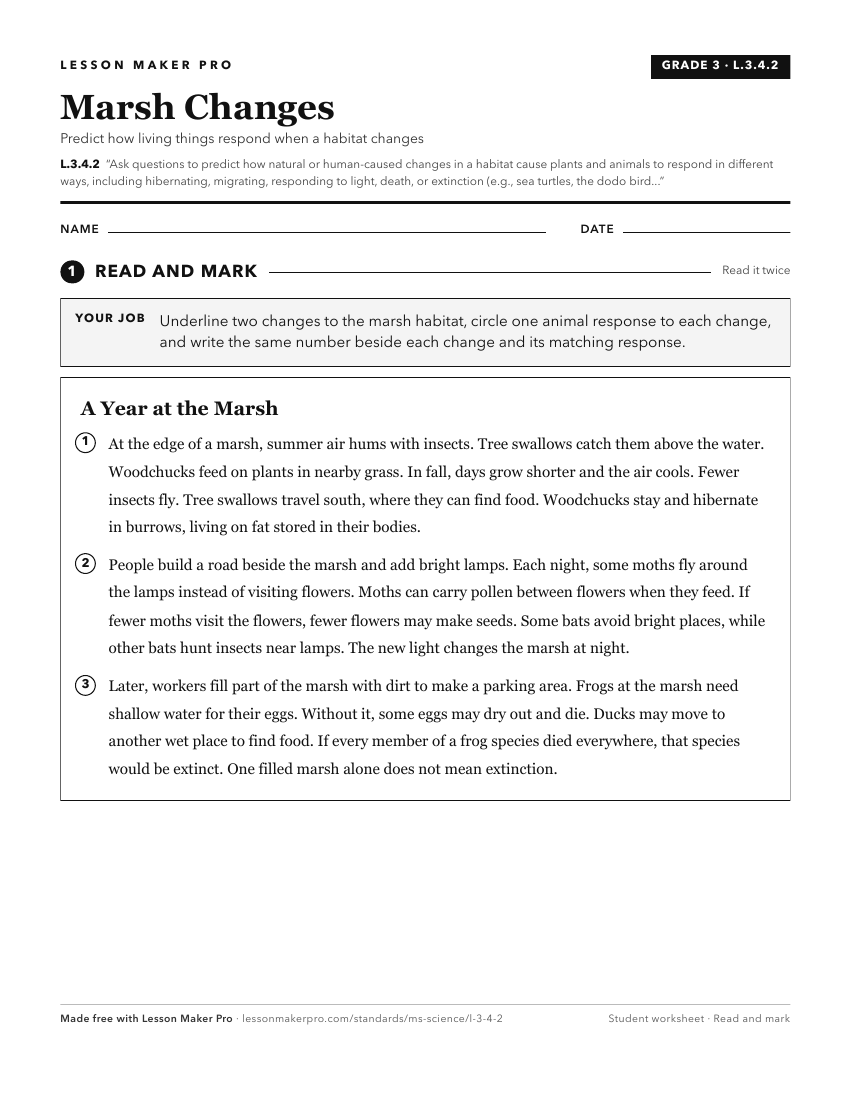
A ready-to-print activity worksheet aligned to L.3.4.2, with an answer key for the teacher on its own page. No account needed.
PDF, US Letter, prints cleanly in black and white.
Download the worksheetKeep exploring
Related Standards
- L.3.4.1
Obtain data from informational text to explain how changes in habitats (both those that occur naturally and those caused by organisms) can be beneficial or harm...
- L.1.4.1
Explore the cause-and-effect relationship between plant adaptations and environmental changes (i.e., leaves turning toward the sun, leaves changing color, leave...
- L.3.1.3
Obtain and communicate examples of physical features or behaviors of vertebrates and invertebrates and how these characteristics help them survive in particular...
- MAQ.6.7
Using key morphological and physiological adaptations found within animal taxa, assess how animals interact with their environment to determine their ecological...
Turn this exact standard into a lesson
Grade, subject, topic, and the complete standard are prefilled. Create one free, no account needed.
Also for this standard:Make a WorksheetMake a QuizMake a Sub Lesson