Mississippi Science L.1.4
Standard Cluster
Students will demonstrate an understanding of the ways plants adapt to their environment in order to survive. Explore the cause-and-effect relationship between plant adaptations and environmental changes (i.e., leaves turning toward the sun, leaves changing color, leaves wilting, or trees shedding leaves). Describe how the different characteristics of plants help them to survive in distinct environments (e.g., rain forest, desert, grasslands, forests). Create a solution to an agricultural problem (i.e., pollination, seed dispersal, overcrowding). Use an engineering design process to define the problem, design, construct, evaluate, and improve the solution. *
2026 Mississippi College- and Career-Readiness Standards for Science · Adaptations and Diversity
Cluster contents
Standards in This Cluster
L.1.4 is a cluster heading. These are the individual standards under it.
- L.1.4.1
Explore the cause-and-effect relationship between plant adaptations and environmental changes (i.e., leaves turning toward the sun, leaves changing color, leave...
- L.1.4.2
Describe how the different characteristics of plants help them to survive in distinct environments (e.g., rain forest, desert, grasslands, forests).
- L.1.4.3
Create a solution to an agricultural problem (i.e., pollination, seed dispersal, overcrowding). Use an engineering design process to define the problem, design,...
Teacher's field guide
What This Cluster Means
What Students Need to Do
- Students observe how plants respond to changes in light, water, and seasons. They compare plant parts that help plants live in deserts, rain forests, and grasslands. They identify a crowded-seed problem, then build, test, and improve a spacing tool.
What Mastery Looks Like
- A student can explain that dry soil may cause a plant to wilt. They can point to a cactus stem and explain that it stores water. They can test a seed-spacing tool, spot where seeds are too close, and change the tool.
Common Misconceptions
- Students may think a wilted plant has found a way to live without water, rather than showing that it needs water. They may think desert plants need no water. They may stop after building a tool instead of testing whether it works.
How to Assess It
- Show a wilted bean plant in dry soil and a cactus photo. Ask students to name the cause of wilting and circle the cactus part that stores water.
Lesson moves
Ways to Teach It
Place a potted bean plant beside a window, mark which way its leaves face, then rotate the pot and check it each morning.
Show photos of a cactus and a fern; ask, "Which plant could live with less rain? What do you see that makes you think so?"
Give pairs illustrated cactus, fern, and prairie grass cards to match with desert, rain forest, and grassland mats; ask them to explain each match.
Show crowded garden seedlings; have pairs mark a seed-spacing strip, test it with beans on paper, then revise the spacing.
Free download
Printable L.1.4 Worksheet
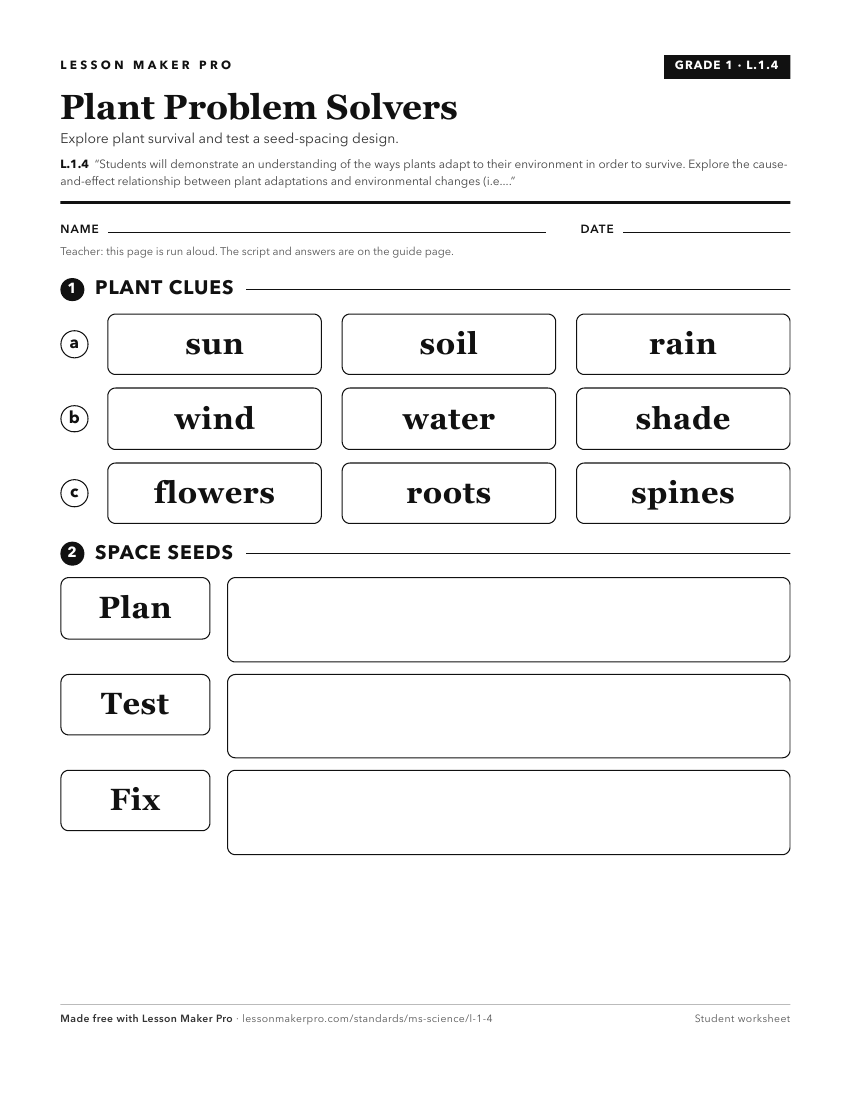
A ready-to-print activity worksheet aligned to L.1.4, with an answer key for the teacher on its own page. No account needed.
PDF, US Letter, prints cleanly in black and white.
Download the worksheetKeep exploring
Related Standards
- L.K.3A
Students will demonstrate an understanding of what animals and plants need to live and grow.
- L.2.4
Students will demonstrate an understanding of the ways animals adapt to their environment in order to survive.
- L.1.3A
Students will demonstrate an understanding of what plants need from the environment for growth and repair.
- BOT.5
Students will explore adaptations that allow plants to survive in various habitats.
Turn this cluster into a lesson
Grade, subject, topic, and the complete cluster are prefilled. Create one free, no account needed.
Also for this cluster:Make a WorksheetMake a QuizMake a Sub Lesson