Mississippi Science L.2.4
Standard Cluster
Students will demonstrate an understanding of the ways animals adapt to their environment in order to survive. Evaluate and communicate findings from informational text or other media to describe how plants and animals use adaptations to survive (e.g., ducks use webbed feet to swim in lakes and ponds, cacti have waxy coatings and spines to grow in the desert) in distinct environments (e.g., polar lands, saltwater and freshwater, desert, rainforest, woodlands). Create a solution exemplified by animal adaptations to solve a human problem in a specific environment (e.g., snowshoes are like hare’s feet or flippers are like duck's feet). Use an engineering design process to define the problem, design, construct, evaluate, and improve the solution. *
2026 Mississippi College- and Career-Readiness Standards for Science · Adaptations and Diversity
Cluster contents
Standards in This Cluster
L.2.4 is a cluster heading. These are the individual standards under it.
- L.2.4.1
Evaluate and communicate findings from informational text or other media to describe how plants and animals use adaptations to survive (e.g., ducks use webbed f...
- L.2.4.2
Create a solution exemplified by animal adaptations to solve a human problem in a specific environment (e.g., snowshoes are like hare’s feet or flippers are lik...
Teacher's field guide
What This Cluster Means
What Students Need to Do
- Students use pictures and short texts to find out how a plant or animal feature helps it survive in a particular place. They check that their explanation fits what the sources show. They use an animal feature as a model for a tool, then build, test, and improve it.
What Mastery Looks Like
- A student can explain how a duck's webbed feet help it swim in a pond or how a cactus's waxy skin helps it keep water in a desert. They can test a tool based on an animal feature and explain what they changed after the test.
Common Misconceptions
- Students may think a duck grows webbed feet because it starts swimming, or that cactus spines store water. They may match a feature to a habitat by looks alone, without explaining how it helps.
How to Assess It
- Give students a picture and fact card about a snowshoe hare. Ask them to explain how its feet help on snow, sketch a shoe based on them, and say how they would test it.
Lesson moves
Ways to Teach It
Give pairs cardboard, tape, and toy figures; have them build snowshoes, test on rice, widen sinking shoes, and retest.
Compare a duck photo and fact card; write what each shows about how webbed feet help ducks swim.
Deal cards showing cactus waxy skin, duck webbed feet, and hare wide feet; students match them to desert, pond, or snow cards.
Show a snowshoe beside a hare foot photo; ask how their wide shapes help both cross deep snow without sinking.
Free download
Printable L.2.4 Worksheet
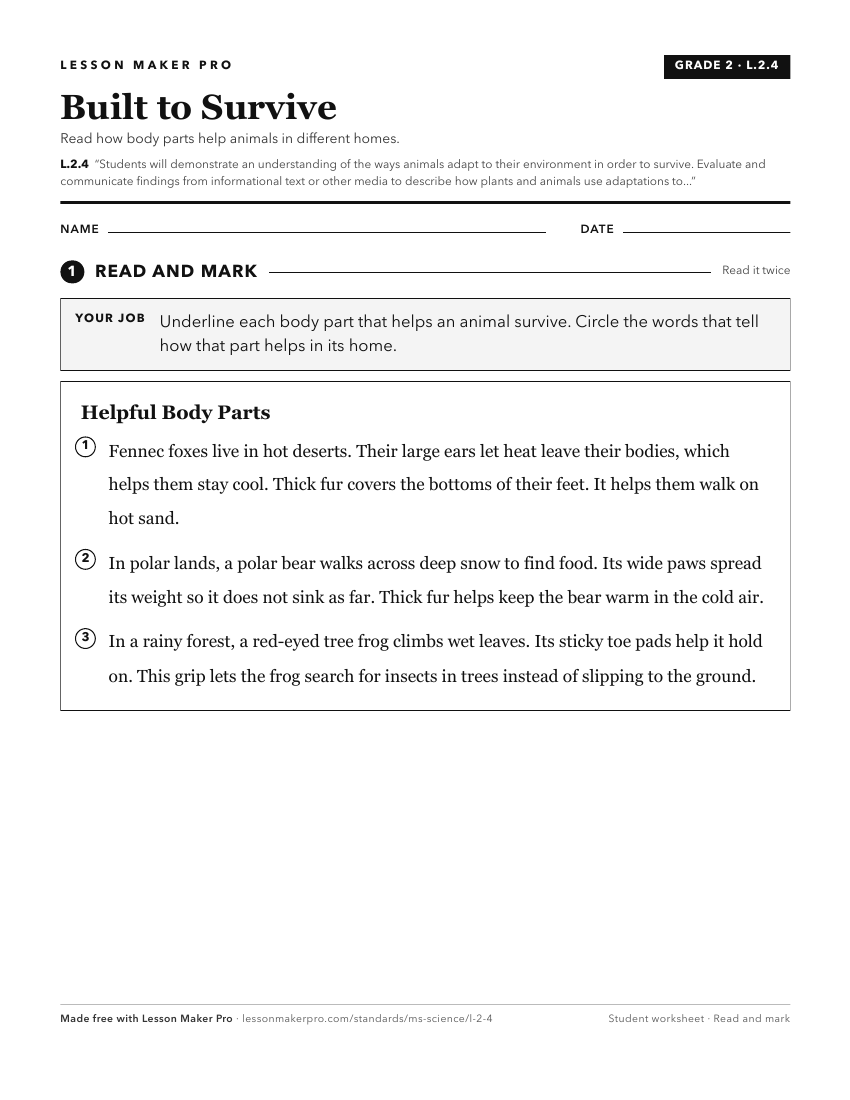
A ready-to-print activity worksheet aligned to L.2.4, with an answer key for the teacher on its own page. No account needed.
PDF, US Letter, prints cleanly in black and white.
Download the worksheetKeep exploring
Related Standards
- L.3.4
Students will demonstrate an understanding of how adaptations allow animals to satisfy life needs and respond both physically and behaviorally to their environm...
- L.6.3
Students will demonstrate an understanding of the relationships between survival, environmental changes, and diversity as they relate to the interactions of org...
- L.K.1B
Students will demonstrate an understanding of how animals (including humans) use their physical features and their senses to learn about their environment.
- L.1.4
Students will demonstrate an understanding of the ways plants adapt to their environment in order to survive.
Turn this cluster into a lesson
Grade, subject, topic, and the complete cluster are prefilled. Create one free, no account needed.
Also for this cluster:Make a WorksheetMake a QuizMake a Sub Lesson