Mississippi Science L.6.3
Standard Cluster
Students will demonstrate an understanding of the relationships between survival, environmental changes, and diversity as they relate to the interactions of organisms, populations, and the environment. Use scientific reasoning to explain differences between biotic and abiotic factors that demonstrate what living organisms need to survive. Develop and use models to describe the levels of organization within ecosystems (species, populations, communities, ecosystems, and biomes). Analyze cause and effect relationships to explore how changes in the physical environment (limiting factors, natural disasters) can lead to population changes within an ecosystem. Investigate organism interactions in a competitive or mutually beneficial relationship (predation, competition, cooperation, or symbiotic relationships). Develop and use food chains, webs, and pyramids to analyze how energy is transferred through an ecosystem from producers (autotrophs) to consumers (heterotrophs, including humans) to decomposers.
2026 Mississippi College- and Career-Readiness Standards for Science · Ecology and Interdependence
Cluster contents
Standards in This Cluster
L.6.3 is a cluster heading. These are the individual standards under it.
- L.6.3.1
Use scientific reasoning to explain differences between biotic and abiotic factors that demonstrate what living organisms need to survive.
- L.6.3.2
Develop and use models to describe the levels of organization within ecosystems (species, populations, communities, ecosystems, and biomes).
- L.6.3.3
Analyze cause and effect relationships to explore how changes in the physical environment (limiting factors, natural disasters) can lead to population changes w...
- L.6.3.4
Investigate organism interactions in a competitive or mutually beneficial relationship (predation, competition, cooperation, or symbiotic relationships).
- L.6.3.5
Develop and use food chains, webs, and pyramids to analyze how energy is transferred through an ecosystem from producers (autotrophs) to consumers (heterotrophs...
Teacher's field guide
What This Cluster Means
What Students Need to Do
- Students distinguish living things from nonliving conditions and explain what organisms need to survive. They model how species, populations, communities, ecosystems, and biomes fit together. They trace energy through food webs and pyramids, then predict how environmental changes and interactions affect populations.
What Mastery Looks Like
- A student can place a species within a population, community, ecosystem, and biome. They draw energy arrows from food to eater, include decomposers, and show less energy at higher pyramid levels. They explain why drought or competition might change a named population.
Common Misconceptions
- Students may call sunlight or water living because organisms need them. They may call all the frogs in a pond a community rather than a population. They may point food web arrows toward the food or think energy cycles back through decomposers.
How to Assess It
- Exit ticket: A pond has algae, snails, fish, and herons, and a drought lowers the water level. Draw three energy arrows, name the abiotic change, and predict what happens to one population and why.
Lesson moves
Ways to Teach It
Use organism cards and paper arrows to build a pond food web, then remove algae after a drought and trace population changes.
Ask: "Two hawks hunt the same mice. What might happen to the hawks if mice become scarce, and why?"
Give pairs cards showing one oak species, five oaks, oaks and squirrels, a forest ecosystem, and a temperate forest biome; race to order them.
Show a photo of bees on fruit blossoms; students explain how both organisms benefit and predict what fewer bees could mean for fruit crops.
Free download
Printable L.6.3 Worksheet
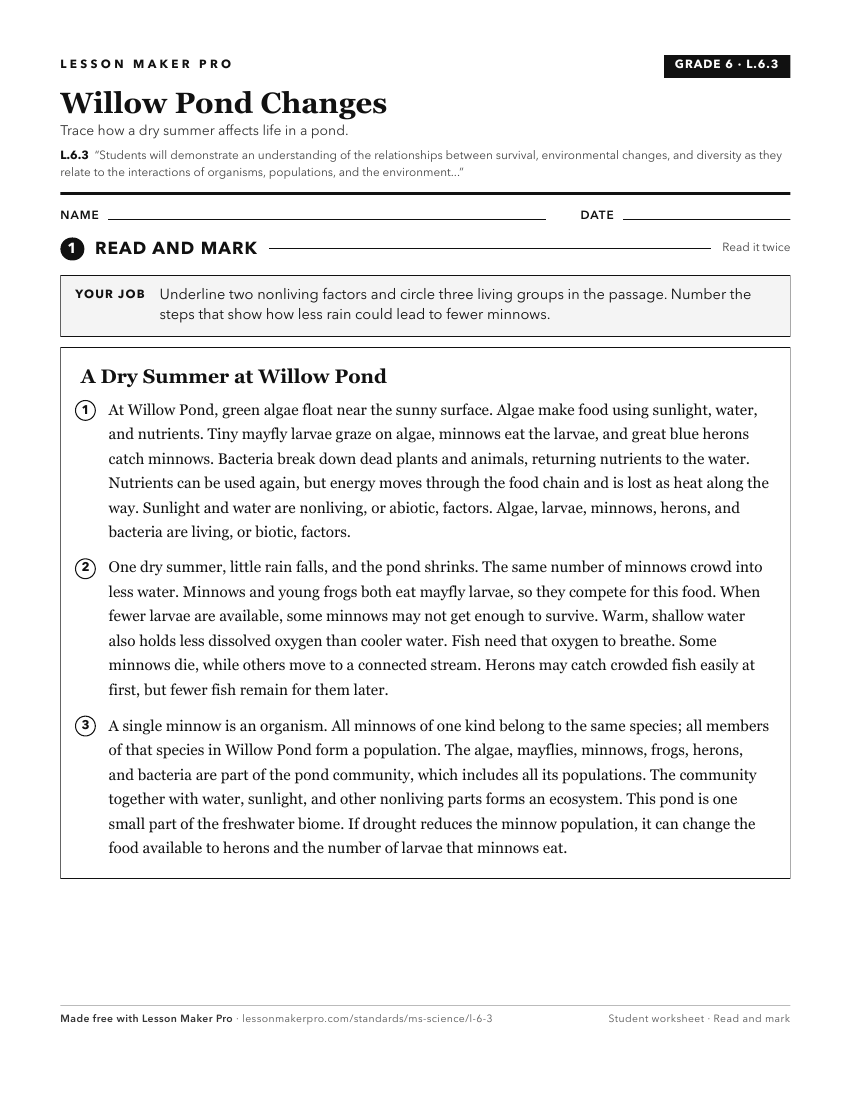
A ready-to-print activity worksheet aligned to L.6.3, with an answer key for the teacher on its own page. No account needed.
PDF, US Letter, prints cleanly in black and white.
Download the worksheetKeep exploring
Related Standards
- L.2.3A
Students will demonstrate an understanding of the interdependence of living things and the environment in which they live.
- L.2.4
Students will demonstrate an understanding of the ways animals adapt to their environment in order to survive.
- FB.6
Students will understand the interdependence of living organisms and their environment.
- L.2.3B
Students will demonstrate an understanding of the interdependence of living things.
Turn this cluster into a lesson
Grade, subject, topic, and the complete cluster are prefilled. Create one free, no account needed.
Also for this cluster:Make a WorksheetMake a QuizMake a Sub Lesson