Mississippi Science L.6.3.4
The Standard
- L.6.3
- Students will demonstrate an understanding of the relationships between survival, environmental changes, and diversity as they relate to the interactions of organisms, populations, and the environment.
Investigate organism interactions in a competitive or mutually beneficial relationship (predation, competition, cooperation, or symbiotic relationships).
2026 Mississippi College- and Career-Readiness Standards for Science · Ecology and Interdependence
Teacher's field guide
What This Standard Means
What Students Need to Do
- Students observe or test how two organisms affect each other. They use evidence to identify competition, predation, cooperation, or a close ongoing relationship. They explain who benefits and who is harmed.
What Mastery Looks Like
- A student can explain why two plants growing close together compete for light and why a bee and a flower can both benefit from a visit. They point to a clue, such as one plant shading the other or pollen on the bee.
Common Misconceptions
- Students may think competition always means fighting, rather than using the same limited resource. They may call a brief encounter symbiosis or assume both organisms benefit whenever they interact.
How to Assess It
- Exit ticket: A bee drinks nectar from a flower and carries pollen to another flower. Explain what each organism gains, then tell how this differs from two plants competing for light.
Lesson moves
Ways to Teach It
Put 20 beans on a tray; have two students collect them with spoons, repeat with 10 beans, and compare each student’s count.
Show a photo of a bee on a flower and ask, “What does each organism gain, and what can you see that supports your answer?”
Give teams cards showing an owl catching a mouse, two deer eating one shrub, and bees visiting flowers; have them sort and explain.
Show an apple and a photo of a bee on an apple blossom; ask students to trace how the bee’s visit helps produce fruit.
Free download
Printable L.6.3.4 Worksheet
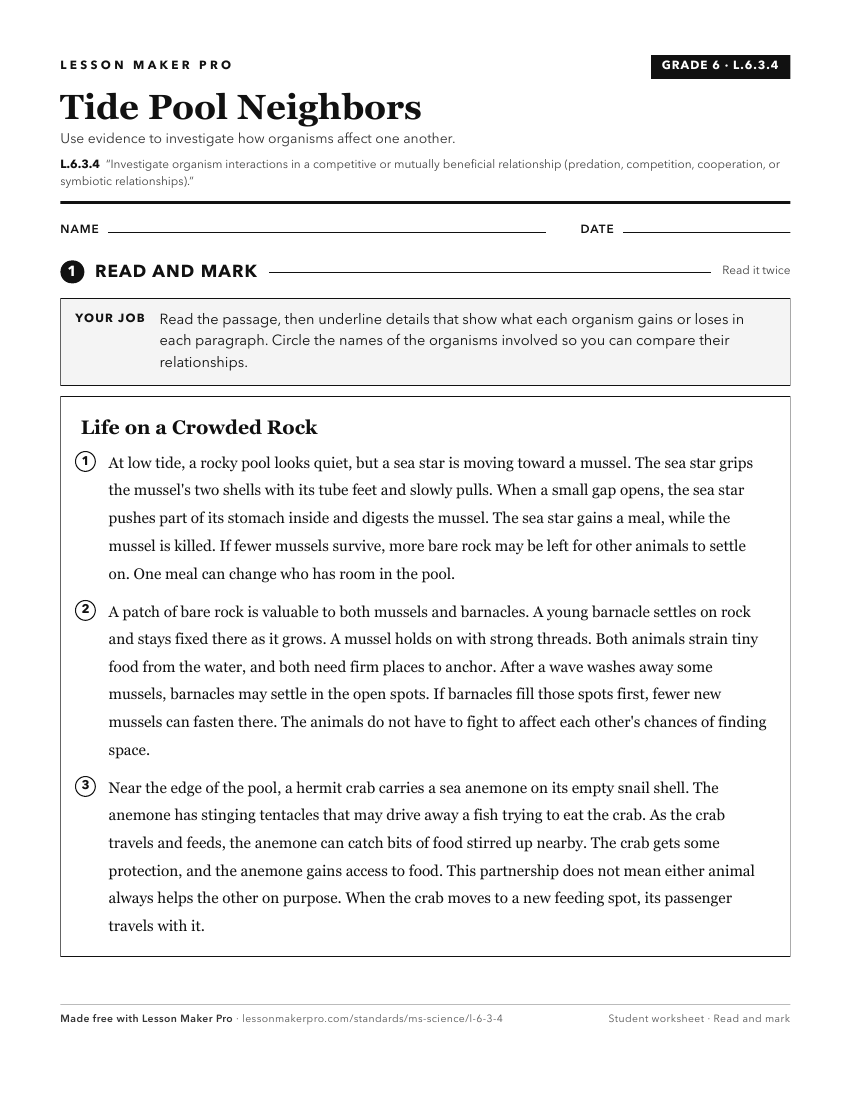
A ready-to-print activity worksheet aligned to L.6.3.4, with an answer key for the teacher on its own page. No account needed.
PDF, US Letter, prints cleanly in black and white.
Download the worksheetKeep exploring
Related Standards
- FB.6.6
Engage in scientific argument from evidence to distinguish organisms that exist in symbiotic (mutualism, parasitism, commensalism) or co-evolutionary (predator-...
- BIO.5.5
Evaluate symbiotic relationships (e.g., mutualism, parasitism, and commensalism) and other co-evolutionary (e.g., predator-prey, cooperation, competition, and m...
- ENV.1.4
Describe symbiotic relationships (e.g., mutualism, parasitism, and commensalism) and other co-evolutionary (e.g., predator-prey, cooperation, competition, and m...
- L.2.3B.2
Conduct an investigation to find evidence where plants and animals compete or cooperate with other plants and animals for food or space. Present findings (i.e.,...
Turn this exact standard into a lesson
Grade, subject, topic, and the complete standard are prefilled. Create one free, no account needed.
Also for this standard:Make a WorksheetMake a QuizMake a Sub Lesson