Mississippi Science FB.6.6
The Standard
- FB.6
- Students will understand the interdependence of living organisms and their environment.
Engage in scientific argument from evidence to distinguish organisms that exist in symbiotic (mutualism, parasitism, commensalism) or co-evolutionary (predator-prey, cooperation, competition, and mimicry) relationships within ecosystems.
2026 Mississippi College- and Career-Readiness Standards for Science · Ecological Principals
Teacher's field guide
What This Standard Means
What Students Need to Do
- Students use observations to tell who benefits, who is harmed, who is unaffected, and when one organism resembles another. They defend each relationship label with evidence. They look for changes in both species over generations before claiming coevolution.
What Mastery Looks Like
- A student can explain why a tick feeding on a dog is parasitism, while an orchid growing on an unharmed tree is commensalism. They use data showing rising newt toxin levels and snake resistance over generations to support a claim of coevolution.
Common Misconceptions
- Students may call a tick and dog predator and prey, though the tick feeds without killing the dog. They may treat no measured effect as harm or assume every predator-prey pair has coevolved.
How to Assess It
- Exit ticket: A tick feeds on a dog. Local newts become more toxic as snakes gain toxin resistance over generations. Label each relationship, cite evidence, and explain which pair shows coevolution.
Lesson moves
Ways to Teach It
Give pairs photo and evidence cards for bees and flowers, ticks and dogs, and orchids on trees; have them sort by benefit and harm.
Show a table of newt toxin levels and snake resistance across generations; ask students to write a claim supported by two data points.
Play Evidence Match with cards showing ants protecting aphids, seedlings competing for light, and hoverflies resembling wasps; require a reason for each match.
Use garden photos of hoverflies and wasps; ask who benefits from the resemblance and what observation would support their answer.
Free download
Printable FB.6.6 Worksheet
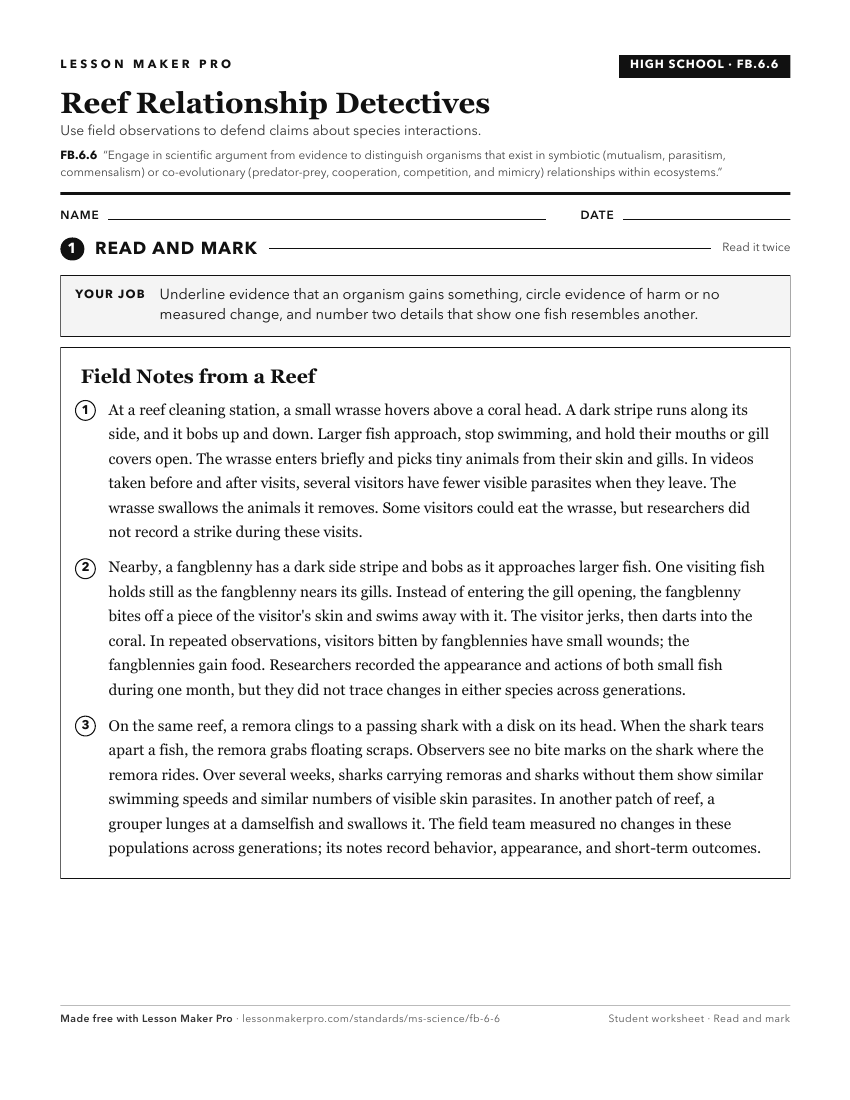
A ready-to-print activity worksheet aligned to FB.6.6, with an answer key for the teacher on its own page. No account needed.
PDF, US Letter, prints cleanly in black and white.
Download the worksheetKeep exploring
Related Standards
- BIO.5.5
Evaluate symbiotic relationships (e.g., mutualism, parasitism, and commensalism) and other co-evolutionary (e.g., predator-prey, cooperation, competition, and m...
- L.6.3.4
Investigate organism interactions in a competitive or mutually beneficial relationship (predation, competition, cooperation, or symbiotic relationships).
- ENV.1.4
Describe symbiotic relationships (e.g., mutualism, parasitism, and commensalism) and other co-evolutionary (e.g., predator-prey, cooperation, competition, and m...
- L.2.3B.2
Conduct an investigation to find evidence where plants and animals compete or cooperate with other plants and animals for food or space. Present findings (i.e.,...
Turn this exact standard into a lesson
Grade, subject, topic, and the complete standard are prefilled. Create one free, no account needed.
Also for this standard:Make a WorksheetMake a QuizMake a Sub Lesson