Mississippi Science L.2.3B.2
The Standard
- L.2.3B
- Students will demonstrate an understanding of the interdependence of living things.
Conduct an investigation to find evidence where plants and animals compete or cooperate with other plants and animals for food or space. Present findings (i.e., using technology or models).
2026 Mississippi College- and Career-Readiness Standards for Science · Ecology and Interdependence
Teacher's field guide
What This Standard Means
What Students Need to Do
- Students observe plants or animals for signs that they compete for food or space, or work together to get food. They record what they see and present their findings with a drawing, model, or photo.
What Mastery Looks Like
- A student can point to birds pushing for the same seed or ants carrying a crumb together and explain what is happening. They use something they observed to support their answer.
Common Misconceptions
- Students may call animals near each other cooperative, even when they have not seen them work together. They may call any crowded group competitive without seeing an effect on food or space. Some think plants get food from soil rather than making their own food using sunlight.
How to Assess It
- Show a short clip of ants carrying a crumb together. Ask students to draw what they saw and finish this sentence: “The ants cooperate because ____.”
Lesson moves
Ways to Teach It
Plant six bean seeds close together in one tray and far apart in another; sketch their space tomorrow and compare leaf growth next week.
Show a clip of ants carrying food and ask, “What did they do together, and what did you see that proves it?”
Give pairs picture cards of birds pushing at a feeder and ants carrying crumbs; have them sort the cards and name one visible clue.
Study a photo of a crowded garden bed; mark where leaves block other leaves, then draw a spacing plan for that garden.
Free download
Printable L.2.3B.2 Worksheet
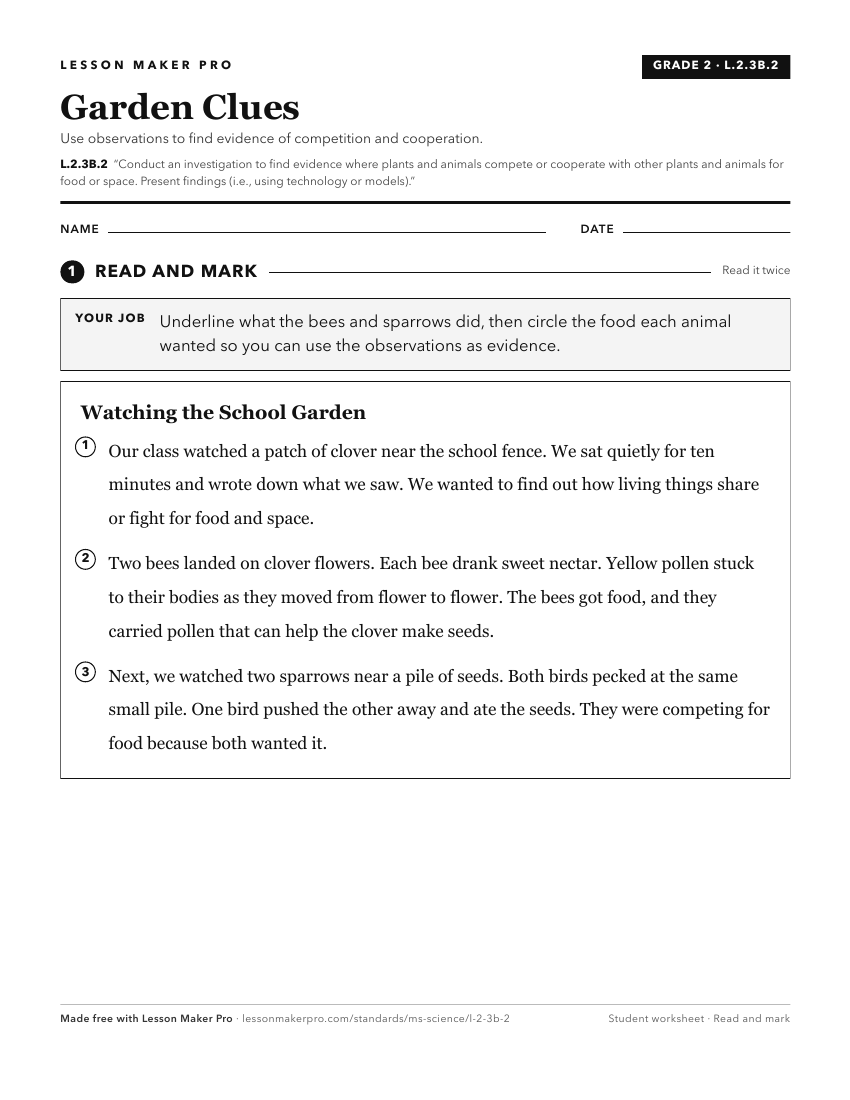
A ready-to-print activity worksheet aligned to L.2.3B.2, with an answer key for the teacher on its own page. No account needed.
PDF, US Letter, prints cleanly in black and white.
Download the worksheetKeep exploring
Related Standards
- FB.6.6
Engage in scientific argument from evidence to distinguish organisms that exist in symbiotic (mutualism, parasitism, commensalism) or co-evolutionary (predator-...
- L.1.3A.1
Conduct structured investigations to make and test predictions about what plants need to live, grow, and repair including water, nutrients, sunlight, and space....
- L.2.3B.1
Evaluate and communicate findings from informational text or other media to describe and to compare how animals interact with other animals and plants in the en...
- L.6.3.4
Investigate organism interactions in a competitive or mutually beneficial relationship (predation, competition, cooperation, or symbiotic relationships).
Turn this exact standard into a lesson
Grade, subject, topic, and the complete standard are prefilled. Create one free, no account needed.
Also for this standard:Make a WorksheetMake a QuizMake a Sub Lesson