Mississippi Science BIO.5.5
The Standard
- BIO.5
- Students will Investigate and evaluate the interdependence of living organisms and their environment.
Evaluate symbiotic relationships (e.g., mutualism, parasitism, and commensalism) and other co-evolutionary (e.g., predator-prey, cooperation, competition, and mimicry) relationships within specific environments.
2026 Mississippi College- and Career-Readiness Standards for Science · Interdependence of Organisms and Their Environments
Teacher's field guide
What This Standard Means
What Students Need to Do
- Students examine pairs of organisms in a specific habitat. They identify how each organism is affected, then use evidence to explain interactions such as parasitism, competition, predation, and mimicry.
What Mastery Looks Like
- A student can explain why a tick benefits while a deer is harmed, and why squirrels and chipmunks compete for acorns. They can predict how a change in one population might affect another and support the prediction with evidence.
Common Misconceptions
- Students may call any relationship that helps one organism mutualism, even when the other is harmed. They may think an individual animal develops a new trait because it needs one, rather than inherited traits changing across generations.
How to Assess It
- Exit ticket: In an oak woodland, squirrels and chipmunks both eat acorns. Name their relationship, explain the effect on each species, and predict what might happen if acorns become scarce.
Lesson moves
Ways to Teach It
Give pairs woodland organism cards and counters, then have them show who gains, loses, or is unaffected in each interaction.
Ask students to write: If ticks disappeared from a woodland, what might change for deer, and what evidence supports your answer?
Play a card-matching round with woodland pairs, relationship names, and evidence cards, then have students defend one match.
Read a county tick advisory and sketch how ticks feeding on deer can affect hikers in nearby woods.
Free download
Printable BIO.5.5 Worksheet
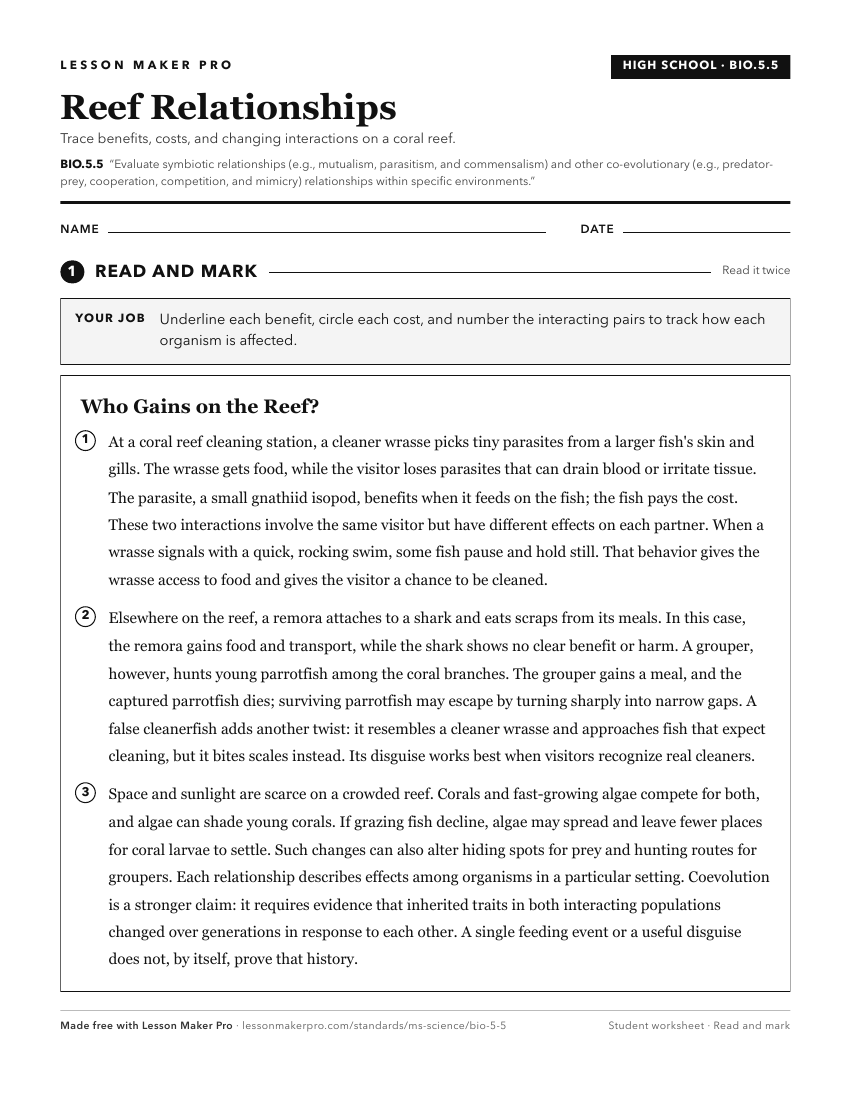
A ready-to-print activity worksheet aligned to BIO.5.5, with an answer key for the teacher on its own page. No account needed.
PDF, US Letter, prints cleanly in black and white.
Download the worksheetKeep exploring
Related Standards
- FB.6.6
Engage in scientific argument from evidence to distinguish organisms that exist in symbiotic (mutualism, parasitism, commensalism) or co-evolutionary (predator-...
- L.6.3.4
Investigate organism interactions in a competitive or mutually beneficial relationship (predation, competition, cooperation, or symbiotic relationships).
- ENV.1.4
Describe symbiotic relationships (e.g., mutualism, parasitism, and commensalism) and other co-evolutionary (e.g., predator-prey, cooperation, competition, and m...
- MAQ.6.7
Using key morphological and physiological adaptations found within animal taxa, assess how animals interact with their environment to determine their ecological...
Turn this exact standard into a lesson
Grade, subject, topic, and the complete standard are prefilled. Create one free, no account needed.
Also for this standard:Make a WorksheetMake a QuizMake a Sub Lesson